

Swinburne welcomes Made in Victoria 2030 manufacturing statement

In summary
- The Victorian Government has released its ‘Made in Victoria 2030’ statement, outlining its plans, priorities and promises for advanced manufacturing
- Victoria is a leader in this $31 billion industry
- Five opportunities were identified as key to future investment in Victoria’s advanced manufacturing capability
Swinburne welcomes the Victorian Government’s ‘Made in Victoria 2030’ statement, which outlines its priorities for enhancing advanced manufacturing in the state, attracting and stimulating investment, and creating new jobs.
Victoria is a leader in advanced manufacturing and this $31 billion industry is growing with a government-supported pipeline of investment policy and partnerships.
Innovation, creative digitalisation and automation are key to the next generation of advanced manufacturing – which, in turn, will have a major role to play in skills, jobs and transitioning to a zero or low emissions economy.
Five opportunities were identified as key to future investment in Victoria’s advanced manufacturing capability:
- Zero and low emissions technologies
- Health technologies
- Food manufacturing
- Defence, aerospace and space
- Digital and advanced technologies
Deputy Vice-Chancellor, Research and engineer, Professor Karen Hapgood, is enthused by the government commitment and the promise in the future of manufacturing.
“Government support for advanced manufacturing will allow Swinburne to accelerate our work in the development of skilled workers for the next generation and research that allows industry to transform its manufacturing to be smarter, faster and cleaner,” says Professor Hapgood.
The future of manufacturing
We are currently experiencing the fourth Industrial Revolution. This is an emerging era of technology where we expect to see entirely new smart factories, automated processes, 3D printing, greener processes with reduced waste, and reusable materials.
At Swinburne, we have a number of key focus areas. The Victorian Hydrogen Hub (VH2) is home to fantastic initiatives to kickstart a hydrogen economy – such as a hydrogen fuelling station with CSIRO at our Clayton campus and the release of the Hydrogen Skills Road Map to outline recommendations around the upskilling and training required to meet demand.
We also have a focus on health technology through Medical Technology Victoria (MedTechVic), which is working to grow Victorian supply chains and co-create assistive technologies between researchers and people with lived experience.
Aerospace and space are major areas of research and education for Swinburne, whose Space Technology and Industry Institute has been partnering with industry to 3D print space technology, improve materials for space, and even make manufacturing on the Moon possible.
To support all manufacturing, we need to be improving our digital and advanced technologies for industry and that is a major focus for Swinburne’s Manufacturing Futures Research Platform, Advanced Manufacturing Industry 4.0 Hub and Swinburne-CSIRO National Industry 4.0 Testlab who are making manufacturing digital.
Made in Victoria 2030 will make Victoria the leader in manufacturing for the next century, and Swinburne is excited to help lead the next steps.
-
Media Enquiries
Related articles
-

- Technology
- Health
- Education
- Science
- University
- Engineering
Swinburne continues to rise in global subject rankings
Swinburne has achieved strong results across 26 subjects in the ShanghaiRanking’s Global Ranking of Academic Subjects 2026.
Thursday 17 September 2026 -

- Technology
- Health
- Science
- University
- Engineering
Swinburne joins global biomaterials research training program
Swinburne has joined the prestigious German Research Foundation-funded International Research Training Group (IRTG) on Multidimensional Biomaterials (MB)2 program
Monday 17 August 2026 -
- Technology
- Health
- Education
- Business
- Science
- Sustainability
- Engineering
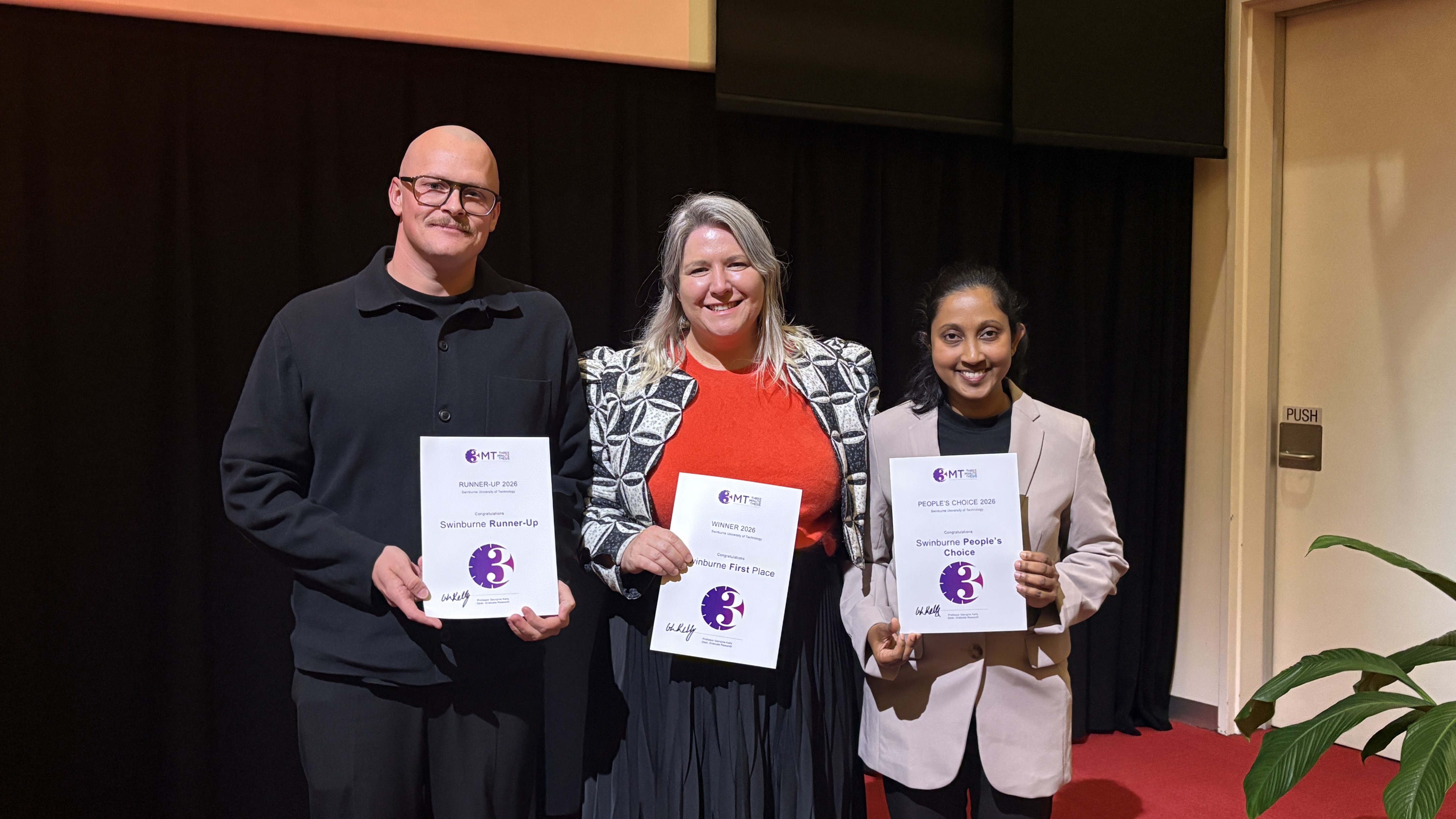
Celebrating Swinburne’s next generation of researchers
Swinburne’s inaugural Research Festival brought together Higher Degree by Research students and early career researchers to learn, share and connect.
Monday 27 July 2026 -
- Engineering
- Student News
Award-winning engineering student solution to benefit remote village
Swinburne engineering students’ waste-to-resource solution has been implemented in a Timor-Leste village.
Monday 15 June 2026 -

- Social Affairs
- Science
- Sustainability
- Engineering
Swinburne secures ARC Linkage funding for industry-focused research
Swinburne is the lead organisation for two ARC Linkage Projects while also contributing to four externally led projects
Thursday 28 May 2026


