

50 years of psychology at Swinburne: celebrating the people behind the science

In summary
Swinburne’s Department of Psychological Sciences marks its 50th anniversary in 2026, celebrating five decades of psychology education, research and professional training.
The department has grown from 10 ongoing staff in 1976 to 43 in 2026, while expanding its reach across undergraduate, postgraduate and professional psychology education.
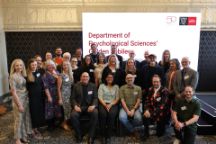
Staff, alumni and members of the department community came together on 6 November to celebrate its Golden Jubilee and recognise the people who have shaped its first 50 years.
Half a century of teaching, research, friendship and impact was celebrated at the Hawthorn Town Hall on Friday 6 November, marking 50 years of the Department of Psychological Sciences.
The Golden Jubilee provided an opportunity to celebrate not just how far psychology at Swinburne has come, but the generations of staff, students, alumni and collaborators who have shaped the department along the way.
Professor Diane Sivasubramaniam, Chair of the Department of Psychological Sciences, identified two enduring strengths across those 5 decades in the anniversary publication: “excellent science and excellent people.”
From 10 staff to five decades of impact
Swinburne’s Department of Psychological Sciences’ began in 1976, when psychology became its own department in Swinburne’s Faculty of Arts, with just 10 ongoing psychology appointments. From the outset, the vision was to combine a strong understanding of psychological theory and research with an applied approach to education.
Today, the department has grown to 43 staff, with undergraduate, honours, master's and doctoral pathways spanning psychological science, forensic psychology, cognitive neuroscience, clinical psychology, educational and developmental psychology and counselling.
Across those 50 years, innovation in education has remained a constant. In 2011, Swinburne’s Bachelor of Behavioural Studies (Psychology) became Australia’s first online psychology program to receive professional accreditation. This year, the tradition of innovation continued with the launch of the Master of Psychology (Educational and Developmental Psychology).
Research has also flourished. In 2025 alone, psychology researchers published more than 300 peer-reviewed journal articles and secured more than $8.5 million in competitive research funding. Their research spans areas including mental health, social and developmental psychology, forensic psychology, mood disorders and cognitive neuroscience.
That impact reaches well beyond Swinburne.
Established in 1990, the Swinburne Psychology Clinic combines professional training with low-cost mental health services for the community. Mental Health Online, established in 2008, has enabled more than 130,000 people to access digital mental health support, while the Wellbeing Clinic for Older Adults, established in 2011, brings together psychological care, research, professional training and community engagement.
Celebrating the people behind the legacy
For Professor Sivasubramaniam, the department’s longevity reflects more than academic achievements alone.
“Across 50 years, generations of staff and students have built something remarkable: a department defined not only by what it achieves, but by the values that underpin its work” says Professor Sivasubramaniam.
“A commitment to excellence, generosity, and using psychological science to make a positive difference in the world has shaped this department throughout its history.”
Looking to the next 50 years
The department enters its second half-century with a continued focus on research excellence, innovative teaching, professional training and applying psychological science to real-world challenges.
Future plans include the SwinCare Community Clinic, which is being developed to expand psychology and counselling training, interdisciplinary collaboration and connections between research, teaching and community impact.
After five decades of transformation, the milestone is both a celebration of longevity and a foundation for what comes next.

-
Media Enquiries
Media Enquiries
Related articles
-
50 years of psychology at Swinburne: celebrating the people behind the science
- Education
- Science
- University
Swinburne’s Department of Psychological Sciences celebrates its 50th anniversary in 2026, reflecting on five decades of psychology education, research and professional training.
Wednesday 11 November 2026 -
Music therapy could help protect cognitive function in people living with dementia
- Science
Swinburne research explores how music therapy could support brain function, memory and cognition in people living with dementia and help delay its onset.Tuesday 10 November 2026 -
Landmark reform of Australian university leadership

- University
Australian university Chancellors and Vice-Chancellors will come together within a single national representative body.
Friday 06 November 2026 -
Bringing Indigenous students and industry together

- Social Affairs
- Business
- University
Swinburne’s inaugural Indigenous Industry and Careers Expo connected Aboriginal and Torres Strait Islander students with industry to explore career pathways and build professional connections.
Friday 06 November 2026 -
Swinburne to bolster Victoria’s future healthcare workforce with new healthcare precinct

- University
Swinburne University of Technology will train and upskill an additional 2500 future health professionals, with a new healthcare precinct at its Hawthorn campus.
Monday 12 October 2026


