

Swinburne recognised as a national leader in research and innovation

In summary
Swinburne has been recognised as Australia’s leading research institution in Automation & Control Theory and Microelectronics & Electronic Packaging.
Three Swinburne researchers have been named as national leaders in their respective fields and two Swinburne researchers have been named among the 20 superstars of Australian research.
Swinburne has also been recognised as one of Australia’s top 25 inventive research institutions.
Swinburne University of Technology has been recognised among Australia's research and innovation leaders in The Australian's Research 2027 magazine, with national recognition across two research fields and five of its researchers named among Australia's best.
Swinburne researchers recognised among Australia's top 250
Three Swinburne researchers have been recognised as national leaders in Australia’s list of the top 250 researchers:
Professor Qing-Long Han (Automation & Control Theory)
Professor David Moss (Optics & Photonics)
Dr Ekaterina Pechenkina (Education)
Professor Qing-Long Han is advancing the control of intelligent and autonomous systems, David Moss is driving advances in nanophotonics, and Ekaterina Pechenkina is improving teaching and learning by exploring how educators and students experience technological and pedagogical change.
Swinburne has also been named Australia’s leading institution in two research field: Automation & Control Theory and Microelectronics & Electronic Packaging.
Swinburne researchers among Australia’s research superstars
Swinburne researchers Dr Xian-Ming Zhang and Associate Professor Xiaohua Ge have been named among the 20 superstars of Australian research.
Dr Xian-Ming Zhang is a globally recognised researcher in control systems engineering, cybernetics and industrial automation. His research into time delays in dynamic systems helps engineers better predict how delays in sensing and communication can affect system stability.
Associate Professor Xiaohua Ge is a computer engineer recognised for his research into the control and resilience of autonomous systems. His work explores how these systems can continue operating when faults or disruptions occur, including communication delays, and how complex systems can be protected from cyber threats.
Swinburne's Deputy Vice-Chancellor, Research, Professor Karen Hapgood, said that while rankings are just one measure of success, the results recognise the calibre and breadth of research underway across the university.
“To have Swinburne leading nationally in two research fields, alongside five researchers recognised among Australia’s best, is an outstanding result for a university of our size,” said Professor Hapgood.
“This result demonstrates the strength of a highly focused research ecosystem that plays to our distinctive strengths and targets the areas where we can have the greatest impact".
Professor Hapgood added that “these researchers are tackling challenges across intelligent systems, emerging technologies and education, creating new knowledge and capability that will have an impact well beyond Swinburne.”
Turning research into real-world impact
Swinburne was also named one of Australia’s top 25 inventive research institutions, recognising the commercial potential of its research.
The Australian Research Magazine measures inventiveness through a Translation Readiness Index, which uses machine learning to assess the likelihood that research could lead to commercial outcomes. Swinburne’s inclusion reflects its strength in translating new knowledge into products, services and solutions with real-world applications.
Dr Werner van de Merwe, Vice-President, Innovation and Enterprise, said “Swinburne’s strength is creating the conditions where academic expertise is connected with the people and organisations that can use it to create impact.”
“That means investing in the creation of knowledge through discovery research, working with industry, practitioners, investors, and policymakers to generate ideas to create value from that knowledge, and to then support the development of those into technologies, businesses and practical solutions.”
The Australian’s Research magazine highlights researchers and institutions making significant contribution across 250 areas of research. The results are informed by citation performance in each field's top 20 journals over a five-year period, offering a snapshot of the researchers and institutions having the greatest influence in their fields.
Explore the research behind Swinburne’s rankings and meet the researchers shaping what comes next at Swinburne's Research Experts portal.
Featured
-
Dr Werner van der Merwe

Dr Werner van der Merwe
Vice President (Innovation and Enterprise) -
Professor Karen Hapgood

Professor Karen Hapgood
Deputy Vice-Chancellor (Research)


-
Media Enquiries
Media Enquiries
Related articles
-
Swinburne spinout to cut AI’s energy demands with breakthrough chip
- Technology
A new Swinburne spinout is tackling one of AI’s biggest infrastructure challenges: moving more information through data centres while using less energy.
Friday 30 October 2026 -
Young Victorians to bring unique view to Vic Votes Broadcast

- Media and Communication
Swinburne students will take the microphone this state election night, running their own live radio coverage of the results as they unfold.
Monday 23 November 2026 -
Swinburne recognised as a national leader in research and innovation

- Technology
- Education
- Science
- University
Swinburne has been named as Australia’s leading institution in two research fields, with five researchers recognised among the nation’s best in The Australian Research Magazine 2027.
Tuesday 24 November 2026 -
Swinburne climbs global university sustainability rankings for 2027

Swinburne University of Technology has climbed seven places to rank 283rd globally in the QS Sustainability Rankings 2027, recognising its social and environmental impact.
Wednesday 18 November 2026 -
50 years of psychology at Swinburne: celebrating the people behind the science
- Education
- Science
- University
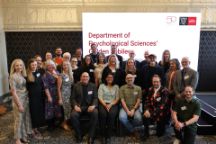
Swinburne’s Department of Psychological Sciences celebrates its 50th anniversary in 2026, reflecting on five decades of psychology education, research and professional training.
Wednesday 11 November 2026


