

Distinguished Professor Hao Wang joins Swinburne

Distinguished Professor Hao Wang has joined Swinburne’s School of Engineering
In summary
Distinguished Professor Hao Wang has joined Swinburne’s School of Engineering
Professor Wang is a world leader in composite materials with more than 30 years of experience in composites, plastic recycling, low-carbon concrete, and turning CO₂ into useful materials
He will contribute to Swinburne’s work in Swinburne-CSIRO National Industry 4.0 Testlab, Aerostructures Innovation Research (AIR) Hub and Manufacturing Futures Research Platform (MFRP), helping drive sustainable solutions in collaboration with industry
Professor Hao Wang, one of the world’s leading composites researchers, has joined Swinburne University of Technology, bringing more than 30 years of experience in making materials stronger and cleaner. His work in carbon fibre composites, plastics recycling, low-carbon concrete and CO₂ conversion is a perfect fit for Swinburne’s focus on real-world solutions.
Swinburne’s Professor Karen Hapgood, Deputy Vice-Chancellor, Research, welcomed Professor Wang to the new role.
“Professor Wang is an expert in sustainable materials and advanced manufacturing. His work addresses some of the toughest challenges we face, like reducing industrial waste, making things lighter but stronger, and cutting carbon emissions. At Swinburne, his expertise will help us develop practical solutions that benefit industry and the community,” said Professor Karen Hapgood.
“Professor Wang’s leadership will strengthen Swinburne’s position as a global leader in engineering innovation and applied science”
Joining the School of Engineering, Professor Wang is the first recruit in the new Swinburne Talented Researcher Scheme (STaRS), which has been designed to enhance the university’s ability to attract and retain world-class research talent.
A Global Leader in Composite Materials
Professor Wang’s work focuses on creating materials and processes that help protect the environment and reduce waste. He brings expertise in composites, plastic recycling, low-carbon concrete, and turning CO₂ into useful products. This fits perfectly with Swinburne’s Aerostructures Innovation Research (AIR) Hub, Manufacturing Futures Research Platform (MFRP) and Swinburne-CSIRO National Industry 4.0 Testlab projects.
Swinburne’s AIRHub brings researchers and industry together to build the next generation of aircraft structures for planes, electric air taxis, drones, advanced air mobility, and space. The Swinburne-CSIRO National Industry 4.0 Testlab supports this work with fully digital engineering and manufacturing, helping design and test parts, processes, and systems for automotive, aerospace, and more.
Meanwhile, the Manufacturing Futures Research Platform (MFRP) connects research and industry to solve complex problems using expertise in advanced materials, automation, robotics, manufacturing, design, and data science. Together, these initiatives put Swinburne at the forefront of sustainable and innovative engineering.
“I have long admired Swinburne as a university that has delivered remarkable impact in engineering research and teaching. I am excited to be joining this great institution and to work with the talented research team there,” Professor Wang said.
“We also have a tremendous opportunity to further strength our research in some identified areas, support the growth and development of our early- and mid-career researchers, and further enhance the university’s international collaboration and reputation.”
Professor Wang is a leading expert whose research has had a wide impact around the world. He has published over 500 journal articles and seven books, with an h-index of 112 and over 60,000 citations. He is a Clarivate Highly Cited Researcher with thousands of citations recognising his work.
Recently, Professor Wang won an ARC Linkage grant to turn agricultural plastic waste into valuable materials. Working with a recycling company and a local council, his project aims to recycle about 200,000 kilometers of plastic film each year. This shows his strong focus on research that makes a real difference for industry and the environment.
Before joining Swinburne, he was Professor of Materials and Manufacturing and Director of the Centre for Future Materials at University of Southern Queensland. He holds PhDs in Materials Engineering from The University of Queensland and Ceramic Chemistry from the Shanghai Institute of Ceramics, Chinese Academy of Sciences.
Professor Wang was the Editor-in-Chief of Composites Part B, the top journal in composite materials research. He was also President of the Asian Association for Composite Materials. Since 2009, he has been a Fellow of Engineers Australia and, since 2016, a Fellow of the Queensland Academy of Arts and Sciences.
Beyond his strong research record, Professor Wang is known for mentoring early career researchers and partnering with industry. He’s dedicated to using engineering and science to create practical, sustainable solutions that tackle real-world problems.
-
Media Enquiries
Media Enquiries
Related articles
-
Landmark reform of Australian university leadership
- University
Australian university Chancellors and Vice-Chancellors will come together within a single national representative body.
Friday 06 November 2026 -
Bringing Indigenous students and industry together

- Social Affairs
- Business
- University
Swinburne’s inaugural Indigenous Industry and Careers Expo connected Aboriginal and Torres Strait Islander students with industry to explore career pathways and build professional connections.
Friday 06 November 2026 -
Swinburne to bolster Victoria’s future healthcare workforce with new healthcare precinct

- University
Swinburne University of Technology will train and upskill an additional 2500 future health professionals, with a new healthcare precinct at its Hawthorn campus.
Monday 12 October 2026 -
Staff and students come together with Council to shape Swinburne’s governance
- University
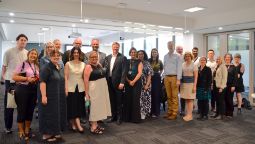
Swinburne staff and students have come together with members of University Council and university leaders for the first of a series of collaborative governance forums, sharing their experiences and ideas to help shape the future of Swinburne.
Monday 26 October 2026 -
Sitting for longer than 25 minutes may be a tipping point for worse health outcomes, world-first Swinburne research finds

- Health
World-first Swinburne research has revealed sitting for longer than 25 minutes may be a tipping point for worse health outcomes.
Monday 12 October 2026


