

Swinburne Future Fellows delivering safer roads, stronger families and space science breakthroughs

In summary
- Five ambitious research projects at Swinburne University of Technology will help make roads safer, support families experiencing housing stress and advance discoveries in space science
- The projects are backed by more than $5.7 million in Australian Research Council (ARC) Future Fellowships funding
- The Swinburne projects form part of the ARC’s $344 million Future Fellowships
Five ambitious research projects at Swinburne University of Technology will help make roads safer, support families experiencing housing stress and advance discoveries in space science.
The projects are backed by more than $5.7 million in Australian Research Council (ARC) Future Fellowships funding.
The projects, which have been funded for the next four years, will:
Improve road safety through two next-generation safety projects. Associate Professor Kwong Ming Tse will combine biomechanical modelling, experiments and advanced machine learning to design better bicycle helmets, improve traumatic brain injury diagnosis and support protective equipment for sport and military use. Dr Shanqing Xu will integrate impact mechanics, structural optimisation and artificial intelligence to develop recyclable, cost-effective roadside barriers for electric vehicles, with applications across aerospace, automotive, civil and marine engineering.
Strengthen families and communities by examining how homelessness and housing insecurity are reshaping family life across generations. Professor Wendy Stone will work with people with lived experience on a project exploring new finance, assistance, tenure, and housing options to inform policy and industry change and position Australia at the forefront of family housing innovation.
Transform healthcare and environmental monitoring by developing next-generation materials that can simultaneously detect mechanical, thermal and chemical signals in real time. A/Prof Nisa Salim’s project will deliver sensitive, durable sensor prototypes for healthcare, space and environmental applications, strengthening Australia’s sovereign capability in advanced materials.
Advance space science and technology by developing new models and software to improve the detection of ultra-low-frequency gravitational waves. Dr Daniel Reardon’s project will turn interstellar scattering from a source of noise into a calibration tool, strengthening the scientific return from the global Square Kilometre Array and Australia’s leadership in radio astronomy.
Acting Deputy Vice-Chancellor, Research, Professor Alan Duffy said the projects demonstrate how Swinburne’s world-class researchers use technology for purpose to deliver tangible benefits for Australians.
“This funding is about impact that matters. Our researchers are developing technology and new knowledge to reduce injuries, improve housing outcomes and unlock the mysteries of the universe.
“By working across disciplines and with industry, government and community, Swinburne is turning ambitious research into practical benefits for Australia and the world,” Professor Duffy said.
“This funding is not only a strong endorsement of the work underway at Swinburne, it is also a welcome investment in Australian research at a time when sustained funding is critically needed to address the challenges and opportunities ahead,” Professor Duffy said.
The Swinburne projects form part of the ARC’s $344 million Future Fellowships. Learn more about the ARC Future Fellowships here.
Featured
-

Professor Alan Duffy
Institute Director

-
Media Enquiries
Related articles
-

- University
Why skills matter more than ever in technology-infused future
Swinburne leaders reflect on how practical skills, digital capability and flexible learning pathways are preparing people for a changing workforce.
Wednesday 09 September 2026 -
- Student News
- Education
- University
Swinburne tops Victoria for overall educational experience among postgraduate students
Swinburne has been ranked number one in Victorian higher education institutions by domestic postgraduate students for overall educational experience, in the 2025 Quality Indicators for Learning and Teaching Student Experience Survey.
Monday 07 September 2026 -
- Social Affairs
- University
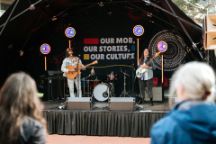
Honouring Country, culture and connection at Swinburne’s inaugural NAIDOC celebration
Swinburne's inaugural NAIDOC celebration celebrated the power of storytelling and provided a space for everyone to engage with Indigenous culture
Thursday 03 September 2026 -

- University
Swinburne Future Fellows delivering safer roads, stronger families and space science breakthroughs
Five ambitious research projects at Swinburne University of Technology will help make roads safer, support families experiencing housing stress and advance discoveries in space science.
Wednesday 09 September 2026 -
New medtech company targets global rollout of personalised TMS software
A new Melbourne-based medtech spin-off has been launched to commercialise software that could make personalised brain stimulation treatment cheaper, faster, and more scalable for clinics worldwide.Wednesday 09 September 2026


