

Swinburne spinout to cut AI’s energy demands with breakthrough chip

In summary
- Swinburne's new spinout Microcomb has officially launched with photonic chip technology designed to change how data centres are planned, built and powered
- Microcomb tackles one of AI’s biggest infrastructure challenges: moving more information through data centres while using less energy
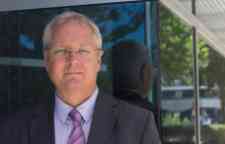
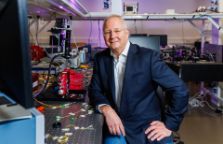
- Swinburne Optical Sciences Centre Director Microcomb Co-Founder Professor David Moss is one of the first to apply optical microcomb technology to data centres
A new Swinburne spinout is tackling one of AI’s biggest infrastructure challenges: moving more information through data centres while using less energy.
Microcomb, a deep technology company, has officially launched with photonic chip technology designed to change how data centres are planned, built and powered.
It is the first company in Australia to bring optical microcomb technology to market and one of the first in the world to apply it to data centres.
Building on research published in Nature, Microcomb’s technology uses an optical microcomb - a fingernail-sized chip that turns a single laser colour into a rainbow of laser light to transmit data.
The chip divides this light into many channels, much like turning a single-lane road into a multi-lane data highway.
Swinburne Optical Sciences Centre Director, and Microcomb Co-Founder Professor David Moss explains how the technology could improve the operation of AI data centres.
“Traditional optical transmission uses multiple lasers to generate separate channels for transmitting data,” he says.
“This energy intensive approach requires significant power to operate the lasers and detectors, while limiting the amount of data each channel can carry.”
"We use a laser to send light down a fibre, then we slot in a small microcomb chip which splits the light into multiple channels so the data can be transmitted on these individual layers.”
He says one of Microcomb’s biggest advantages is its small footprint, which could allow the technology to be introduced without large components or major upgrades.
“AI data centres rely on many servers working together as one large computer, which means they need vastly more connections, fibre optics and data movement. All of that requires power,” he says.
“The energy required to support this growth is the huge bottleneck we’re up against. We’re reaching a crisis point, and we have to solve it from multiple angles because simply throwing more money and energy at the problem won’t work.”
“We are proud to be at the forefront of this technology and look forward to seeing it make a real impact.”
Microcomb brings together leading researchers David Moss from Swinburne, Bill Corcoran from Monash University and Arnan Mitchell from RMIT University, with support from the ARC Centre of Excellence in Optical Microcombs and pre-seed investment from Innovation Victoria.
David also credits commercialisation support from Swinburne’s Innovation and Enterprise group, led by Vice-President Werner van der Merwe and initial funding by Swinburne Ventures Limited, with helping transform pioneering research into a commercially viable technology with global market potential.
“It has been incredibly rewarding to support Microcomb’s journey from breakthrough research to real-world impact - something Swinburne is proud to champion,” van der Merwe says.
"Backing startups and spinouts like Microcomb at an early stage is critical to turning world-class research into real-world solutions, accelerating the path from discovery to impact for industry and the community."
With incorporation complete and pre-seed financing secured, Microcomb has commenced building a customer-informed demonstrator and is engaging prospective customers and partners across AI infrastructure and photonic communications.
Featured
-
Professor David Moss
Director, Optical Sciences Centre -

Dr Werner van der Merwe
Vice President (Innovation and Enterprise)


-
Media Enquiries
Related articles
-
- University
Swinburne spinout to cut AI’s energy demands with breakthrough chip
A new Swinburne spinout is tackling one of AI’s biggest infrastructure challenges: moving more information through data centres while using less energy.
Monday 12 October 2026 -

- Health
Sitting for longer than 25 minutes may be a tipping point for worse health outcomes, world-first Swinburne research finds
World-first Swinburne research has revealed sitting for longer than 25 minutes may be a tipping point for worse health outcomes.
Monday 12 October 2026 -

- Education
- University
First Nations language course graduates to revitalise community languages
Aboriginal graduates from Swinburne's inaugural Learning an Australian First Nations Language course are helping strengthen language and culture in their communities.
Thursday 08 October 2026 -

- Science
World-first psilocin binge eating disorder trial reveals improvement in all patients
Swinburne University of Technology and Entropy Neurodynamics’ world-first IV-infused psilocin binge eating disorder trial has led to improvement in all participants.
Tuesday 15 September 2026 -

- University
Why skills matter more than ever in technology-infused future
Swinburne leaders reflect on how practical skills, digital capability and flexible learning pathways are preparing people for a changing workforce.
Wednesday 09 September 2026


