

Swinburne JWST collaboration to receive prestigious 2027 Berkeley Prize from American Astronomical Society

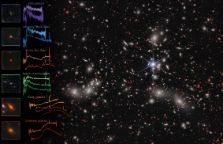
Pandora's Cluster as imaged by UNCOVER, with example spectra and close-ups of the kinds of objects the team found: the first galaxies, accreting black holes, little red dots, galaxies from the Epoch of Reionization, dusty galaxies and quiescent galaxie. Credit: NASA, ESA, SCA, Ivo Labbé (Swinburne), Rachel Bezanson (University of Pittsburgh), Sedona Price (STScl); Image Processing: Alyssa Pagan (STScl)
In summary
- Swinburne leads the international team who have been awarded the American Astronomical Society’s 2027 Lancelot M. Berkeley Prize for the Uncover project
- The Uncover project took the deepest James Webb Space Telescope (JWST) images and spectroscopy of “Pandora’s Cluster”, letting JWST see extremely distant galaxies that would otherwise be too faint to detect
- The Lancelot M Berkeley Prize is one of astronomy’s highest honours around the world recognising groundbreaking work in the field
Swinburne University of Technology leads the international team who have been awarded the American Astronomical Society’s 2027 Lancelot M. Berkeley Prize for the UNCOVER project.
UNCOVER (Ultradeep NIRSpec and NIRCam Observations before the Epoch of Reionization) took the deepest James Webb Space Telescope (JWST) images and spectroscopy of "Pandora's Cluster".
The gravity of this massive cluster of galaxies bends space-time and magnifies the light of galaxies far behind it, letting JWST see extremely distant galaxies that would otherwise be too faint to detect.
The Lancelot M. Berkeley – New York Community Trust Prize for Meritorious Work in Astronomy is one of astronomy’s highest honours around the world. Awarded annually by the American Astronomical Society, it has recognised groundbreaking work such as the discovery of gravitational waves, mapping the Milky Way, and directly imaging supermassive black holes.
Swinburne Associate Professor Ivo Labbé is the Co-Principal Investigator among the 70 astronomers across the globe who are part of UNCOVER. He will accept the Berkeley Prize on behalf of the collaboration and give the prize lecture in January 2027. Swinburne’s Professor Karl Glazebrook, Daniel Lyon, Dr Themiya Nanayakkara, and Professor Ned Taylor are also part of the team.
Associate Professor Labbé was surprised and shocked when he received news of the esteemed honour.
"We first thought someone was playing a prank on us,” he says.
So many groups are doing amazing work with JWST, so for our team to be recognised in the middle of all that feels incredibly special.”
Associate Professor Labbé says that the Berkeley Prize is a “rare honour”.
“What I love most is that it recognises the team effort as a whole,” he says.
“The real prize is the team itself: it is a such wonderful group of humans who generously shared everything, from data to ideas to credit, while having a lot of fun along the way.”
The UNCOVER collaboration is being honoured with the 2027 Berkeley Prize for combining the power of telescopes and gravitational lenses to reveal the contents of the distant universe, including the discovery of large populations of luminous galaxies and supermassive black holes at cosmic dawn.
Amongst dozens of publications in The Astrophysical Journal, and several in Nature, the prize cites three recent UNCOVER studies: the survey's imaging, its ultradeep spectroscopy, and the discovery that JWST's mysterious "little red dots" were reddened supermassive black holes in the early universe.
“A scientific revolution like JWST happens maybe once in a generation. It’s really as if we were blind before and now we can see”, Labbé explains.
"With Pandora's Cluster acting as a natural magnifying glass we were able to zoom in on some of the first galaxies and supermassive black holes that ever formed.
"The biggest surprise was finding all these 'little red dots': tiny, red objects that turned out to be growing supermassive black holes in the early universe, in far greater numbers than anyone expected."
The UNCOVER survey set out to measure the properties of the first galaxies and supermassive black holes; find out how and when galaxies reionised the universe; discover dust-obscured galaxies in the early universe; and trace when galaxies stop forming stars.
“UNCOVER has fundamentally expanded our view of the early universe, revealing a population of distant galaxies and growing black holes that was largely hidden from previous observations,” American Astronomical Society’ Senior Vice President Ted Bergin says.
“Its discoveries challenge our understanding of how the cosmos took shape while setting a powerful example of how large-scale collaboration can advance astronomy."
Featured
-
Associate Professor Ivo Labbe
ARC Future Fellow
-
Media Enquiries
Related articles
-

- Science
World-first psilocin binge eating disorder trial reveals improvement in all patients
Swinburne University of Technology and Entropy Neurodynamics’ world-first IV-infused psilocin binge eating disorder trial has led to improvement in all participants.
Tuesday 15 September 2026 -

- University
Why skills matter more than ever in technology-infused future
Swinburne leaders reflect on how practical skills, digital capability and flexible learning pathways are preparing people for a changing workforce.
Wednesday 09 September 2026 -

- Student News
- Education
- University
Swinburne tops Victoria for overall educational experience among postgraduate students
Swinburne has been ranked number one in Victorian higher education institutions by domestic postgraduate students for overall educational experience, in the 2025 Quality Indicators for Learning and Teaching Student Experience Survey.
Monday 07 September 2026 -

- Social Affairs
- University
Honouring Country, culture and connection at Swinburne’s inaugural NAIDOC celebration
Swinburne's inaugural NAIDOC celebration celebrated the power of storytelling and provided a space for everyone to engage with Indigenous culture
Thursday 03 September 2026 -
- Astronomy
- Science
- University
Swinburne JWST collaboration to receive prestigious 2027 Berkeley Prize from American Astronomical Society
Swinburne leads the international team who have been awarded the American Astronomical Society’s 2027 Lancelot M. Berkeley Prize for the UNCOVER project
Friday 18 September 2026


