

New JWST low-mass galaxy observations could help settle scientific debate about early universe origins

Image: The process of reionization in numerical simulations. Credit: J. Rosdahl, H. Atek and the SPHINX project team
In summary
- International researchers have found that small galaxies are very likely at the origin of reionization
- Swinburne led the use of the James Webb Space Telescope to obtain the first spectra of very low-mass galaxies
- Their observations could help settle a long-running scientific debate about the drivers of reionization
International researchers have made a major astronomical breakthrough, revealing that small galaxies are very likely at the origin of reionization – a crucial period in the early universe where neutral hydrogen transformed into ionized gas.
A paper published in Nature has used the James Webb Space Telescope (JWST) to obtain the first spectra of very low-mass galaxies less than a billion years after the Big Bang.
Their observations could help settle a long-running scientific debate about the drivers of reionization and could be essential to understanding the formation of the very first galaxies.
Swinburne University of Technology is the only Australian university as part of the international collaboration, led by Associate Professor Ivo Labbe.
Co-author, JWST Australian Data Centre Senior Scientist, and Swinburne Laureate Postdoctoral Research Associate in Galaxy Spectral Modelling Dr Themiya Nanayakkara says he is thrilled with the outcomes of this global research involving the Paris Astrophysics Institute (Sorbonne University/CNRS), and universities in Pittsburgh and Texas.
“This work makes a strong case for smaller galaxies to be the driving force behind reionizing the universe. While the number of energetic photons produced by these small galaxies may come as a shock to many, the cosmological implications are also profound.”
Reionization, which occurred some 500 to 900 million years after the Big Bang, marks a crucial period in the history of the universe. It represents the transformation of neutral hydrogen – which predominated the universe – into ionized gas and marks the end of the ‘Dark Ages’ in cosmic history.
Scientists have been arguing what drove the reionization of the universe for a long time. Confirmation of the hypothesis relating to low-mass galaxies has proven particularly difficult, given their low luminosity.
The study achieved this technological feat through the unique combination of JWST sensitivity and the gravitational lensing effect of the Abell 2744 cluster, making nearby galaxies act like cosmic magnifiers, distorting space and amplifying the light of background galaxies.
The team wants to extend this study to a larger scale, to confirm that this location is representative of the average distribution of galaxies in the universe.
“We have now entered uncharted territory with the JWST,” says Dr Nanayakkara. “This work opens up more exciting questions that we need to answer in our efforts to chart the evolutionary history of our beginnings."
-
Media Enquiries
Related articles
-
- Astronomy
- Science
- University
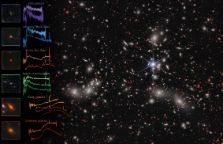
Swinburne JWST collaboration to receive prestigious 2027 Berkeley Prize from American Astronomical Society
Swinburne leads the international team who have been awarded the American Astronomical Society’s 2027 Lancelot M. Berkeley Prize for the UNCOVER project
Friday 18 September 2026 -
- Astronomy
Rare ultra-magnetic star the key to solving a quantum cold case
A Swinburne astronomer may have just confirmed one of the quirkiest aspects of quantum mechanics: that seemingly empty space can alter the behaviour of light.
Thursday 06 August 2026 -

- Astronomy
- Education
- Business
- Science
Planting the seeds for future space scientists
A Swinburne spinout LaunchLabz, is inspiring the next generation of space scientists with their Mission Kits
Monday 17 August 2026 -
- Astronomy
New measurement brings us closer to understanding the Universe’s rate of expansion
Researchers have used gravitational waves from a neutron star collision to make a new measurement of the Universe’s expansion rate, offering new insight into the long-standing Hubble tension.
Tuesday 30 June 2026 -
- University
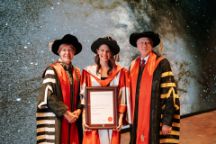
Swinburne recognises Australian space innovator with Honorary Doctorate
Swinburne University of Technology has recognised Katherine Bennell-Pegg, a trailblazer in space engineering and exploration, with an Honorary Doctorate of the University.
Friday 08 May 2026


