

Where do we go from here? Yorta Yorta man Ian Hamm reflects on the post-referendum landscape at Barak Wonga

Ian Hamm is a proud Yorta Yorta man and Chair of the Swinburne National Centre for Reconciliation Practice Advisory Board
In summary
Yorta Yorta man Ian Hamm delivered the 2023 Swinburne Annual Barak Wonga Oration
The annual address is hosted by the Moondani Toombadool Centre, named after Aboriginal leaders William Barak and Simon Wonga, and aims to advance the understanding of Aboriginal and Torres Strait Islander issues in Australia
The title of the address was 'What does the 2nd Aborigines Referendum tell us and, more importantly, where might we go from here’
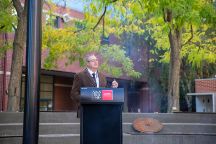
Yorta Yorta man and Swinburne National Centre for Reconciliation Practice of the Advisory Board Chair Ian Hamm delivered a thought-provoking oration on 'What does the 2nd Aborigines Referendum tell us and, more importantly, where might we go from here' in the wake of Australia’s failed 2023 referendum.
Swinburne’s annual Barak Wonga Oration, hosted by the Moondani Toombadool Centre, serves as a significant platform for advancing understanding on Aboriginal and Torres Strait Islander matters - aligning with Swinburne's commitment to reconciliation.
Reflections on failure and fallout
Ian reflected on the result of the October 2023 referendum and underscored the inherent challenges the Yes Campaign faced in actualising the Uluru Statement from the Heart.
He said the attempt to take a document of purity, of hope, of ambition and try to “make it real” revealed a distinct lack of understanding not only of the Australian electorate but of the Australian character.
The referendum was not just about a constitutional amendment but a broader reflection of the place of Aboriginal people in Australia.
“It was never clear to the bulk of Australians if ‘yes’ is the answer – what is the question?”
Ian said the question the referendum was asking Australians to consider was should Aborigines be able to speak? “Should I as a voter allow the Aborigines to talk about things that are about them – yes or no? Simple question, simple answer”.
Discussing the political fallout, Ian acknowledged the potential for opportunistic exploitation of the referendum's defeat. He expresses concern over the setback in state government opposition to treaty legislation, lamenting the re-politicisation of Indigenous affairs after years of effort to remove politics from the equation.
“This wasn’t just defeat of an idea, the campaign had been run on political lines. I worked hard for years and years to take the politics out of Indigenous affairs. And it just got blown up.”
Looking to the future of reconciliation
Looking forward, Ian Hamm issued a call to arms for reconciliation, emphasising the need for Indigenous people to determine their own destiny rather than relying on referendums or political parties.
“We need to look at what do we really mean by reconciliation, what are we trying to achieve, what are the terms of it?”
“It is up to us as blackfellas to determine what our place in Australia is, not our country men voting through referendums,” Ian said.
“We should be the ones who determine our own destiny.”
“If I have a takeaway from all this it is that hope lives. And as long as it does, we will find a way because we always find a way. Hope lives.”
Swinburne remains unwavering in its support for the Uluru Statement from the Heart, and its commitment to voice, treaty, and truth.
The University continues to drive reconciliation through initiatives led by the Moondani Toombadool Centre and the National Centre for Reconciliation Practice, exemplified by the competition of construction on the Indigenous Learning Circles — a tangible manifestation of Swinburne's ongoing dedication to reconciliation.
-
Media Enquiries
-
- Astronomy
Indigenous students explore the cosmos through Swinburne’s astrophysics program
Indigenous students explored astrophysics at Swinburne, connecting science and culture while building pathways to future careers in STEM.
Friday 19 September 2025 -
- University
Michelle Searle paints a new path through leadership diploma
Proud Awabakal artist and Wathaurong Country resident Michelle Searle is expanding her role as a community leader through Swinburne's Indigenous-only Diploma of Leadership .
Friday 11 July 2025 -
- University
Changing the trajectory of reconciliation
Melinda Cilento delivered the address at the 2025 Swinburne Annual Reconciliation Lecture. She shared insights from two decades of engagement with reconciliation efforts across Australia.
Thursday 26 June 2025 -
- University
- Film and television
From Melbourne to the Tiwi Islands: LINGER brings Indigenous stories to the big screen
Indigenous students from Swinburne’s Advanced Diploma of Screen and Media lead a powerful collaborative film project exploring dispossession, identity, and resilience.
Thursday 05 June 2025 -
- University
National Reconciliation Week at Swinburne
Swinburne embraced the National Reconciliation Week 2025 theme, "Bridging Now to Next," building on our strong and rich history of celebrating, acknowledging and progressing reconciliation.
Friday 13 June 2025


