

Underground lab plunges researchers into the dark (matter)

Researchers visited the Stawell Underground Physics Laboratory as Stage 1 was completed. Credit: The University of Melbourne
In summary
- The Southern Hemisphere’s first dark matter underground physics laboratory has opened
- The lab is located over one kilometre underground, accessible by a 10-kilometre or half hour drive through a maze of tunnels
- Researchers from five institutions will use the Stawell Underground Physics Laboratory to attempt to understand dark matter and unlock the mysteries of the universe
Located one kilometre underground, the Southern Hemisphere’s first dark matter underground physics laboratory is open. The one-of-a-kind lab will allow researchers from several Australian universities to attempt to understand the nature of dark matter and unlock the secrets of our universe.

Lead researcher on the project, Professor Elisabetta Barberio from the University of Melbourne, unveils the Stawell Underground Physics Laboratory
A lab to shine a light in the dark
The first stage of the Stawell Underground Physics Laboratory, located at the active Stawell Gold Mine in the Wimmera region of Victoria, is complete.
It takes half an hour to journey down to the lab site along a 10-kilometre drive through what seems like a maze of tunnels. Once you get there, you find a 33-metre-long by 10-metre-wide lab protected further by a product sprayed on the walls called Tekflex – which reduces the potential for interference from radon gas in the rock mass.
All this to house the SABRE detector (Sodium-iodide with Active Background REjection). With it, researchers will look for visible light emitted as dark matter particles collide with a highly sensitive crystal target.
Professor Alan Duffy, Professor Geoffrey Brooks and Dr Shanti Krishnan – all from Swinburne University of Technology – have been collaborating with scientists from other universities in the design and construction of the SABRE detector, with the main vessel at Swinburne’s Wantirna campus. The components are currently being tested in different facilities around the country before being installed underground in the Stawell Underground Physics Laboratory next year for the first experiment conducted in the lab.
“One of the critical elements developed at Swinburne has a been the ‘slow control system’ developed by a team led by Shanti Krishnan from our Factory of the Future. It is designed to ensure that all the conditions in the SABRE detector are accurately recorded, given the detector is sensitive to small changes in temperature, humidity and movement,” says Professor Geoffrey Brooks.
“It’s exciting that the cutting-edge of physics research is happening right here in Wantirna, just down the road from where I grew up. A boyhood dream has come true!”
Five research institutions will use the Stawell Underground Physics Laboratory to unlock the secrets of the universe, including Swinburne University of Technology, the University of Melbourne, the Australian National University, the University of Adelaide and the Australian Nuclear Science and Technology Organisation (ANSTO).
The Australian and Victorian governments each gave $5 million in funding for the building of the Stawell Underground Physics Laboratory, and this funding was boosted by the Australian Research Council awarding a $35 million grant for the development of a national Centre of Excellence for Dark Matter Particle Physics.
What’s the matter with dark matter?
Dark matter is an invisible and unknown form of mass, which accounts for five times more of the universe than all the atoms, or baryons, we can see. Understanding the nature of this so-called dark matter is one of the greatest challenges in the physical sciences for this century, bringing together astronomers, particle and nuclear physicists in a global hunt.

An animation showing the motion of the galaxy within a vast cloud of dark matter, and the resulting headwind of this material as the Sun travels through it. The Earth’s motion aligns with that direction for half of the year meaning the headwind, and any resulting collisions, increase while the next six months the motion is in the opposite direction so the rate of dark matter through the planet and any dark matter detectors drops in a predictable manner – a signal known as the annual modulation. Credit: CAASTRO
There are many candidates for this collisionless, non-luminous gravitating mass; from ultralight axion particles to weakly interacting massive particles (WIMPs) to even primordial black holes.
At Swinburne, researchers use supercomputer simulations to better predict the distribution of dark matter around visible tracers, such as stars and galaxies, that are then compared with gravitational lensing maps from the Hubble Space Telescope or high-energy emission from potential dark matter self-annihilation signatures as revealed by NASA’s Fermi Gamma-ray Space Telescope.
Director of the Space Technology and Industry Institute and expert in dark matter, Professor Alan Duffy, says that answering ‘what is dark matter?’ has the potential to be one of the most significant discoveries of this century.
“Explaining the nature of dark matter would reveal more of the universe than all of our collective efforts to date, the search is a global race that merges supercomputers, vast telescopes, and enormous underground detectors,” he says.
“Whatever we find will transform our picture of physics in this century as surely as splitting the atom did in the 20th century.”
-
Media Enquiries
Related articles
-

- Astronomy
- Technology
- Health
- Science
- University
- Sustainability
- Engineering
Swinburne highly cited researchers reach the top in 12 fields
Ten Swinburne academics have been named on the Highly Cited Researchers 2025 list, released by Clarivate
Tuesday 02 December 2025 -

- Astronomy
- Technology
- Science
- Engineering
Meet Swinburne’s Roo-ver Mission team
Roo-ver will be Australia's first lunar rover, and it’s being designed, built and tested in Australia. Swinburne is playing a key role in the design and construction of Roo-ver, through its involvement in the ELO2 Consortium.
Wednesday 26 November 2025 -
- Astronomy
- Technology
- Science
- Aviation
- Engineering
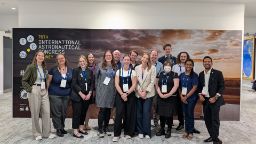
Shaping space innovation at the International Astronautical Congress
The 76th International Astronautical Congress (IAC) united over 7,000 delegates from more than 90 countries to explore the future of space. Swinburne staff and students delivered 20 talks, panels and presentations, showcasing Australia’s growing leadership in research and education.
Friday 10 October 2025 -
- Astronomy
Indigenous students explore the cosmos through Swinburne’s astrophysics program
Indigenous students explored astrophysics at Swinburne, connecting science and culture while building pathways to future careers in STEM.
Friday 19 September 2025 -
- Astronomy
- Science
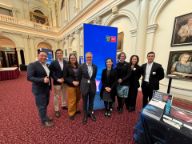
Swinburne’s space stars on show at Parliament House
Swinburne University of Technology hosted a three-day exhibition at Queens Hall in Victoria’s Parliament House . The showcase highlighted the innovative work being done at Swinburne to support the burgeoning space science sector.
Friday 30 May 2025


