

National Science Week at Swinburne
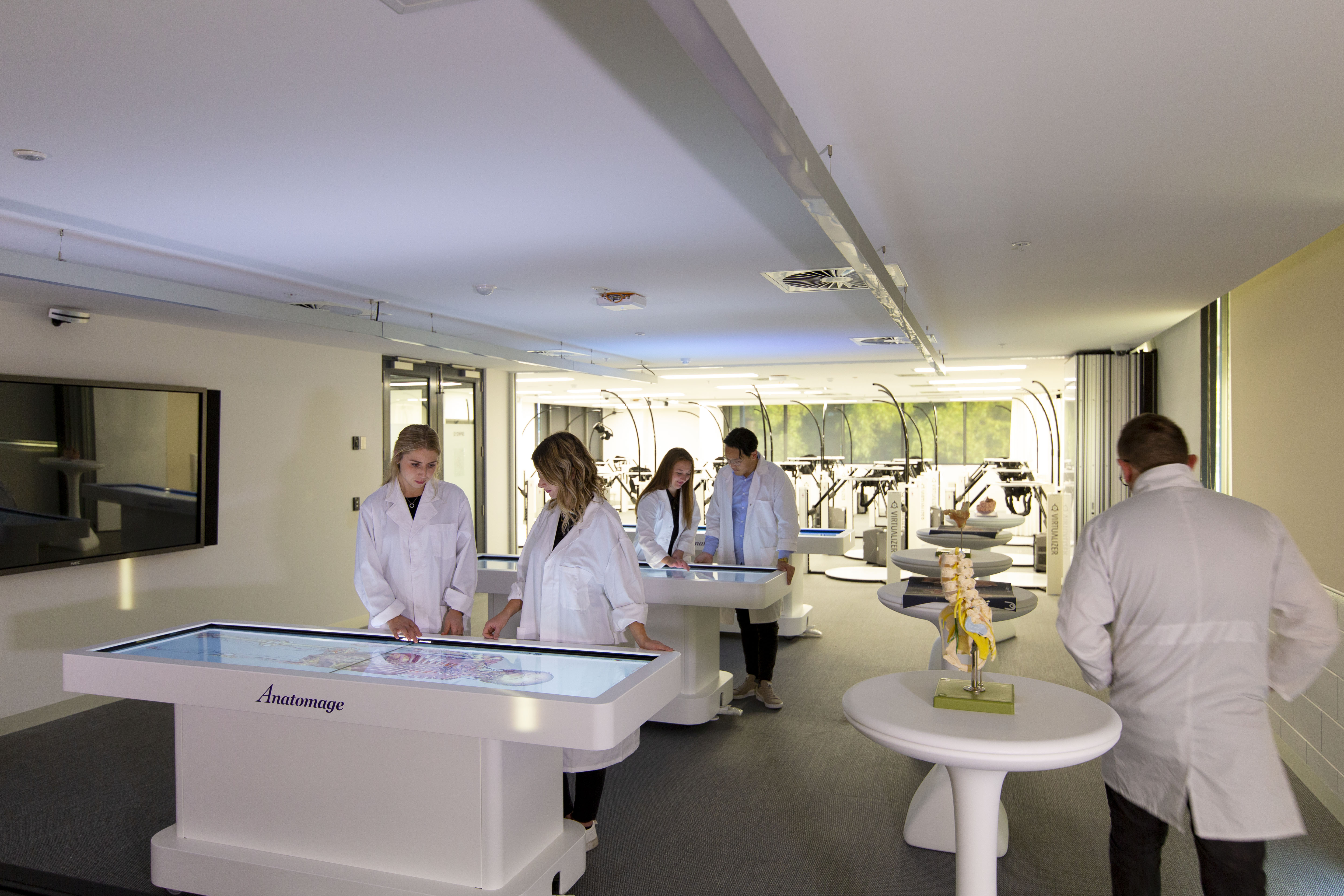
Swinburne's VR anatomy teaching lab provides an immersive, interactive teaching environment for students from across health sciences programs.
In summary
- National Science Week provides an opportunity to showcase Swinburne's outstanding science education and research programs
- This year, Swinburne’s inaugural Chief Scientist, Professor Virginia Kilborn will oversee a range of events and activities
For this year’s National Science Week Swinburne’s inaugural Chief Scientist, Professor Virginia Kilborn will oversee a range of exciting events and activities that speak to Swinburne’s strengths in research and education
Australia’s annual celebration of science and technology runs from 14-22 August.
‘I'm excited to celebrate National Science Week at Swinburne, with events that offer something for everyone - whether you're interested in science, science education, astronomy or the environment,’ Professor Kilborn says.
‘National Science Week is the perfect opportunity to showcase Swinburne's outstanding science and education research programs.’
Embedding STEAM in Early Childhood Education and Care
On Tuesday 17 August, Professor Susanne Garvis will launch her new book Embedding STEAM in Early Childhood Education and Care. An important contribution to early childhood education, this title focuses on the teaching and learning of STEAM (Science, Technology, Engineering, the Arts and Mathematics) subjects to children from two years of age to the early years of school. Professor Garvis and co-editor Associate Professor Caroline Cohrssen will share important insights from their book. Register here.

The role of forests in decarbonising the atmosphere
In a keynote presentation on Wednesday 18 August, Professor Mark Adams (pictured above) will give an overview of what we currently know about the role of forests in ‘decarbonising’ the atmosphere, and in regional and global water cycles.
Using data derived from tree rings, Professor Adams and his team have shown that our long-standing assumptions around forests’ ability to absorb carbon dioxide are no longer valid. Much of the global evidence of the capabilities of mature forests to take up carbon is derived from regions with relatively abundant water and nitrogen, which is not the case in Australia or much of the southern hemisphere.
Professor Adams will discuss the implications of these findings, both locally and globally. Register here.
Swinburne Science Futures Panel
On Friday 20 August, Professor Kilborn will moderate the Swinburne Science Futures Panel. Five Swinburne science students at different stages of their careers – from postgraduate study to working in industry – will share their journey in science and how their Swinburne study has shaped where they are today.
This session is aimed at current science students and high school students who might be interested in studying science at university.
The panel includes a biochemistry honours student, a chemistry PhD student, a physics in industry student and a chemistry in industry student. Register here.

State of the Universe
Later in the day, the Centre for Astrophysics and Supercomputing will present its annual ‘National Science Week State of the Universe’ public lecture virtually.
PhD candidate Sara Webb will share some of the amazing contributions from the international astronomy community. Highlights from the last year include insights into hungry blackholes, goldilocks exoplanets, billionaires in space and much more.
The live, online family-friendly event include plenty of time for a Q&A session involving audience members. Register here.

Science in VR (SciVR) livestream event
On Saturday 21 August, astrophysicists Professor Alan Duffy and Dr Rebecca Allen will take participants for a virtual tour of our solar system and beyond. They will travel through the most explosive events in the Universe in a live streamed talk at 11am.
This event involves participation at home with a smartphone or another device that can connect to the internet. New content this year includes the Mars rover Perseverance and helicopter Ingenuity.
Discover and explore extreme and advanced space science and the research that fuels it. Watch the live stream and send in your questions to be answered LIVE.
Download the free SciVR app any time at www.scivr.com.au
-
Media Enquiries
Related articles
-

- Science
We must seed discoveries for a strong nation
This National Science Week, Swinburne’s Chief Scientist is calling on the federal government to rethink our investment in science as a matter of global importance.
Wednesday 19 August 2026 -

- Technology
- Health
- Science
- University
- Engineering
Swinburne joins global biomaterials research training program
Swinburne has joined the prestigious German Research Foundation-funded International Research Training Group (IRTG) on Multidimensional Biomaterials (MB)2 program
Monday 17 August 2026 -
- Science
- University
- Technology
Swinburne celebrates the seeds of discovery for National Science Week
Swinburne celebrated National Science Week 2026, culminating with the Seeds of Science Festival, held on 21 August. The festival showcased the people, research and ideas shaping the future of science and innovation.
Friday 21 August 2026 -
- Astronomy
- Education
- Business
- Science
Planting the seeds for future space scientists
A Swinburne spinout LaunchLabz, is inspiring the next generation of space scientists with their Mission Kits
Monday 17 August 2026 -
/crop-swinburne-virtual-universe-show-2.jpg/_jcr_content/renditions/cq5dam.web.256.144.jpeg)
- University
- Science
Swinburne welcomes Federal Government’s new Statement on Space
Swinburne University of Technology has welcomed the Australian Government’s new Statement on Space.
Tuesday 21 July 2026


/crop-swinburne-virtual-universe-show-2.jpg/jcr:content/renditions/cq5dam.web.1024.576.jpeg)