

New Swinburne hydrogen hub to advance a net zero emission future

A graphic impression of the aerial view of the Victorian Hydrogen Hub that will house hydrogen production and storage facilities and a demonstration hydrogen refuelling station. (Credit CSIRO)
In summary
- Swinburne has received $10 million from the Victorian Government to build the Victorian Hydrogen Hub (VH2) with the CSIRO
- VH2 is designed to bring researchers, industry partners and businesses together to test, trial and demonstrate new and emerging hydrogen technologies
- It will house a demonstration hydrogen refuelling station with hydrogen production and storage facilities
Swinburne University of Technology has received a $10 million injection from the Victorian Government to build the Victorian Hydrogen Hub with the CSIRO.
The Victorian Hydrogen Hub (VH2) is designed to bring researchers, industry partners and businesses together to test, trial and demonstrate new and emerging hydrogen technologies. These will support sustainable manufacturing practices, as well as support the ability to store clean energy from renewable sources.
Swinburne’s Vice-Chancellor Professor Pascale Quester said the Victorian Hydrogen Hub would house a demonstration hydrogen refuelling station with hydrogen production and storage facilities, to expand the understanding of hydrogen as a fuel for industry partners and businesses who are striving to create a sustainable future for all.
“We are excited by this development and we are grateful to the Victorian Government for its support. The Victorian Hydrogen Hub will be another demonstration of how we can bring people and technology together to create a better world,” Professor Quester said.
“Swinburne’s strong partnership with CSIRO means that we will be able to build on our focus of digitalisation and Industry 4.0, and support industry to enhance understanding of what hydrogen can deliver,” she said.
Building global partnerships
Swinburne has also partnered with Germany’s ARENA 2036, a research facility that brings industry on campus at the University of Stuttgart, to engage the global hydrogen economy. Working together since 2016, joint research projects focusing on light weighting and digitalisation have facilitated new business partnerships between Australia and Germany.
“The Victorian Hydrogen Hub will be connected to a matching facility to be built by ARENA 2036 in Germany, to bring together more than 40 industry partners in Stuttgart. This is a unique opportunity to work across continents to create scalable, global solutions. Australia will be at the forefront in this important research, led by the team at Swinburne and CSIRO,” Professor Bronwyn Fox, Deputy Vice-Chancellor Research and Enterprise said.
“The international partnership connects the largest industry players in the hydrogen sector in both countries, as well as some of the largest users of hydrogen expected to drive future demand. Our deep partnership with the CSIRO and the Hydrogen Mission connects VH2 into the wider Australian hydrogen ecosystem,” Professor Fox said.
“Along with Swinburne, we thank the Victorian Government for this generous funding towards the Victorian Hydrogen Hub. This is another great example of how we’re helping Australia transition towards a net zero emissions future,” Nigel Warren, CSIRO’s Executive Director, Growth said.

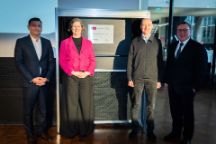
CSIRO Lead, Hydrogen Industry Mission Dr Patrick Hartley; Director, Swinburne Manufacturing Futures Research Institute, Professor Sally McArthur; Swinburne Deputy Vice-Chancellor (Research and Enterprise) Professor Bronwyn Fox; Swinburne Vice-Chancellor Professor Pascale Quester, CSIRO Director, Manufacturing Business Unit Dr Marcus Zipper; CSIRO Executive Director, Growth Nigel Warren at the Victorian Government's funding announcement.
Creating jobs, creating opportunity
“Locally, this is an excellent opportunity to advance the bright minds focused on creating a sustainable future. Projected to create around 300 new full-time jobs across research, engineering, construction and professional areas, the Victorian Hydrogen Hub will serve as the beacon for hydrogen advancement in Australia,” Professor Quester said.
“VH2 will also become an educational hub, providing the multidisciplinary capability that Victoria will need to participate in the growing hydrogen sector through the creation of the Victorian Hydrogen Industry Capability Program. As well as research, knowledge and training, half of Swinburne’s PhD/Masters scholarships will be offered to women, with the support of CSIRO, to advance the hydrogen understanding and skills and help achieve Australia’s hydrogen ambitions. Work integrated learning and internship opportunities for Swinburne PhD, undergraduate and PAVE students will also be offered in this exciting area. We will also be developing a Vocational Education training roadmap for the hydrogen economy,” Professor Quester said.
“It is certainly an exciting time to be involved in the future of hydrogen and advance our net zero emission future,” she said.
Construction of the Victorian Hydrogen Hub is expected to take 18 months.
The funding comes from the Victorian Higher Education State Investment Fund, which was developed in response to the impact of the coronavirus pandemic on Victorian universities.
-
Media Enquiries
Related articles
-
/crop-swinburne-virtual-universe-show-2.jpg/_jcr_content/renditions/cq5dam.web.256.144.jpeg)
- University
- Science
Swinburne welcomes Federal Government’s new Statement on Space
Swinburne University of Technology has welcomed the Australian Government’s new Statement on Space.
Tuesday 21 July 2026 -
.jpg/_jcr_content/renditions/cq5dam.web.256.144.jpeg)
- University
Swinburne and Stonnington agreement paves way for community childcare to continue
Swinburne University of Technology and City of Stonnington have signed the contract of sale for Swinburne’s Union Street property.
Friday 03 July 2026 -

- Design
- Technology
- Science
Swinburne students AI-powered learning platform wins Design for Change 2026
Swinburne Master of Technology students receive first prize in the 2026 Design for Change competition with VidVersity Transformation.
Monday 06 July 2026 -
- Technology
- Education
- Science
- University
Swinburne and Geotab to advance AI-powered transport innovation and research
The Geotab-Swinburne Transport Innovation Hub will connect industry professionals, policymakers and researchers to translate insights into solutions.
Wednesday 03 June 2026 -

- Technology
- Education
- Science
- University
Swinburne helps accelerate medical innovations through ACMD partnership
Swinburne is a partner in the new hospital-based engineering research centre, the Aikenhead Centre for Medical Discovery (ACMD).
Thursday 11 June 2026
/crop-swinburne-virtual-universe-show-2.jpg/jcr:content/renditions/cq5dam.web.1024.576.jpeg)


