


Certificate III in Pathology Collection
Overview
This qualification reflects the role of pathology collectors. Workers in this role follow known routines and procedures, taking responsibility for their own work under general supervision. They combine communication, customer service and technical skills, and use discretion and judgment to adapt and transfer their skills to different situations.
As the health sector continues to grow, with many new hospitals and facilities being opened in the coming years, particularly in the southeast of Melbourne, pathology collectors are in high demand to work within the private pathology collection centres as well as hospitals, day surgeries and general practitioner clinics.
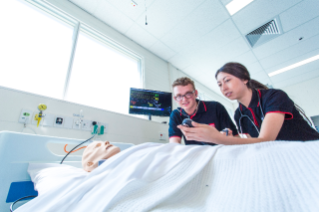
Students will be required to complete a minimum of 35 hours of work placement, giving them skills to progress into employment. Within the program students will complete a minimum number of simulated bleeds on venepuncture arms, before progressing to live bleeds within the program. This will all occur prior to the work placement component being completed.
This course is delivered in line with the Occupational Health and Safety Act 2004, National Standards Guidelines on Infection Prevention, and the Health (Infectious Diseases) Regulations 2001.
Intake cancelled
The March 2026 intake for this course has been cancelled. The next available intake is July 2026. If you'd like to know more get in touch with us today.
Course currently in transition
The course code, title, units, and content may change. Further information will become available on our website, upon enrolment or during your studies. To discuss your study options, please get in touch with us today.
This is a nationally approved vocational course that is recognised throughout Australia.


Are you in high school?
Back by popular demand: A Day in the Life of a Swinburne Student. Get a taste of uni with hands-on workshops, tours and more across different study areas, exclusive for Year 9–12 students.
Your industry experience
As part of this course you will be required to undertake a minimum of 35 hours of work placement. This will be sourced by Swinburne.
Skills you’ll learn
- Patient care
- Sample preparation
- Communication
- Infection control
Your career opportunities
- Pathology collector
- Specimen reception officer
- Pathology laboratory assistant
- Phlebotomist
Further education
- Diploma of Nursing
Admissions
The following additional criteria for entry apply for this course:
Applicants must be 18 years of age at the time of placement.of the course and hold:
- A National Police Check, with no disclosable offences*. This is required to be obtained at least 10 weeks prior to clinical placement commencement. *If a candidate believes there would be a disclosable issue on their National Police Check, a confidential conversation will be required prior to enrolment to determine suitability for work within the healthcare environment.
- A current Working with Children Check (Volunteer or Employee) for the duration of the program.
Immunisations
- Influenza immunisation (annual requirement)
- COVID-19 immunisation fully vaccinated)
Additional immunisations may be required in response to any changes in Government policy per the specific requirements of the organisation you attend for your clinical placement.
English language requirements
Satisfactory completion of one of the following:
- IELTS overall band of 6.5 (Academic Module) with no individual band below 6.0
- Swinburne’s English for Academic Purposes (EAP 5 Advanced level) with overall 70%, all skills 65% or above
- or equivalent measures available at English language requirements.
Need to undertake an English assessment for entry?
A prerequisite for many courses, the Pearson Test of English (PTE Academic) can now be done at our Hawthorn campus.
Credit transfer
Credit transfer is the recognition of academic credits gained through formal study (i.e. units of competency) completed either at another institute or in another qualification. The total amount of credit will vary from individual to individual, based on the unit/s that have been successfully completed.
Recognition of prior learning
Recognition of Prior Learning (RPL) is the process of transferring the skills and knowledge that you have acquired over your lifetime (irrespective of how they were obtained) against the requirements of the unit.
RPL is an assessment process that requires you to provide evidence that demonstrates how you meet the requirements of the unit/s. The amount and types of evidence you will need to provide will depend on the unit requirements.
Finding your fit
At Swinburne, we recognise that not one size fits all. If this course doesn’t meet all your study criteria, check out these alternatives.
-
Certificate III in Health Services Assistance
-

Certificate III in Individual Support (Ageing and Disability)
-
Certificate III in Non-Emergency Patient Transport
Course structure
To be awarded this qualification, students will complete 14 units (nine core and five electives) and successfully complete a clinical placement of 35 hours.
Please note: Whilst all attempts are made to make this one week full time placement available at the end of the course work completion, you will be advised during the course what provider and date has been allocated to you. While significant effort is made to match students geographically to placements, students do need to be prepared to travel to placements in the event that this is required.
Students who are already working in the Industry, and would like this considered as a work placement, are required to contact the Placement Coordinator at the commencement of the course.
Your units
| Units of study | Unit code |
|---|---|
| Core units | |
|
Deliver a service to customers
Core unit |
BSBCUS201 |
|
Interpret and apply medical terminology appropriately
Core unit |
BSBMED301 |
|
Communicate and work in health or community services
Core unit |
CHCCOM005 |
|
Work with diverse people
Core unit |
CHCDIV001 |
|
Apply basic principles and practices of infection prevention and control
Core unit |
HLTINF006 |
|
Identify and respond to clinical risks in pathology collection
Core unit |
HLTPAT001 |
|
Perform venous blood collections
Core unit |
HLTPAT002 |
|
Collect pathology specimens other than blood
Core unit |
HLTPAT004 |
|
Participate in workplace health and safety
Core unit |
HLTWHS001 |
| Elective units | |
|
Use business software applications
Elective unit |
BSBTEC201 |
|
Recognise healthy body systems
Elective unit |
HLTAAP001 |
|
Provide First Aid
Elective unit |
HLTAID011 |
|
Perform electrocardiography (ECG)
Elective unit |
HLTCAR001 |
|
Receive, prepare and dispatch pathology specimens
Elective unit |
HLTPAT006 |
2026 fees
Full fee* ($AUD)
$9,350
Skills first government-subsidised place* ($AUD)
$3,720
2026 fees
Fees are estimates only
Fees published on this page are estimates only and are subject to change depending on individual circumstances at the time of enrolment. The above fees apply for units studied in 2026 only and may change for units studied in future years. There may be additional costs related to learning material and equipment.
Fees are estimates only
The indicative course fees shown apply to international students for the relevant year, based on a standard study load per year. Fees are assessed according to actual study load each semester, with variations to study load resulting in tuition fee adjustments. These fees generally include the Student Services and Amenities Fee (SSAF) and are subject to annual review. Enrolled students will receive reasonable notice of any fee changes before payment is due.
Skills first government-subsidised place
This training is delivered with Victorian and Commonwealth Government funding. To qualify for a government-subsidised place, you must meet various eligibility criteria. The course you’ve applied for must also be offering government-subsidised places. Swinburne will determine your eligibility by conducting a full assessment of your eligibility during the course application process.
How do I pay my fees?
You can pay your Swinburne fees in person, via credit card, BPAY, or at Australia Post. Check to see if loans and employer sponsored training are also available.
International students need to pay tuition fees up-front by the relevant due date. You can find the due dates on your Statement of Account.
To pay your fees:
- log in to My Financials
- check your Australian bank account details are correct
- check your Statement of Account to see how much you owe
- pay using your preferred payment method.
Eligibility for VET student loans (VSL)
If you apply for a VET Student Loan, Swinburne must first verify your identity. If you are eligible, we will provide your enrolment information to the government so you can complete the application within their eCAF system.
The VET Student Loan amount for this course is capped. You must start repaying this loan once you earn above the compulsory repayment threshold.
Concessions rates for vocational students
If you’re enrolling in a Certificate IV-level program or below, are eligible for a government-subsidised training place and hold a valid concession card, you may be eligible for a concession of 80 per cent off the published fee of your unit(s) tuition – which means you’ll only be charged 20 per cent of the published fee.
Student services and amenities fee
This funding serves to improve the student experience at Swinburne. You may use many or just some of the services and amenities that the fee provides.
From 1 January 2024, all courses at the Diploma level and higher will contribute to the Student Services and Amenities fee.
Please refer to the Student Services Amenities Fee page for more information.
This funding serves to improve the student experience at Swinburne. You may use many or just some of the services and amenities that the fee provides.
This amenities fee is included within your annual tuition fee listed above. The fee shown is the capped amount for 2026.
Please refer to the Student Services Amenities Fee page for more information.
SSAF fee* ($AUD)
$373.00
SSAF fee* ($AUD)
$373.00
Scholarships
Scholarship applications for 2026 are open. Scholarships at Swinburne are about providing opportunity, promoting equity and recognising excellence and achievement. We want you to reach your potential and achieve your life and career goals.
Our handy guide will assist you to gather documents for your application.
When you apply for a Swinburne course, we automatically consider you for an international scholarship of up to 30 per cent off your course fees – no separate application required! Just apply for your Swinburne course of choice and when we review your course application, we will also assess you for an international scholarship.
Apply through an agent
Most international students use an education agent to help them through the application process. Swinburne has agents all over the world that can help you with your application to study. Search for a Swinburne representative in your country. If your country is not listed, please contact us.
Apply directly
Ready to take on a new challenge and reach your academic goals? If you already know which course you want to study and understand the entry requirements, what are you waiting for? Apply online! Remember, you cannot apply direct if you have an active VTAC application.