


We take a universal approach to sustainability, considering the physical environment we operate in, as well as our people, practices and research.
Advances in technology offer enormous potential to improve sustainability outcomes. Much of our research is focussed on one or more aspects of sustainability and, increasingly, this research and its real-world application has the potential to transform lives and create more sustainable outcomes, both for individuals and society.
Sustainability concepts are progressively being established within the curriculum in all disciplines, in the design and construction of our on-campus environment, and in how we manage our campuses.
Sustainability Development Goals
The United Nations Sustainable Development Goals (SDGs) are designed to end poverty, fight inequality and injustice, protect the environment and address climate change. Governments, businesses and civil society together with the United Nations are mobilising efforts to achieve the Sustainable Development Agenda by 2030 — a plan of action for people, planet and prosperity.
Swinburne is a signatory to the University Commitment to the Sustainable Development Goals. We are now part of Australia/Pacific Regional Network of the Sustainable Development Solutions Network (SDSN). The SDSN aims to bring its members together to develop and promote solutions, policies and public education for sustainable development.
Our commitment to the SDGs focuses on recognition and commitment to the following areas:
- the enormous social, economic, and environmental challenges facing the world
- future development that is socially, economically, and environmentally sustainable
- the vital role universities can play in achieving a sustainable future through teaching, research, and operations.
Swinburne’s carbon neutral commitment
In 2019, Swinburne made a commitment to being carbon neutral by 2025. The pledge – championed by our Vice-Chancellor Professor Pascale Quester – has resulted in a number of initiatives to reduce emissions across our campuses. This is being achieved through our operations, building and construction, procurement and research endeavours.
To ensure we meet this target, a cross-functional team is investigating, developing and prioritising further initiatives to decarbonise our operations. Opportunities to leverage sustainability focused research, partnerships and curriculums are also top of mind.
Learn about our progress on our carbon neutral commitment.
Addressing Modern Slavery
Swinburne is committed to taking the necessary steps to identify and resolve any form of modern slavery within the University’s operations, its suppliers and partner organisations. We deplore all forms of slavery and forced labour, and we understand the significant role of universities in helping to end modern slavery.
Responsible Investment Charter
Swinburne’s Responsible Investment Charter guides our future investment decisions.
The Charter commits us to take account of environmental and social impacts in the investment choices that we make. We can use our influence to increase positive impacts and reduce negative ones.
Through investments in public and private companies, we have an indirect impact on the environment and communities worldwide. We have an opportunity to influence those companies to create positive change.
Our areas of focus are:
- climate change
- human rights and modern slavery
- sustainable development.
We will also exclude companies that are inconsistent with a sustainable future that generates significant revenues from:
- carbon-intensive fossil fuels
- tobacco production
- controversial weapons such as landmines.
Looking for our Responsible Investment Charter 2025?
The purpose of Swinburne's Responsible Investment Charter is to guide us in considering how these core values are applied to investment practices.
Swinburne's current investment manager is Mercer who supports the university to implement its Responsible Investment Charter. Mercer also provides advice and benchmarking reporting to Swinburne on our sustainability and reponsible investment performance.
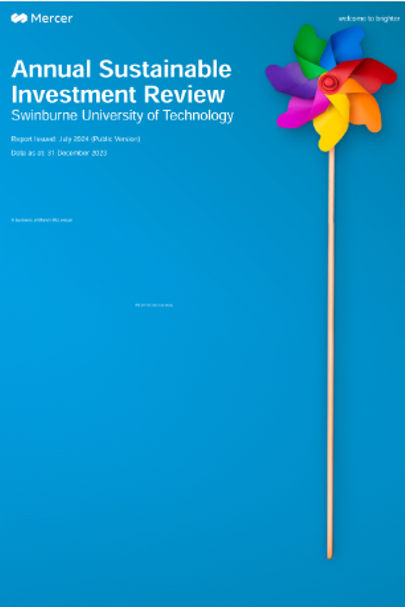
Annual Sustainable Investment Review
-

Accredited by the Carbon Literacy Project
Carbon literacy training
Swinburne's School of Business, Law and Entrepreneurship runs a Carbon Literacy Training (CLT) short certification course in collaboration with The University of Queensland, Federation University and Deakin University.

Sustainability news
-
- Technology
- Health
- Education
- Business
- Science
- Sustainability
- Engineering
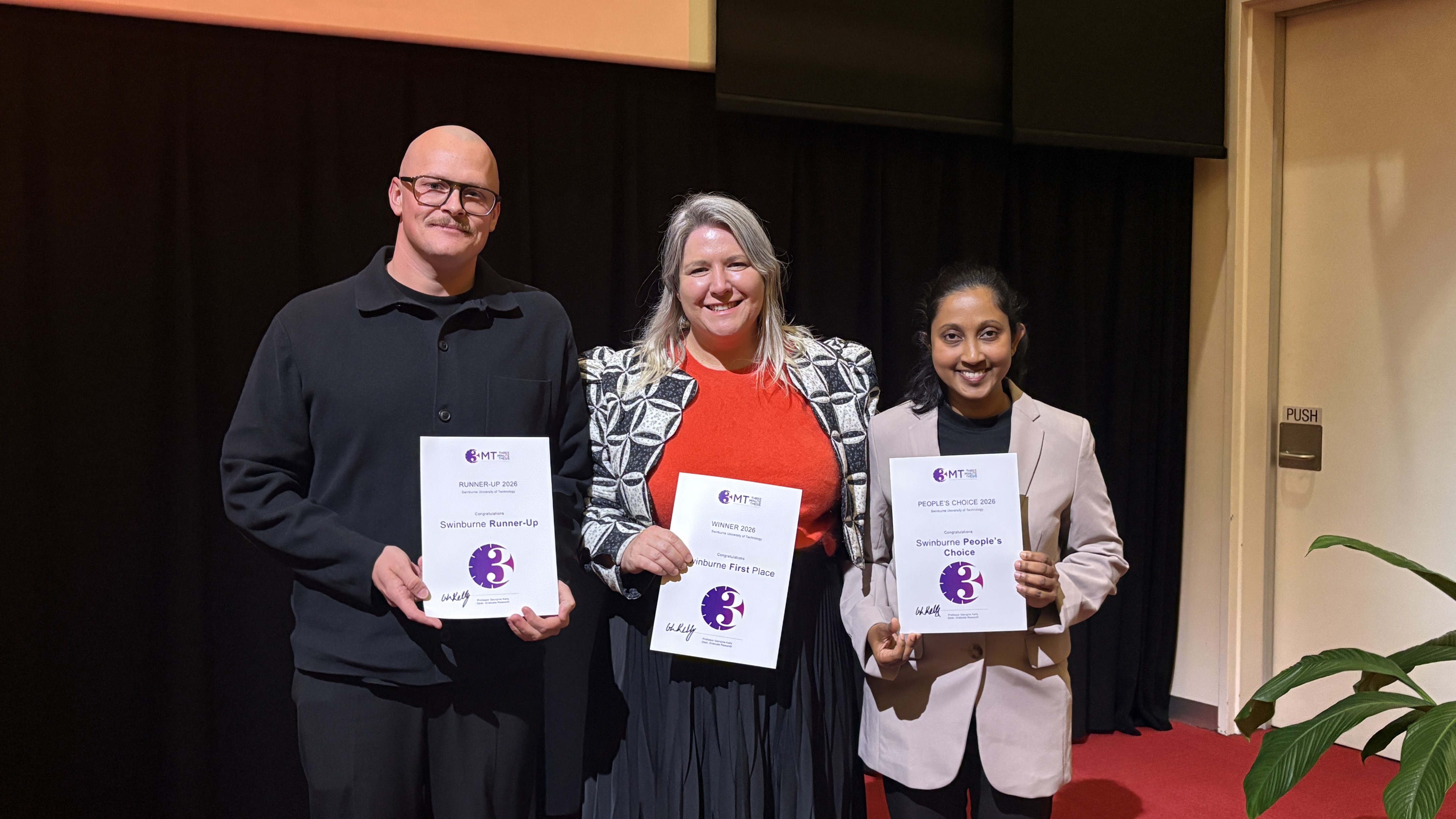
Celebrating Swinburne’s next generation of researchers
Swinburne’s inaugural Research Festival brought together Higher Degree by Research students and early career researchers to learn, share and connect.
Monday 27 July 2026 -
- Sustainability
- Technology
French climate-tech startups to join international Climate 4.0 Hub at Swinburne
Six French climate-tech startups to join FACET’s Climate 4.0 Hub Flagship Accelerator, hosted at Swinburne’s Hawthorn campus.
Friday 19 June 2026 -

- Social Affairs
- Science
- Sustainability
- Engineering
Swinburne secures ARC Linkage funding for industry-focused research
Swinburne is the lead organisation for two ARC Linkage Projects while also contributing to four externally led projects
Thursday 28 May 2026 -

- Science
- University
- Sustainability
Swinburne appoints Gordon Chakaodza as new Co-Director of FACET
Gordon Chakaodza has been appointed as Co-Director of the Franco-Australian Indo-Pacific Centre for Energy Transition (FACET), he brings extensive leadership experience in hydrogen and energy transition and will guide FACET’s next phase of growth
Tuesday 17 March 2026 -
- Technology
- Science
- Sustainability
- Engineering
Swinburne’s international collaborations driving meaningful impact
Swinburne is collaborating with international researchers to tackle global challenges in clean energy, sustainable materials and energy-efficient buildings.
Monday 16 March 2026 -

- Technology
- Science
- Sustainability
- Engineering
Swinburne to drive innovation in critical minerals research and industry
Swinburne will contribute its expertise to the Critical Metals for Critical Industries Cooperative Research Centre (CMCI CRC)
Thursday 12 March 2026


Contact us
To learn more about our strategies and initiatives, please call our general enquiries number on +61 3 9214 8000.