

How Hao Wei is uniting design and technology to solve problems

Hao Wei’s time at Swinburne helped him grow and shaped him as a designer
In summary
Hao Wei Tu enrolled in a study abroad program at Swinburne and is now pursuing a PhD with Swinburne’s School of Design and Architecture and Design Factory Melbourne
He was recently named a finalist for the 2025 Australian Graphic Design Association (AGDA) Emerging Designer of the Year award
Hao Wei’s time at Swinburne helped him grow and shaped him as a designer
Hao Wei Tu has always been driven to make things work better. That curiosity eventually led him to study design at Swinburne, where he turned his childhood ideas into real-world creative skills.
"A significant part of my love for design stems from my childhood passion for imagining better solutions to everyday problems,” he says.
“I would look at everyday problems and brainstorm solutions or consider a different perspective. I didn't realise it then, but this was the beginning of my design thinking," he said.
Hao Wei was recently named a finalist for the 2025 Australian Graphic Design Association (AGDA) Emerging Designer of the Year award.
The AGDA Emerging Designer of the Year award celebrates rising talent shaping the future of design. The category celebrates fresh perspectives, creative bravery and the potential to shape the future of design in Australia and beyond.
“This nomination is a profound affirmation of the design work I have done throughout my design journey, from Taiwan to Australia. Additionally, it validates my persistence in pursuing an interdisciplinary path, navigating the space between different design fields, a path I wasn't always sure was 'correct' but one I deeply believed in.”
Hao Wei’s design journey began at a vocational high school in his home country, Taiwan. While completing his Masters in Taiwan, he was selected for a design scholarship program, co-sponsored by Swinburne and the Taiwan Ministry of Education.
The Swinburne effect
During his time at Swinburne, Hao Wei enrolled in different units in Swinburne’s Master of Design course. His turning point was Swinburne’s Applied Innovation unit, which was his first experience with human-centred design.
“Coming from a visual communication background, I had no prior experience with human-centred design or design innovation. However, Swinburne Design Factory Melbourne's practical, hands-on teaching was transformative. It showed me how design could be a powerful force for social good and expanded my potential, transforming me from a graphic designer into a communication and interdisciplinary designer.”
“This wasn’t just a title change, it was a newfound ability to apply human-centred methods to communication design, adding significant depth and professionalism to my work,” he says.
Intersecting design and technology
Hao Wei is currently undertaking a PhD at Swinburne exploring how text-to-image generative AI tools can be applied to support communication and collaboration within scientific organisations.
“My research is at the intersection of design, science and technology,” he says.
“With my PhD, I aim to gain a deeper understanding of the opportunities and challenges related to communication and collaboration within scientific organisations such as the Australian Nuclear Science and Technology Organisation (ANSTO), the Commonwealth Scientific and Industrial Research Organisation (CSIRO) and the European Organisation for Nuclear Research (CERN).”
“This research democratises access to scientific knowledge by enabling non-designers to visualise complex concepts rapidly, making science more transparent and inclusive.”
He recently presented at TEDxSwinburne on the use of text-to-image generative AI to help us see the unseen.

“My core message was that AI-generated images aren't final truths or proofs. Instead, they are sketches or prompts for a richer conversation,” he says.
“On a personal note, this TEDxSwinburne talk was a massive milestone for me. As a non-native English speaker, it was the first time I had ever delivered a speech entirely in English without any notes. It was challenging, but also incredibly rewarding to share a topic I am so passionate about.”
“Swinburne taught me the power of co-creation and interdisciplinary collaboration; that foundation isn’t threatened by new technology, it is only made more relevant.”
“This is the foundation of my PhD research here at Swinburne, exploring how AI, specifically text-to-image AI, can support human communication and collaboration, rather than replace us.”
-
Media Enquiries
Related articles
-
- Design
- University
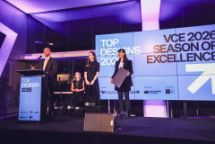
Future of design industry recognised at first ever Swinburne Top Designs Awards
Swinburne University of Technology has celebrated four of Victoria’s most promising young designers as part of the annual Top Designs exhibition at Melbourne Museum.
Tuesday 14 April 2026 -
.jpg/_jcr_content/renditions/cq5dam.web.256.144.jpeg)
- Design
- Science
- University
- Aviation
- Engineering
Swinburne continues its strong performance in QS World University Rankings by Subject 2026
Swinburne continues its strong performance in the QS World University Rankings by Subject 2026, with 17 subjects placing in the rankings
Thursday 26 March 2026 -
- Design
- Technology
- Health
- Law
- Education
- Business
- Science
- University
- Engineering
Swinburne moves up in Times Higher Education World University Rankings by Subject 2026
Swinburne University of Technology has performed strongly in the Times Higher Education World University Rankings by Subject 2026, with two subjects moving up the ranks.
Thursday 22 January 2026 -

- Design
- Student News
How Hao Wei is uniting design and technology to solve problems
Hao Wei Tu enrolled in a study abroad program at Swinburne and is now pursuing a PhD with Swinburne’s School of Design and Architecture and Design Factory Melbourne
Thursday 20 November 2025 -
- Design
How design alum turned passion into a profession
Swinburne design alum Joanna Margiolis is combining her passions of design, photography and sport in her role as a creative specialist at Netball Australia.
Wednesday 03 September 2025

.jpg/jcr:content/renditions/cq5dam.web.1024.576.jpeg)


