

International team discovers the most distant spiral galaxy ever seen

The image of Zhúlóng, the most distant spiral galaxy discovered to date, shows its remarkably well-defined spiral arms, a central old bulge, and a large star-forming disk, resembling the structure of the Milky Way. Image taken by the James Webb Space Telescope. © NASA/CSA/ESA, M. Xiao (University of Geneva), G. Brammer (Niels Bohr Institute), Dawn JWST Archive
In summary
- Swinburne is part of an international team that has discovered a massive, Milky Way-like spiral galaxy.
- It formed just 1 billion years after the Big Bang, revealing an unexpectedly mature structure in the early Universe.
- The discovery offers important insights into how galaxies can form and evolve so rapidly in the early Universe.
The most distant spiral galaxy candidate known to date has been discovered. This ultra-massive system existed just one billion years after the Big Bang and already shows a remarkably mature structure, with a central old bulge, a large star-forming disk, and well-defined spiral arms.
Swinburne University of Technology is the only Australian institution behind this discovery made using data from the James Webb Space Telescope (JWST), offering important insights into how galaxies can form and evolve so rapidly in the early Universe.
Professor Karl Glazebrook and Dr Themiya Nanayakkara from Swinburne’s Centre for Astrophysics and Supercomputing led the effort in Australia.
“This result demonstrates the scientific effectiveness of what are called ‘pure parallel’ surveys,” explains Professor Glazebrook. “This is where JWST images a random piece of sky next to a pre-planned observation, basically for free, and can find new objects just sitting there waiting to be discovered. It is serendipity on steroids thanks to JWST’s enormous sensitivity.”
Among these new findings is Zhúlóng, the most distant spiral galaxy candidate identified to date, seen at a redshift of 5.2 – just 1 billion years after the Big Bang. Despite this early epoch, the galaxy exhibits a surprisingly mature structure: a central old bulge, a large star-forming disk, and spiral arms – features typically seen in nearby galaxies.
“It is a big surprise to me how JWST is finding giant and fully formed spiral galaxies further and further back in time,” explains Professor Glazebrook. “First, we had the Big Wheel a few weeks ago, and now we have Zhúlóng seen only one billion years after the Big Bang. It baffles me!”
Large spiral galaxies like the Milky Way are expected to take several billion years to form. During the first billion years of cosmic history, galaxies are thought to be small, chaotic, and irregular in shape. However, the JWST is beginning to reveal a very different picture. Its deep infrared imaging is uncovering surprisingly massive and well-structured galaxies at much earlier times than previously expected – prompting astronomers to reassess how and when galaxies take shape in the early Universe.
This makes it one of the most compelling Milky Way analogues ever found at such an early time, raising new questions about how massive, well-ordered spiral galaxies could form so soon after the Big Bang.
Professor Glazebrook says future JWST and Atacama Large Millimeter Array (ALMA) observations will help confirm its properties and reveal more about its formation history.
“As new wide-area JWST surveys continue, astronomers expect to find more such galaxies – offering fresh insights into the complex processes shaping galaxies in the early Universe.”
“This is going to be a very exciting new few years with JWST when we see how early massive galaxies can form and whether new physics is required. I look forward to ever larger JWST sky surveys.”
-
Media Enquiries
Related articles
-
- Astronomy
- Science
- University
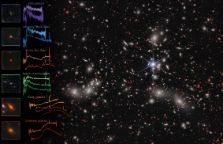
Swinburne JWST collaboration to receive prestigious 2027 Berkeley Prize from American Astronomical Society
Swinburne leads the international team who have been awarded the American Astronomical Society’s 2027 Lancelot M. Berkeley Prize for the UNCOVER project
Friday 18 September 2026 -
- Astronomy
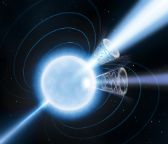
Rare ultra-magnetic star the key to solving a quantum cold case
A Swinburne astronomer may have just confirmed one of the quirkiest aspects of quantum mechanics: that seemingly empty space can alter the behaviour of light.
Thursday 06 August 2026 -

- Astronomy
- Education
- Business
- Science
Planting the seeds for future space scientists
A Swinburne spinout LaunchLabz, is inspiring the next generation of space scientists with their Mission Kits
Monday 17 August 2026 -

- Astronomy
New measurement brings us closer to understanding the Universe’s rate of expansion
Researchers have used gravitational waves from a neutron star collision to make a new measurement of the Universe’s expansion rate, offering new insight into the long-standing Hubble tension.
Tuesday 30 June 2026 -
- University
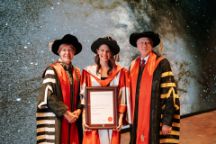
Swinburne recognises Australian space innovator with Honorary Doctorate
Swinburne University of Technology has recognised Katherine Bennell-Pegg, a trailblazer in space engineering and exploration, with an Honorary Doctorate of the University.
Friday 08 May 2026


