

Close to $1M in funding for Swinburne industry-linked projects: 3D printing houses and conserving digital artefacts

Swinburne has received new funding for 3D printing earth houses and conserving digital artefacts.
In summary
- Swinburne has been awarded almost $1M in Australian Research Council funding for industry-linked projects in the latest Linkage scheme rounds
- Swinburne researchers will develop a new approach to 3D printing earth houses, thanks to a Linkage Project grant
- Swinburne’s Professor Melanie Swalwell will lead a collaborative project to conserve digital artefacts for research use, thanks to a Linkage Infrastructure, Equipment and Facilities grant
Swinburne has been awarded close to $1M in funding for two industry-linked projects under the Australian Research Council’s (ARC) latest Linkage funding scheme rounds.
One project, funded by a Linkage Project grant, will develop a new system for 3D printing earth houses, in a bid to transform social housing in Australia.
A second project, funded through the Linkage Infrastructure, Equipment and Facilities (LIEF) scheme, aims to extend the reach of the Australian Emulation Network to conserve digital artefacts for use by researchers.
Swinburne's Deputy Vice-Chancellor Research, Professor Karen Hapgood, said the Linkage funding success demonstrates the university’s commitment to exchanging knowledge, involving industry, and having experts from different disciplines work together to address research challenges.
“The two projects showcase Swinburne’s strengths in transdisciplinary collaboration and our deep research connections with industry, community and other research institutions,” Professor Hapgood said.
“Together, these future-focused projects will transform social housing and drive new knowledge using previously inaccessible content – demonstrating how our research brings people and technology together to build a better world.”
New system for 3D printing earth houses for social housing
Swinburne researchers Dr Mohamed Gomaa, Professor Jay Sanjayan, Professor Blair Kuys, Dean, School of Design and Architecture, and Professor John Evans, Pro Vice-Chancellor Indigenous Engagement, will collaborate with industry partner Luyten 3D to develop a new 3D construction printing approach for earth houses in Australia.
The 2024 Linkage Project aims to overcome current limitations in 3D earth printing by standardising a new, multi-feed extrusion technique, to be used on engineered earth mixtures, with on-demand fibre mixing features.
The 3D printing project will offer a substitute for conventional concrete construction – in turn addressing the critical demand for affordable and sustainable dwellings, especially in regional Australia and remote communities.
The project adds to a growing breadth of Swinburne projects revolutionising the world of building construction – such as Swinburne’s new Indigenous Building Co-Fab initiative, which tackles housing affordability and sustainability by creating innovative pathways to upskilling Indigenous communities themselves.
The 3D earth printing project draws on cross-disciplinary expertise, with researchers spanning Swinburne’s School of Design and Architecture, School of Engineering, Centre for Sustainable Infrastructure and Digital Construction, and Moondani Toombadool Centre.
The Swinburne research team was awarded $436,000 for the project. A contribution of $150,000 from industry partner Luyten 3D, a leading provider of advanced 3D construction printing technology, will provide additional support to the project.
Conserving digital artefacts to drive new media arts, design and architecture knowledge
Swinburne’s Professor Melanie Swalwell will lead a project to conserve digital artefacts and make them accessible for research use, harnessing the Australian Emulation Network.
The Australian Emulation Network aims to provide access to culturally significant born-digital artefacts held in the archives and collections of Australian universities, research institutions and organisations in the Galleries, Libraries, Archives and Museums (GLAM) sector.
The project will extend the Network’s reach, targeting high value collections from university archives and the GLAM sector to offer emulated access to researchers. Emulation uses current technology to recreate digital artefacts’ original hardware and software environments, combating obsolescence to ensure digital artefacts remain available to researchers.
The project expects to generate new knowledge across media arts, design and architecture. It also seeks to build skills in preserving and emulating digital cultural artefacts – including software preservation and sharing legacy computer environments – across a broadening network.
Professor Melanie Swalwell was awarded $544,947 for the project.
-
Media Enquiries
Related articles
-

- Technology
- University
Swinburne secures national funding to boost heavy vehicle safety with real-time hazard detection
Swinburne researchers will develop real-time technology that helps heavy vehicles detect at-height hazards, improving road safety across Australia.
Thursday 12 March 2026 -
- Technology
- Science
- Sustainability
- Engineering
Swinburne’s international collaborations driving meaningful impact
Swinburne is collaborating with international researchers to tackle global challenges in clean energy, sustainable materials and energy-efficient buildings.
Monday 16 March 2026 -

- Technology
- Science
- Sustainability
AI innovation protecting biodiversity wins global award for Swinburne researcher
Swinburne Sarawak researcher, Ts Dr Lee Sue Han has won a 2025 Inspiring Women in Science Award for her AI-driven biodiversity research, which uses artificial intelligence to identify plant species, protect ecosystems and support sustainable agriculture.
Friday 06 March 2026 -
- Technology
- Science
- Sustainability
- Engineering
Swinburne to drive innovation in critical minerals research and industry
Swinburne will contribute its expertise to the Critical Metals for Critical Industries Cooperative Research Centre (CMCI CRC)
Thursday 12 March 2026 -
- Technology
- Social Affairs
- Health
- Science
Driving meaningful progress in assisted living tech
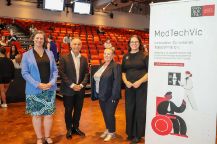
Swinburne’s MedTechVic hub annual showcase brings together research, lived experience and practical innovation in assisted living technologies. This year's theme was ‘Real innovation, real lives’, highlighting the hub’s ongoing commitment to driving inclusive innovation.
Thursday 12 February 2026


