

Using AI to enhance satellite imagery to monitor our planet

Designing and operating Earth observation satellites involves trade-offs between the size, cost and quality.
In summary
- An international team led by Swinburne has developed a new method to assess different satellite designs using a powerful AI technique
- The AI-powered method reduces the cost of Earth Observation satellites while keeping the quality of images high
- Designing and operating Earth observation satellites typically involves trade-offs between the size, cost and quality
A new method to assess different satellite designs using a powerful AI technique to more cheaply monitor our planet from space has been released.
Thanks to an international team led by Swinburne University of Technology and leading provider of global Earth observation data, Planet Labs, the AI-powered method reduces the cost of Earth Observation satellites while keeping the quality of images high.
Traditionally, designing and operating Earth observation satellites involves trade-offs between the size, cost and quality of different hardware options.
Dr Steve Petrie, Earth Observation Research Fellow at Swinburne, was part of the team developing the innovative method.
“We used AI to compensate for compromises limitations in satellite hardware that degrade the quality of images,” he says.
“The glass lens was the most difficult component to compensate for, suggesting that satellite designers should not compromise on the quality of the lens relative to the quality of other components.”
Taking images of the Earth's surface is important for many applications, from monitoring climate change and biodiversity loss, to tracking extreme events like bushfires and floods.
Lowering the cost of Earth observation satellites will allow better tracking of these important phenomena.
Professor Alan Duffy, Swinburne Pro Vice-Chancellor of Flagship Initiatives says, “the new method demonstrates how AI can enhance images of Earth beyond the limits of the satellites themselves”.
“This provides higher-quality data with potentially lower-cost satellites and can help drive the uptake of Earth Observation as a tool for everything from agriculture to mining.”
“Swinburne is proud of the close collaborations it has nurtured with industry. This project is a wonderful example that brings together the best of Swinburne’s Space Technology and Industry Institute researchers as well as leading Earth Observation companies like Planet Labs and EY to show how space can be used to help Earth.”
Dr Petrie hopes that the research collaboration with Planet Labs and EY can be further developed on future satellite-focused research projects.
“The project gave us experience in using AI to enhance satellite images, and those techniques can potentially be used across several Swinburne projects that involve satellite imagery.”
-
Media Enquiries
Media Enquiries
Related articles
-
Swinburne JWST collaboration to receive prestigious 2027 Berkeley Prize from American Astronomical Society

- Astronomy
- Science
- University
Swinburne leads the international team who have been awarded the American Astronomical Society’s 2027 Lancelot M. Berkeley Prize for the UNCOVER project
Friday 18 September 2026 -
Rare ultra-magnetic star the key to solving a quantum cold case

- Astronomy
A Swinburne astronomer may have just confirmed one of the quirkiest aspects of quantum mechanics: that seemingly empty space can alter the behaviour of light.
Thursday 06 August 2026 -
Planting the seeds for future space scientists

- Astronomy
- Education
- Business
- Science
A Swinburne spinout LaunchLabz, is inspiring the next generation of space scientists with their Mission Kits
Monday 17 August 2026 -
New measurement brings us closer to understanding the Universe’s rate of expansion

- Astronomy
Researchers have used gravitational waves from a neutron star collision to make a new measurement of the Universe’s expansion rate, offering new insight into the long-standing Hubble tension.
Tuesday 30 June 2026 -
Swinburne recognises Australian space innovator with Honorary Doctorate
- University
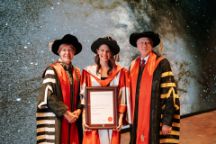
Swinburne University of Technology has recognised Katherine Bennell-Pegg, a trailblazer in space engineering and exploration, with an Honorary Doctorate of the University.
Friday 08 May 2026


