

Swinburne professor saving decades of digital artefacts

Professor Melanie Swalwell speaks at the launch event of her new project, The Australian Emulation Network.
In summary
Professor Melanie Swalwell has launched The Australia Emulation Network, an ARC Linkage Infrastructure, Equipment and Facilities project, that brings digital artefacts back to life for emulation and use
If action isn’t taken now, decades of important historical content could be lost
Professor Swalwell hopes that EaaSI could be the pathway to a Centre of Excellence for digital cultural heritage
Expert in digital media heritage at Swinburne’s Centre for Transformative Media Technologies, Professor Melanie Swalwell has launched The Australia Emulation Network, an ARC Linkage Infrastructure, Equipment and Facilities (LIEF) project, that brings digital artefacts back to life for emulation and use.
The Emulation as a Service Infrastructure platform (EaaSI) provides access to previously inaccessible artefacts that require obsolete computer hardware and software environments. Building on two of Professor Swalwell’s existing Linkage projects, Play It Again and Archiving Australian Media Arts, this project addresses the challenge of aging software with an industry-based focus.

This project builds upon Side-by-Side which emulates videogames and media artworks installed on original platforms and a browser-based emulation platform EasSI.
Time for action
Professor Swalwell says this project scales up her previous projects to prevent the loss of even more important digital material.
“This is an area of great need. We've not done much about this in Australia for quite a long time, so this project is going to really kickstart things and build a national software archive that will benefit all partners,” Professor Swalwell says.
If we don’t take action to archive these artefacts now, Professor Swalwell says, we could lose decades of historical material.
“There is a digital dark ages scenario looming. If we don't have access to records from when we started using computers in a significant way in the 80s and 90s, whole decades of content will be lost,” Professor Swalwell says.
Speaking at the project’s launch event, Dean of the School of Social Sciences, Media, Film and Education Professor James Verdon said the project is one that’s close to his heart.
“This project is about accessibility and thinking about the ways we can engage tangible solutions that enable legacy digital artefacts to become content that can be played and interacted with using minimal IT resources,” he says.

This project shifts the focus of emulating industry-based artefacts.
Professor Swalwell says creating EaaSI as shared infrastructure lowers the bar for its users and will give them confidence to collect digital media now and in the future.
“This shared infrastructure will mean organisations won't need to have incredible IT gurus in house who can build them bespoke solutions. It'll be a platform that organisations can access through a web browser.”
The first steps towards a Centre of Excellence
Professor Swalwell hopes that EaaSI could be the pathway to a Centre of Excellence for digital cultural heritage.
“This infrastructure project is a key step and recognises that there is important research to be done across a number of disciplinary domains, which require access to currently inaccessible, legacy digital artefacts,” Professor Swalwell says.
This project is in collaboration with Swinburne University of Technology (lead), RMIT, University of Melbourne, UniSA, Western Sydney University, University of Western Australia, UNSW, AARNet, ACMI, AIATSIS, Art Gallery of NSW, Museum of Applied Arts and Science, Australian Computer Museum Society, National Archives of Australia, National and State Libraries of Australasia (NSLA), Open SLX, Yale University, Cornell University, Australian Institute of Architects, National Library of New Zealand, and Archives New Zealand.
-
Media Enquiries
Related articles
-
- Technology
- Social Affairs
- Health
- Science
Driving meaningful progress in assisted living tech
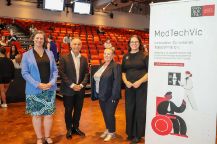
Swinburne’s MedTechVic hub annual showcase brings together research, lived experience and practical innovation in assisted living technologies. This year's theme was ‘Real innovation, real lives’, highlighting the hub’s ongoing commitment to driving inclusive innovation.
Thursday 12 February 2026 -
- Technology
- University
World-first partnership with Adobe drives tech-fluency at Swinburne
Swinburne has become the first Adobe Creative Campus in the world to provide all staff and learners with Adobe Creative Cloud, including Adobe’s full offering of generative AI tools
Tuesday 27 January 2026 -

- Design
- Technology
- Health
- Law
- Education
- Business
- Science
- University
- Engineering
Swinburne moves up in Times Higher Education World University Rankings by Subject 2026
Swinburne University of Technology has performed strongly in the Times Higher Education World University Rankings by Subject 2026, with two subjects moving up the ranks.
Thursday 22 January 2026 -

- Health
Revealing the parental role in preventing childhood internet addiction and how to combat it
New Swinburne-led research has found that the use of mobile devices by primary school-aged children for gaming, social media and streaming significantly increases the risk of internet addiction – and parents are the main influence.
Tuesday 20 January 2026 -

- Technology
- Science
- University
- Aviation
- Sustainability
- Engineering
Swinburne secures AEA funding in aerospace, critical metals, sustainable steel production and protective helmet design
Swinburne University of Technology researchers have secured over $1.6 million in funding from Australia’s Economic Accelerator (AEA) Ignite grants.
Thursday 22 January 2026


