

Forensic Mental Health Professional Development Program 2026 Conference

When
Where
Cost
The annual Forensic Mental Health Professional Development Program (FMH PDP) Conference Day is designed to provide a range of professional development and networking opportunities for the forensic sector, building on the FMHPDP training calendar. It also aims to showcase the research and people of the Centre for Forensic Behavioural Science (CFBS) and offer an in-person experience for students enrolled in one of our online courses. Attendees will hear from leaders in the field, and have opportunities to interact with academics, practitioners, and peers to promote better relationships across disciplines, and improve the outcomes of the people we work with.
The day will feature keynote speakers, presentations, and close with a panel discussion. The day will also feature a range of employers in the forensic sector present to answer questions about employment opportunities. Attendance is offered both online, and in-person at Swinburne University's Hawthorn campus. Catering will be provided for in-person attendees.
The event will be held on level three of the Advanced Manufacturing and Design Centre (AMDC) at 453 Burwood Rd, Hawthorn.
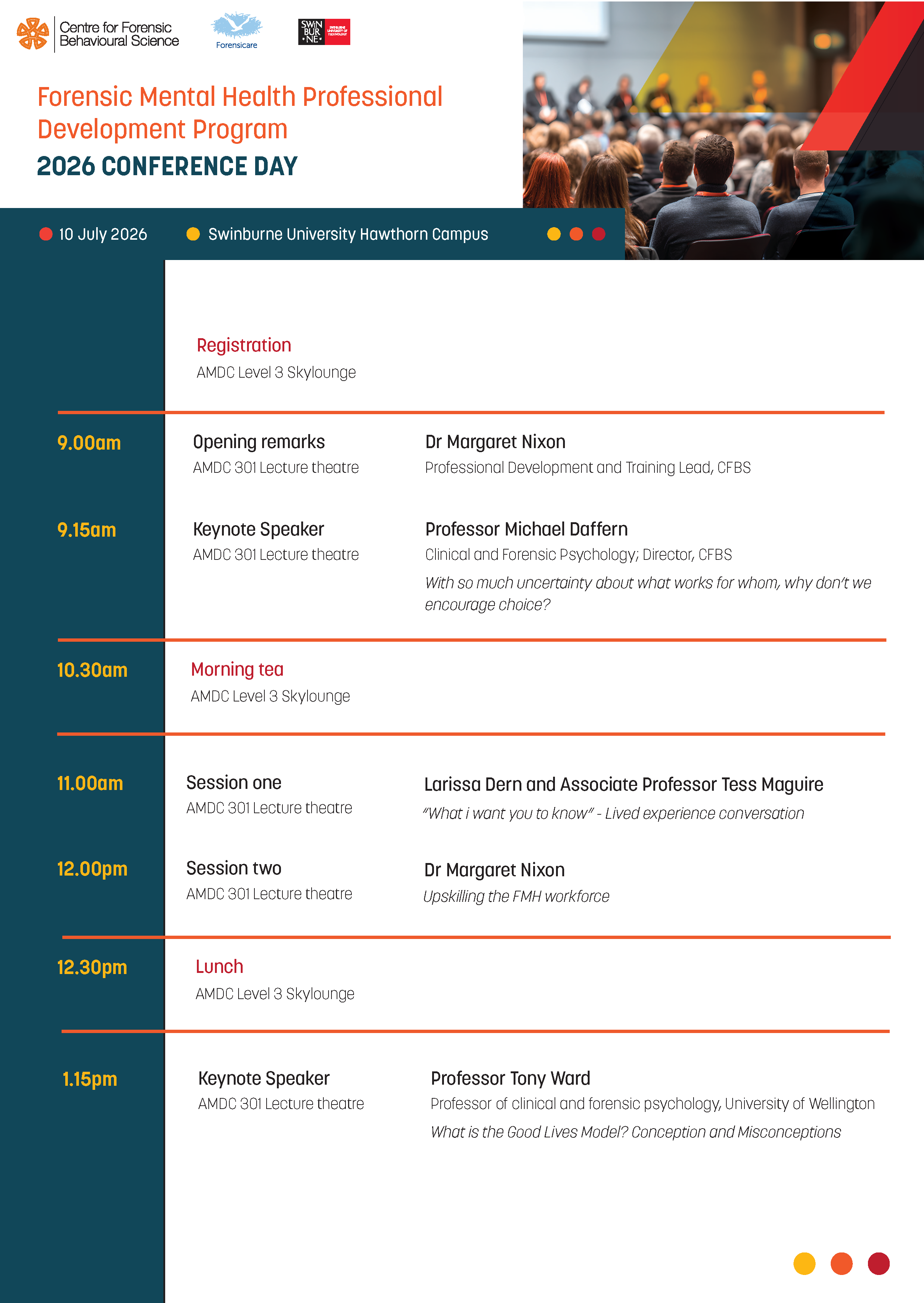
Final program now available!
Key speakers
Michael Daffern - Professor of Clinical Forensic Psychology and Director, Center for Forensic Behavioural Science

With so much uncertainty about what works for whom, why don’t we encourage choice?
Significant advances have been made over the last few decades in how to work effectively with people who have offended. Rehabilitation models have emerged, risk and needs assessment tools have been developed and psychological ‘offence focussed’ treatments have been developed. Although the responsivity principle is widely known, rarely are people who are deemed to require rehabilitation given the choice to pursue their own goals and methods for change. This presentation will explore this idea and consider where choices could be offered and the potential benefits and risks of providing choice.
Michael's bio is available in the conference program.
Tony Ward - Professor of clinical and forensic psychology, University of Wellington

What is the Good Lives Model? Conception and misconceptions
In this keynote Professor Ward will provide a description and analysis of the Good Lives Model of Correctional Rehabilitation and briefly outline its history and development. Prof Ward will then examine its core normative and epistemic commitments and the practice implications that are derived from these. In his talk he will distinguish between etiological models, treatment theories, and practice frameworks, arguing that the GLM is a practice framework. Having established this, Prof Ward will go on to discuss common misconceptions of the GLM, that are directly related to its mischaracterisation as a correctional/forensic treatment model rather than a practice framework. Prof Ward will end by overviewing current research projects that aim to enrich the conceptual and practice components of the GLM, especially the conceptualisation of dynamic risk factors as theoretical hubs rather than causal factors and treatment targets.
We are lucky to have Professor Ward also deliver a two-day pre-conference workshop on the GLM. To find out more and register, visit the GLM workshop event page.
Tony's bio is avaiable in the conference program.
Agenda
In addition to our Keynote presentations the conference will be filled with sessions delivered by leaders in the forensic mental health field.
Larissa Dern and Associate Professor Tess Maguire
Lived experience workers have an essential role in our workforce. In this role they may provide support directly to consumers, families, carers and supporters, or through leadership, consultation, system advocacy, training or research. They also create change and work to shift the culture of care to be more person-centred and recovery oriented. In this session Larissa and Tess will talk about the lived experience workforce, and how we can all work together to enhance care across inpatient and custodial settings.
Dr Margaret Nixon
Managing the needs of people with mental disorders in contact with the justice system requires highly skilled, motivated, and compassionate professionals across a range of disciplines. Their work is governed not only by their own professional standards of practice but is also required to meet community expectations and legislative requirements, often with minimal resources. The work these professionals undertake is often challenging, emotionally taxing, and sometimes involves a risk to their own personal safety. Not surprisingly, significant turnover in staffing is common, leading to a continual and often reactive need for upskilling, education, and professional development. More sustainable models of professional education for the forensic mental health workforce would not only provide better care for the people we work with, but reduce costs, staff attrition, and improve safety. This brief call to arms makes suggestions to organisations about considering staff education as an integral part of their model of care.
Dr David Thomas
This presentation synthesises key empirical and conceptual work on empathy and ToM in autism and other forensically relevant disorders. It will examine how cognitive and affective components of empathy and ToM differ in ASD compared with psychopathy and conduct disorder, how these differences influence misinterpretation, grievance, rumination and susceptibility to antisocial or extremist narratives. Through detailed case vignettes, we will illustrate three broad trajectory patterns: reactive, grievance‑driven violence under misinterpretation and poor regulation; circumscribed‑interest and template‑driven pathways into planned high‑end violence; and co‑offending driven by social naivety and influenceability. The overarching aims are to improve the participants’ ability to: (1) distinguish autistic empathic and ToM profiles from psychopathic profiles, (2) integrate social–cognitive findings into nuanced risk formulations; (3) design management plans that target modifiable factors such as comorbid psychopathology, trauma, social isolation, online immersion and misbeliefs about consent, justice or harm and (4) adopt a more precise, less stigmatizing use of “empathy” and “theory of mind” concepts in forensic reports and court testimony.
Dr Lisa Forrester
The Children’s Court Clinic functions are outlined in the Children, Youth and Families (CYF) Act 2005 under Section 546, however, the key role of the Clinic is to undertake clinical assessments of children, young people and families, and to submit reports to the court to assist in judicial decision making. Referrals received by the Clinic tend to fall into the following categories: referral for a psychological family assessment; referral for a psychological assessment/risk assessment of a young person involved in offending behaviour; referral for a neuropsychological assessment of an individual (child or an adult); and, referral for a psychiatric assessment of an individual (child or an adult). However, within these categories, there are a broad and diverse range of issues that might be listed for assessment and consideration.
This presentation aims to provide an overview of the work undertaken by the Clinical team of the Children’s Court Clinic, focusing on how to work within an evidence-based framework, whilst acknowledging the limitations of a cross-sectional, one-off assessment model. We hope that this can be an interactive session, with opportunities for discussion and questions.
Moderated by Dr Shelley Turner, Executive Director Hospital Operations at Forensicare, panel members include:
- Tony Johannsen - Director of Clinical Practice, Evidence & Quality at Family Life
- Professor Stephane Shepherd - Co-CEO of 16 Yards, and Professor of Forensic Psychology at Deakin University
- Associate Professor Ashley Batastini - Associate Professor in the Centre for Forensic Behavioural Science at Swinburne University of Technology
Event contact
-

Brett McIvor
Operations Manager, Centre for Forensic Behavioural Science

Similar events
-
Research
- Research Impact
- Health
- Law
- Psychology
FMH PDP Workshop: The Good Lives Model of offending rehabilitation
Professor Tony Ward introduces the underlying theory and practice guidelines of the Good Lives Model of offender rehabilitation (GLM)
Register now (FMH PDP Workshop: The Good Lives Model of offending rehabilitation) -
Research
- Research Impact
- Engagement
- Health
- Law
Forensic Mental Health Professional Development Program 2026 Conference
The Centre for Forensic Behavioural Science at Swinburne University presents the annual Forensic Mental Health Conference Day. Join us for keynote speakers, presentations, and panel dicussion, and networking.
Register now (Forensic Mental Health Professional Development Program 2026 Conference) -
Research
- Research Impact
- Engagement
- Indigenous
- Health
6th Australasian Youth Justice Conference. Better outcomes. Wherever you are. Whoever you are.
In collaboration with Department of Human Services SA, the Australasian Youth Justice Administrators (AYJA) will partner with the Centre for Forensic Behavioural Science to deliver the 6th Australasian Youth Justice Conference: Better outcomes. Wherever you are. Whoever you are.