

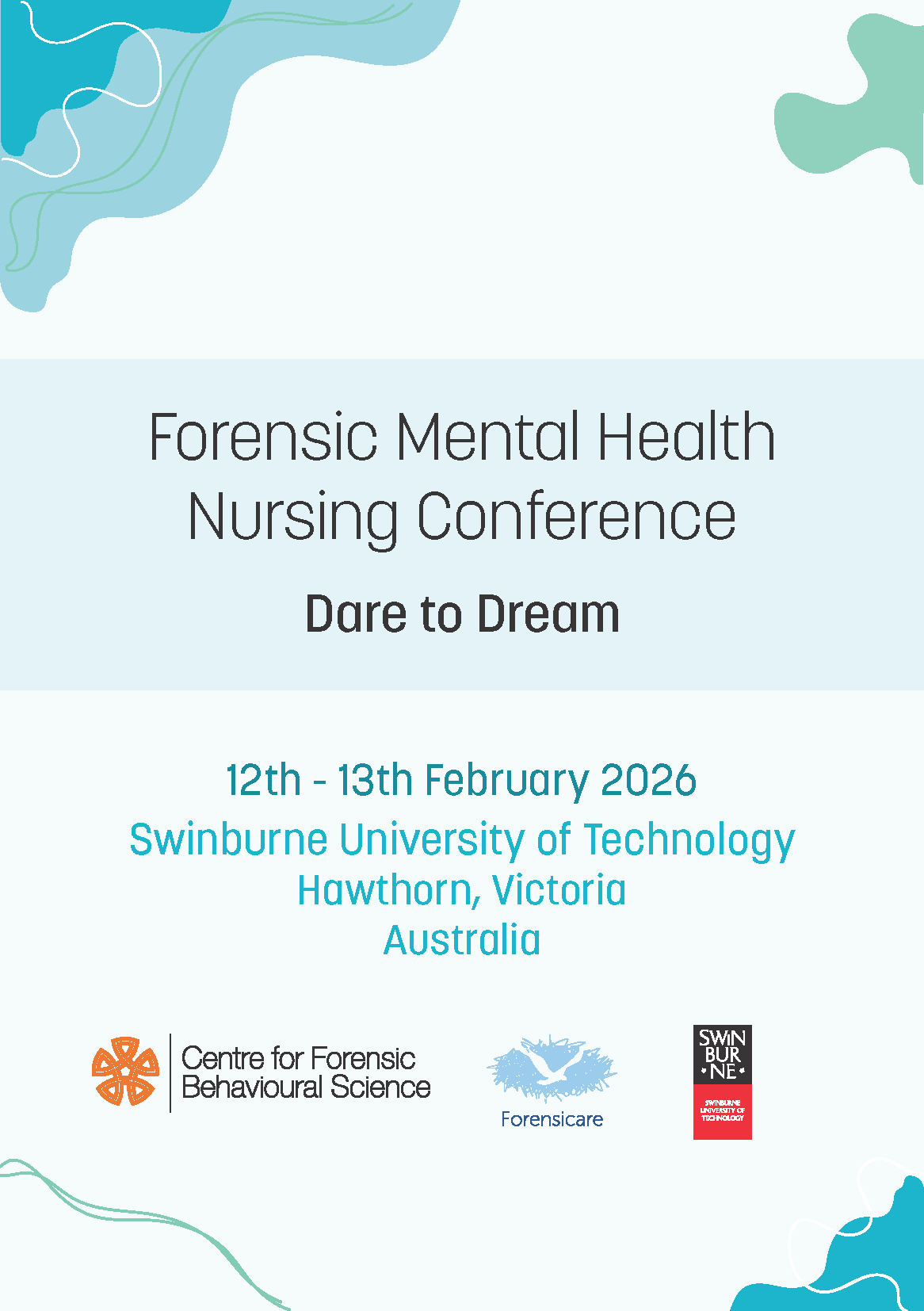
Dare to Dream | 2026 Forensic Mental Health Nursing Conference

When
Where
Cost
The main theme for this conference is innovation in Forensic Mental Health Nursing (FMHN) practice, improving nursing practice and consumer outcomes.
Forensic mental health nursing is a subspecialty of mental health nursing. Nurses working in this setting are required to have specialist knowledge and skills to work within a therapeutic alliance, with people experiencing mental illness (and their families carers and supporters) who are involved in criminal justice processes.
Innovation in FMHN practice can occur across the criminal justice spectrum (at any point) - in secure hospitals, courts, prisons, police stations, and community.
This international conference seeks to bring together forensic mental health nurses who work across a range of settings including inpatient, courts, prisons, community and police custody centres to work together and learn from each other to explore clinical practice and advances in research. Those with an interest in Forensic Mental Health Nursing are also welcome to attend.
This conference will be held in Swinburne's Advanced Technology Centre (ATC) located on Burwood road. You can find our campus map here.

Conference
12 to 13 February 2026
Workshop
11th February 2026
Keynote speakers
Tella Lantta, Tessa Maguire, Brian McKenna, Danny Sullivan
The Centre for Forensic Behavioural Science at Swinburne University of Technology is proud to be partnering with the Victorian Institute of Forensic Mental Health (Forensicare) to deliver this event. The conference will be held at Swinburne's Hawthorn campus in Melbourne, Australia.
The event will commence on Thursday 12 February and continue on Friday 13 February. A welcome reception will be held on Thursday evening.
A pre-conference Saferwards Secure workshop will be held on Wedensday the 11th of February. Scroll down for details.
Final program now available!
Key sub-themes
The conference will give particular attention to:
Preventing and managing aggression and violence
Gender diversity and cultural considerations
Advances in forensic mental health nursing
Working with complex ethical challenges
Conference registration
Registrations for this conference are now open! The registration link can be found at the top of the page. Early bird tickets close on the 23nd of January.
Keep up to date with conference announcements by joining our mailing list.
Program details
Tella Lantta
Adjunct Professor at University of Turku, Finland
Dr Tella Lantta PhD, RN (mental health nursing), is an accomplished health sciences researcher renowned for her work in forensic mental health care. She specialises in the development, implementation, and evaluation of interventions aimed at reducing coercive practices and enhancing safety in mental health and forensic settings.
She currently serves as an adjunct professor at the University of Turku, Finland, a visiting professor in Italy, and an adjunct associate professor in Australia. In Finland, she leads the country’s only national research programme dedicated to mental health nursing science.
Her research portfolio includes leadership of several funded projects, systematic reviews, implementation studies, and intervention trials across diverse mental health environments. Her current work includes a large-scale evaluation of the eDASA+APP using implementation science perspectives.
Dr Lantta is Chair of the IAFMHS Special Interest Group on Forensic Mental Health Nursing, a board member of the European Violence in Clinical Psychiatry Research Group (EViPRG), and leader of the CORRECT network (Nordic Network of Promoting Coercion Prevention Competencies). Through these roles, she has established herself as a central figure in advancing research and practice in forensic mental health nursing.
Her work is widely published in top-tier international journals, and she is deeply committed to translating evidence into practice through multidisciplinary collaboration with mental health professionals, policymakers, and consumers worldwide.

Tessa Maguire
Senior Lecturer in Forensic Mental Health Nursing, Centre for Forensic Behavioural Science and Forensicare
Tess Maguire is a Senior Lecturer in Forensic Mental Health Nursing. She has a joint appointment with Centre for Forensic Behavioural Science Swinburne University of Technology and the Victorian Institute of Forensic Mental Health (Forensicare). She has extensive experience in development and delivery of professional development including prevention and management of aggression.
Her research focuses on forensic mental health nursing practice, including risk assessment and nursing interventions (eDASA + APP) to reduce aggression and use of restrictive practices. She was the recipient of the International Association of Forensic Mental Health Services, Christopher Webster Early Career Award in 2020 and the eDASA + APP received a National Award from the Australian Council on Healthcare Standard for clinical excellence and patient safety. In 2022 she received the Chris Abderhalden Award for Young Researchers in the Field of Aggression in Healthcare at the 12th European Congress on Violence in Clinical Psychiatry.

Brian McKenna
Senior Professor of Forensic Mental Health, Auckland University of Technology and the Auckland Regional Forensic Psychiatry Services
Brian is a mental health nurse and Professor of Forensic Mental Health - a joint appointment between Auckland University of Technology and the Auckland Regional Forensic Psychiatry Services. He is also an Adjunct Professor, at Swinburne University of Technology, in Victoria. His research interests in forensic mental health and intellectual disability are diverse. A commitment to joint appointments has led to a focus on research co-designed with key stakeholders in the services concerned. The intent is for this research to be translational; to assist in the provision of optimal service delivery for the benefit of those we serve.

Danny Sullivan
Adjunct Associate Professor, Swinburne University of Technology
Danny Sullivan is a consultant forensic and adult psychiatrist, previously Executive Director of Clinical Services at the Victorian Institute of Forensic Mental Health (Forensicare). He is Adjunct Associate Professor at Swinburne University and Honorary Senior Fellow at the University of Melbourne. He trained in Melbourne and at the Maudsley Hospital / Institute of Psychiatry in London. He has masters’ degrees in Medical Law (Melbourne), Bioethics (Monash) and Management (McGill).
He has extensive experience in clinical governance and service reviews, and for many years has provided expert opinions to coronial inquests and criminal and regulatory jurisdictions.

FMHN panel - Emerging ethical and practice issues in forensic mental health
The panel of experts from a diverse backgrounds and experience in a variety of forensic mental health settings, will discuss evolving ethical issues in the field including the introduction of new technologies.
About the panel presenters:
Moderator
Nadia Baillie - Executive Director Legal, Governance & Strategy, Forensicare
Nadia Baillie has over 20 years’ experience working in top tier legal firms in Australia and the UK, as well as in-house in the university and health sectors.
In her current role as Executive Director Legal, Governance & Strategy at Forensicare, Victoria’s statewide forensic mental health service, Nadia leads the provision of legal advice, guides Forensicare’s strategy development and oversight, delivers governance services to Forensicare’s board and subcommittees and oversights health information services. Nadia is also a Director on the Board of Parkville Youth Mental Health and Wellbeing Service, Victoria’s newest designated mental health and wellbeing service for young people.
Panel members
Andrew Carroll – Adjunct Associate Professor, Centre for Forensic Behavioural Science
Andrew Carroll has worked in Forensic Psychiatry for over 25 years in various treatment, assessment and managerial roles. He is an Adjunct Associate Professor at the Centre for Forensic Behavioural Science at Swinburne University of Technology. He works at the Victorian Department of Health as Deputy Chief Psychiatrist (Forensic Mental Health) with special responsibility for oversight of prison mental health care. He is also a Director of 'Our Curious Minds', a training and consultancy company that works with mental health and psychosocial services to upskill workers and enhance systems of care. He has a busy medicolegal practice in both the criminal and civil areas. He has published papers and book chapters on a range of topics including insight in psychosis, risk assessment, ethical values in forensic practice, personality disorders and the role of mental health evidence in court.
Larissa Dern - Director Lived Experience, Forensicare
Larissa has worked in Lived Experience for approximately 15 years starting career as a Peer Worker in the Personal Helpers and Mentors Program working her way through to State Leader of Breakthru in 2020, Managing both NDIS, State and Federally funded Mental Health support and homelessness programs. Larrisa furthered her career by becoming the first Chief of Lived Experience at Forensicare in 2022. She is passionate about people getting the right supports at the right time and in a way that supports people being the directors of their lives. "I want to see a system where people are supported to thrive, not just survive"
Courtney Dunn - Senior Psychiatric Nurse and Adjunct Senior Lecturer, Monash University
Courtney is the Senior Nurse with Peninsula Health’s Mental Health and Wellbeing Service. Working previously as a Nurse Practitioner Courney has specialist knowledge and skills in mental health and addiction in community and correctional settings. Passionate about ensuring timely and equitable access to mental health care for all consumers, Courtney is committed to building capacity within the mental health nursing workforce through education, research, supervision and leadership.
Adrianne Mason - Court liaison nurse, Hawkes Bay.
Adrianne Mason is a registered nurse and is employed with Te Korowai Whàriki-Mental Health, Addictions and Intellectual Disability Services (MHAIDS). With extensive experience in various general and mental health settings, Adrianne has worked as a Forensic Justice Liaison in the Hawke’s Bay, New Zealand for the past 15 years.
For 10 years, Adrianne worked as a Forensic Court Liaison Nurse (FCLN) in the Youth Court jurisdiction, and five years ago she transitioned full time into the District Court. To compliment her clinical practice, she also works casually for the Hawke’s Bay emergency mental health service.
Passionate about continuous learning, Adrianne continues to pursue postgraduate studies and holds a particular interest in the challenges faced by clients known as “501 deportees”.
Jill Oetgen – Court Liaison Nurse, Forensic Community Team, Hillmorton Hospital (NZ)
Jill Oetgen is a Court Liaison Nurse with 26 years of practising in the Courts in Christchurch, New Zealand. Her ambition is to work with multiple stakeholders to obtain the best possible outcomes for people with mental health concerns who come into contact with the Criminal Justice system. Working in the Court also places Jill in a position to provide advocacy and education around contemporary forensic mental health practice to the legal and general community. She has provided training and education to other Court Liaison Nurses across the South Island of New Zealand, have organised annual training and networking days for other Court Liaison nurses. Jill has also been involved in organising a national Court/Prison nurse forum to provide education and opportunities for networking and sharing of knowledge and skills for other nurses working within the Justice environment.
Welcome reception
- Date: Thursday 12 February
- Time: 5.30pm–7.30pm
- Venue: Hawthorn Hotel
- Fee: The fee is included for all delegates. Additional tickets for guests are available on the ticketing page.
Safewards Secure workshop
- Date: Wednesday 11 February
- Time: 1pm
- Location: BA307
- Fee: $80 plus GST and booking fee. Tickets are available on the ticket page
This workshop will provide participants with an understanding of the Safewards Secure model and a brief overview of the associated interventions. Safewards Secure is an adaptation to the original Safewards model. The adaptions were developed by engaging experts in forensic mental health who also had Safewards knowledge, and with reference to the literature. The adaptations were designed to enhance the implementation of Safewards by addressing some of the gaps present in the original model for forensic services (for example the impact of long-term care, the experience of trauma and addressing offending behaviour. The workshop will cover the development of the model and highlight some of the key differences between the original Safewards model and the secure version.
About the presenters:
Dr Tess Maguire and Professor Brian McKenna are part of the team of researchers who developed Safewards Secure. Ms Laura Jeffery has been a research assistant providing support, training and oversight for the implementation and evaluation of Safewards Secure at the Thomas Embling Hospital (the secure inpatient service for Forensicare). All presenters are experienced forensic mental health nurses.
Conference location
Swinburne Hawthorn campus
Located in the heart of Hawthorn, Swinburne's main campus is located 10 minutes from Melbourne’s CBD.
Find out how to get to Hawthorn campus.
Stay updated
Sign up to our mailing list to receive updates about the 2026 FMHN Conference - Dare to dream!
Further information
Theme
The overarching theme of the conference is Innovation in FMHN practice: improving nursing practice and consumer outcomes.
We will shortly be calling for submissions that suit the following themes:
- Preventing and managing aggression and violence
- Gender, diversity and cultural considerations
- Advances in forensic mental health nursing
- Working with complex ethical challenges
Submitting authors may choose more than one theme. The conference scientific committee will group presentations by theme, where possible.
Presentation types
Oral Presentation
Presentations are approximately 25 minutes long, including time for discussion and questions.
Symposia
Symposia are made up of three to four papers with an overarching theme. Symposia are given approximately 60 minutes including discussion/question time.
Posters
Posters should be no larger that A1 size, single sided. It is up to the presenter to print the poster ready for display.
Note
Please be advised that there are no online/video presentation options available. All presentations must be delivered in person.
Evaluation criteria
All submissions will be reviewed by the scientific committee.
These criteria are key considerations in the acceptance of all submissions:
- relevance to the conference theme/sub-themes
- relevance to contemporary professional practice
- quality of the abstract
- compliance with the word count and format requirements for abstracts
All submitters will receive an email confirming the outcome of their proposal. All criteria are key considerations in the acceptance of all submissions. We reserve the right to discuss your submission with you as part of the process of assembling the program.
Publication
Successful submissions, including author details (name, institution, city, country, and email), will be featured on the conference website, in the book of abstracts, and the conference program.
Wordcount
Abstracts should be no more than 250 words. Biographical paragraphs should be no longer that 100 words. Symposia overview should be no longer than 150 words, including symposia title. Abstracts exceeding the word count or not adhering to the format may be rejected.
The call for abstracts has been extended to the 31st of August.
Visa and consular information
It is the responsibility of delegates to confirm visa requirements and make suitable arrangements. For further information, consult the Australian High Commission, Consulate, or Embassy in your home country.
Insurance
Conference registration fees do not include insurance of any kind. We recommended you take out personal travel and medical insurance when you register for the conference and book your travel which includes loss or damage of personal possessions, including loss of hotel payments and registration fees through cancellation.
The conference organisers do not take responsibility for participants failing to arrange their own insurance.
Weather
The weather in Melbourne in February is usually very warm to hot with an average high of 26°C and low of 16°C. Melbourne is famous for its unpredictable weather, so we recommend you prepare for all seasons!
Looking for things to do in Melbourne?
Visit City of Melbourne website for ideas!
Can I attend the conference virtually (online)?
No, this event is in-person only.
Presenter facilities
All conference rooms are equipped with video projectors and screens, integrated audio systems with speakers and wireless microphones.
Presentation time allocation
- Oral presentations are allocated between 15 and 20 minutes, including question time
- Symposia are allocated between 45 and 60 minutes, including question time
Places at the conference are limited and will be allocated on a first-registered basis.
All fees are in Australian dollars and include Australian GST. To convert to other currencies, you may use a currency conversion website such as XE Currency Converter as a guide.
Registration fees are available on the ticket page.
Cancellations
Cancellations must be advised in writing by 12 January 2026. The conference organisers reserve the right to apply a $60AUD cancellation fee per registration. After that date, refunds will only be issued in exceptional circumstances.
Substitute delegates will be accepted. Please advised the conference organisers if a ticket is being transferred to another delegate.
By air
Melbourne (Tullamarine) airport
Melbourne airport is approximately 30 minutes by car or 40 minutes by bus to Melbourne's CBD. Taxis, Ubers and the Skybus run between the airport and the CBD.
From Melbourne's CBD, Hawthorn campus is a 10-15 minute train ride to Glenferrie station.
By train
Hawthorn has three railway stations – Hawthorn, Glenferrie and Auburn. From Glenferrie railway station, you will step straight onto campus.
Find out more about getting to Hawthorn campus here.
Dr Tess Maguire
Senior Lecturer in Forensic Mental Health Nursing
Centre for Forensic Behavioural Science
Swinburne University of Technology
tjmaguire@swinburne.edu.au
Event Terms and Conditions
1. Registration and Ticketing:
- By registering for our event, you agree to abide by these terms and conditions
- Tickets can be transferred and refunded under certain circumstances. Contact the conference organiser for details.
2. Payment:
- Payment can be made online through the registration portal.
- All prices include applicable taxes and processing fees.
- Payment can be made via invoice at request. Invoices are generated by Swinburne University of Technology.
3. Attendee Responsibilities:
- Attendees are expected to conduct themselves respectfully and professionally.
- Unlawful or disruptive behaviour will not be tolerated, and organisers reserve the right to remove attendees in violation of the code of conduct.
4. Privacy Policy:
- We collect and process personal data in accordance with Swinburne University of Technology's Privacy Policy, which can be found at https://www.swinburne.edu.au/privacy/
- Event organisers will provide attendee name and organisational details to the conference venue (Swinburne University of Technology) for the purposes of recording visitors to the venue. Attendees are required to sign into the venue at the commencement of each day.
5. Cancellation and Changes:
- In the event of conference cancellation or rescheduling, attendees will be notified promptly.
- Refund policies for cancelled or rescheduled conferences will be communicated at that time.
6. Liability and Disclaimers:
- Speaker cancellations or changes to the program may occur, and we are not responsible for any inconvenience this may cause.
7. Force Majeure:
- In the event of unforeseen circumstances beyond our control (e.g., natural disasters), Swinburne University of Technology will make all efforts to reschedule or refund tickets, but we are not liable for any resulting losses.
8. Contact Information:
- For inquiries, concerns, or requests related to the conference, please contact us at fmhn2026@swinburne.edu.au.
9. Acceptance of Terms:
- By registering for this event, you acknowledge and accept these terms and conditions.
Presenter Terms and Conditions
1. Presenter Responsibility:
- By submitting an abstract for our event, you agree to abide by these terms and conditions.
- All presenters are responsible for ensuring that they have obtained any necessary ethical approvals and approvals from relevant governing bodies to present their research or content.
2. Compliance with Applicable Laws and Regulations:
- Presenters must adhere to all applicable laws, regulations, and guidelines governing their research or content presentation. This includes compliance with ethical standards, human subject protections, and any other relevant laws.
3. Liability:
- Presenters are solely responsible for any legal or ethical issues arising from the content they present. The conference organisers will not be held liable for any breaches of ethical standards, laws, or regulations by presenters.
4. Verification:
- The conference organisers reserve the right to request documentation or evidence of ethical approval and relevant permissions from presenters. Failure to provide such documentation may result in the withdrawal of the presentation.
5. Confidentiality:
- Presenters should be mindful of any confidential or sensitive information they may present and take appropriate measures to protect the privacy and security of such data. Any breaches of confidentiality will be the responsibility of the presenter.
6. Changes to presentations:
- Presenters should inform the conference organisers of any significant changes or updates to their presentations, especially if these changes impact the ethical or regulatory status of their work.
7. Acceptance of Terms:
- By submitting a presentation for this event, you acknowledge and accept these terms and conditions.
Have conference enquiries?
If you have enquiries about the FMHN 2026 conference, please contact Brett McIvor (Conference Coordinator) via fmhn2026@swinburne.edu.au or +61 3 9214 3887.