


Leaders in sustainable energy
The Siemens Swinburne Energy Transition Hub is the first of its kind in Australia. The mission of the lab is to accelerate the transition towards a sustainable energy sector, with a focus on achieving Net-Zero targets and promoting the uptake of renewable energy sources. As one of few labs globally with commercial PSS®E and PSS SINCAL software licensing, here, electrical and electronic engineering students and professionals can access industry-standard tools.

Led by renewable energy expert Professor Mehdi Seyedmahmoudian, research in this lab focuses on sustainable energy and adapting power grids. Current projects contribute to real-world, cost-effective cleaner energy strategies, like power system modelling and simulation, and wireless charging for electric vehicles.
On this page:
Our key research areas
- Renewable energy sources
- Energy storage systems
- Energy efficiency technologies
- Carbon capture and utilisation
- Microgrids and community microgrid energy management system
- Energy policy and economics
- Electric vehicles
- Smart grids
- Power system stability and control
- Power electronics for renewable energy
- High voltage engineering
- Power system protection
- Power quality and harmonics
- Power system modelling and simulation
- Grid integration of distributed energy resources
Our state-of-the-art facilities
Hardware Energy Academy
The Siemens Hardware Energy Academy offers a wide range of modules designed for fundamental and advanced concepts of electrical and electronics engineering and energy systems for students to investigate, experiment and understand their real-world applications.

The training systems designed for:
- basic DC and AC power circuits
- single-phase power transformers
- three-phase transformer banks
- three-phase AC power circuits
- DC power electronics
- three-phase rotating machines
- three-phase AC power electronics
- solar power system
- small-scale wind power electricity generation
- lead-acid batteries
- basic renewable energy system.
Each workstation has dedicated computer with LVDAQ data acquisition software.
Software Energy Academy
The Siemens Software Energy Academy is a cutting-edge educational facility dedicated to exploring the realm of energy systems and digitalisation.
The facility includes PPS®E-licensed workstations, PSS®SINCAL-licensed workstations, PowerWorld, MATLAB, Simcenter MAGNET, ANSYS Electronic Design and Electromagnetics.
-
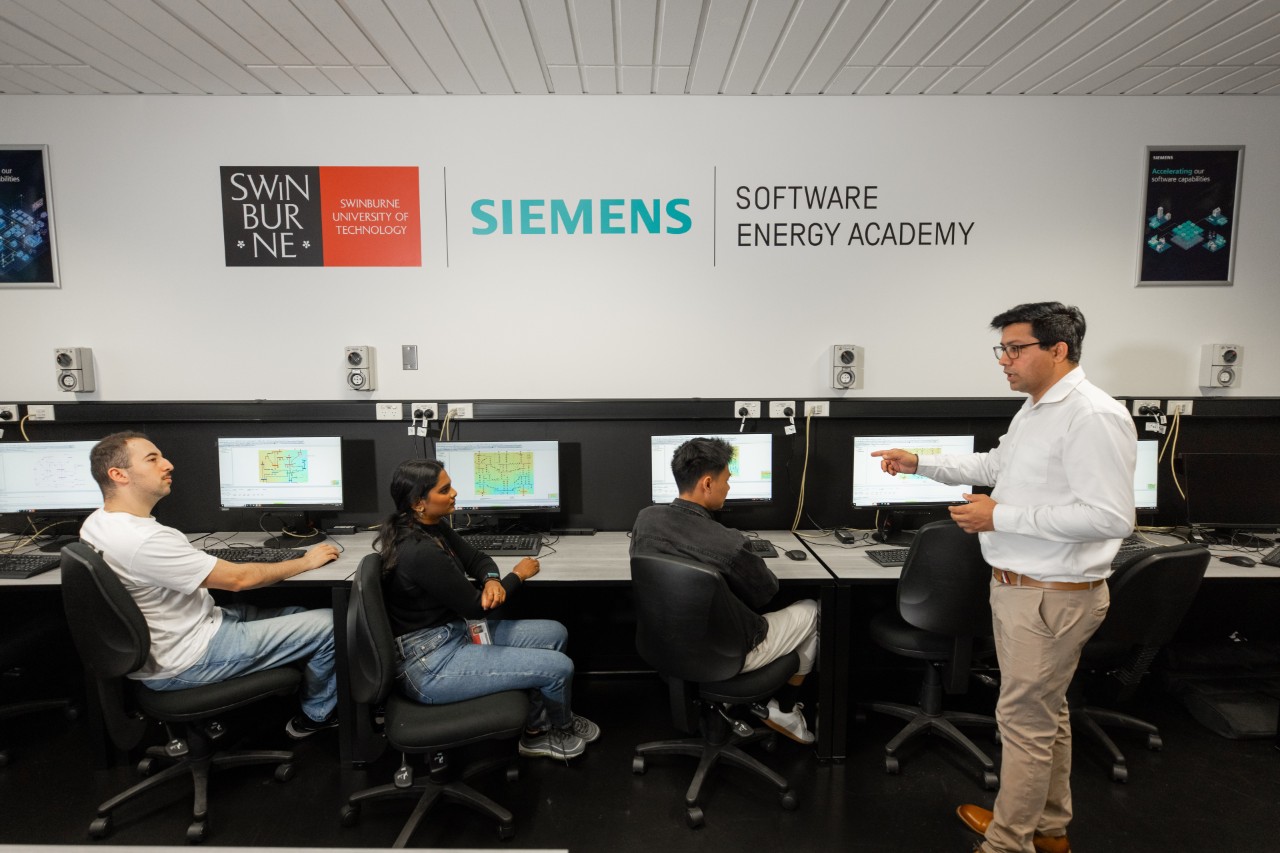 Students learning how to use industry-standard PSSE software to simulate electrical energy systems

Using the lab
With access to advanced industry tools including PSS®E and PSS SINCAL software, digital twin and microgrid management laboratory setups, the Siemens Swinburne Energy Transition Hub provides up-to date training for undergraduate students, PhD students and companies. The hub is also available for external hire.
Information for companies and researchers
Explore innovative avenues of research in the construction and engineering industries with Trimble’s state-of-the-art tools, or discover ways to enhance and streamline your current work output with Trimble’s digital construction management solutions.
Information for students and staff
Third year undergraduate students majoring in Electrical and Electronic Engineering and postgraduate Electrical and Mechanical Engineering students use the lab to develop industry-relevant skills. With access to software designed for real engineers, you’ll be fully equipped to put theory into practice.
-
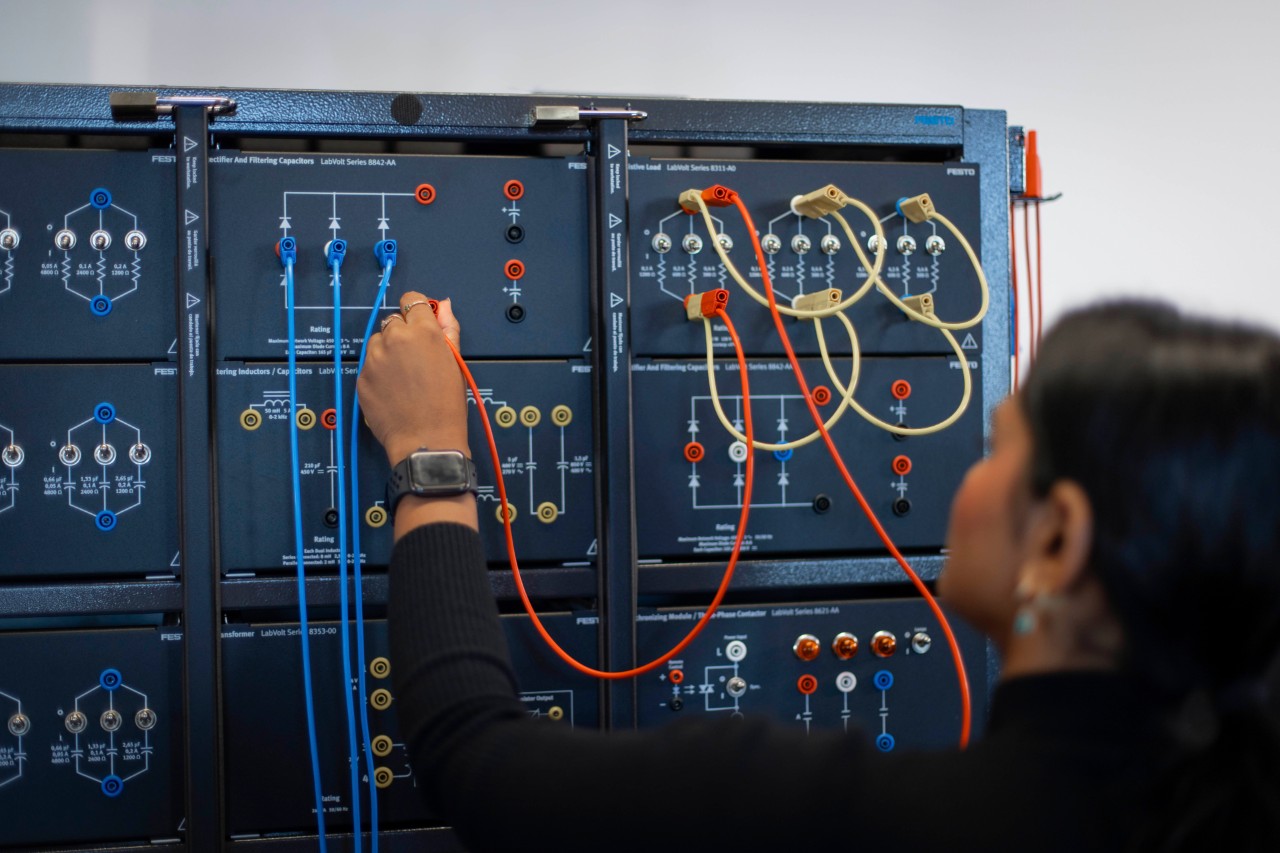 A student using Festo LabVolt hardware to explore and understand the operation of electrical circuits.
 -
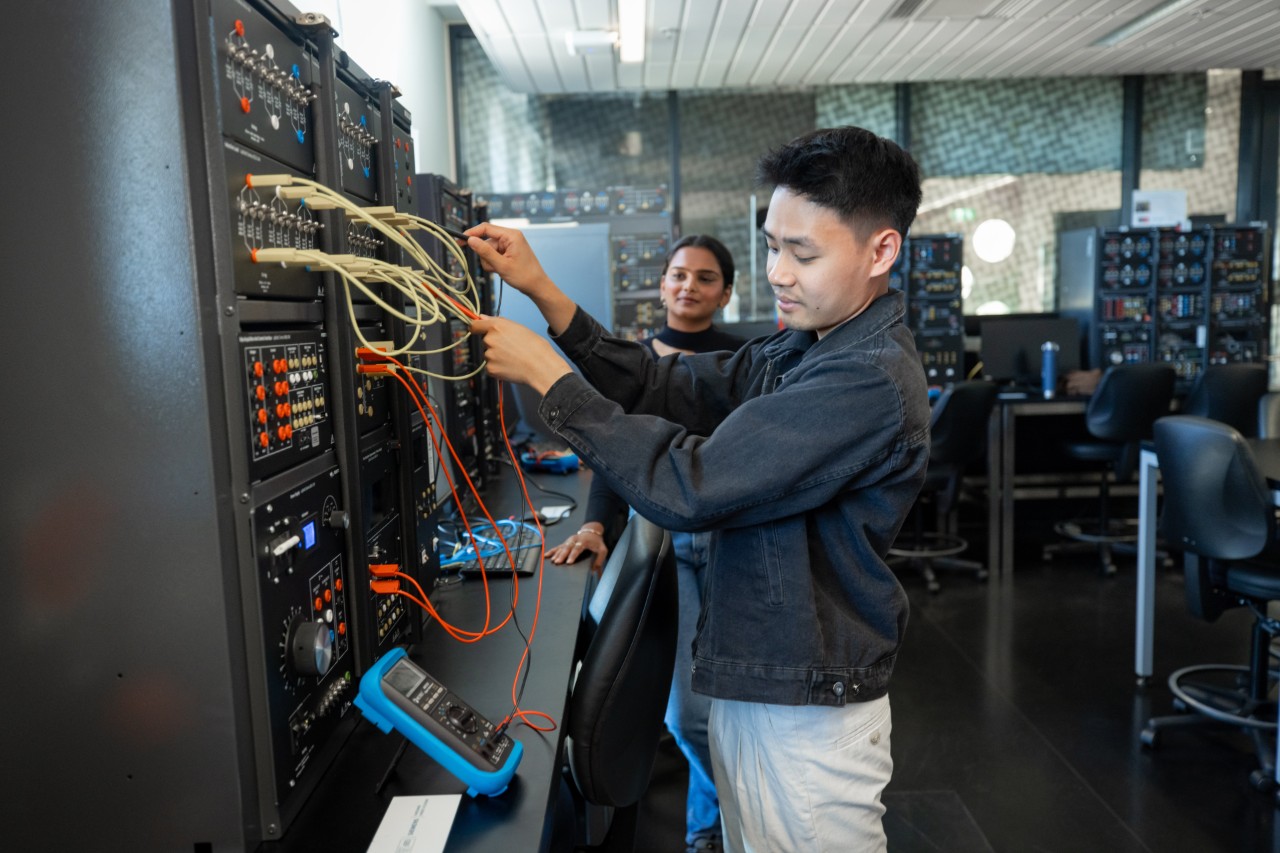 Students using Festo LabVolt: the cutting-edge electrical energy systems emulator designed to teach core electrical engineering concepts
 -
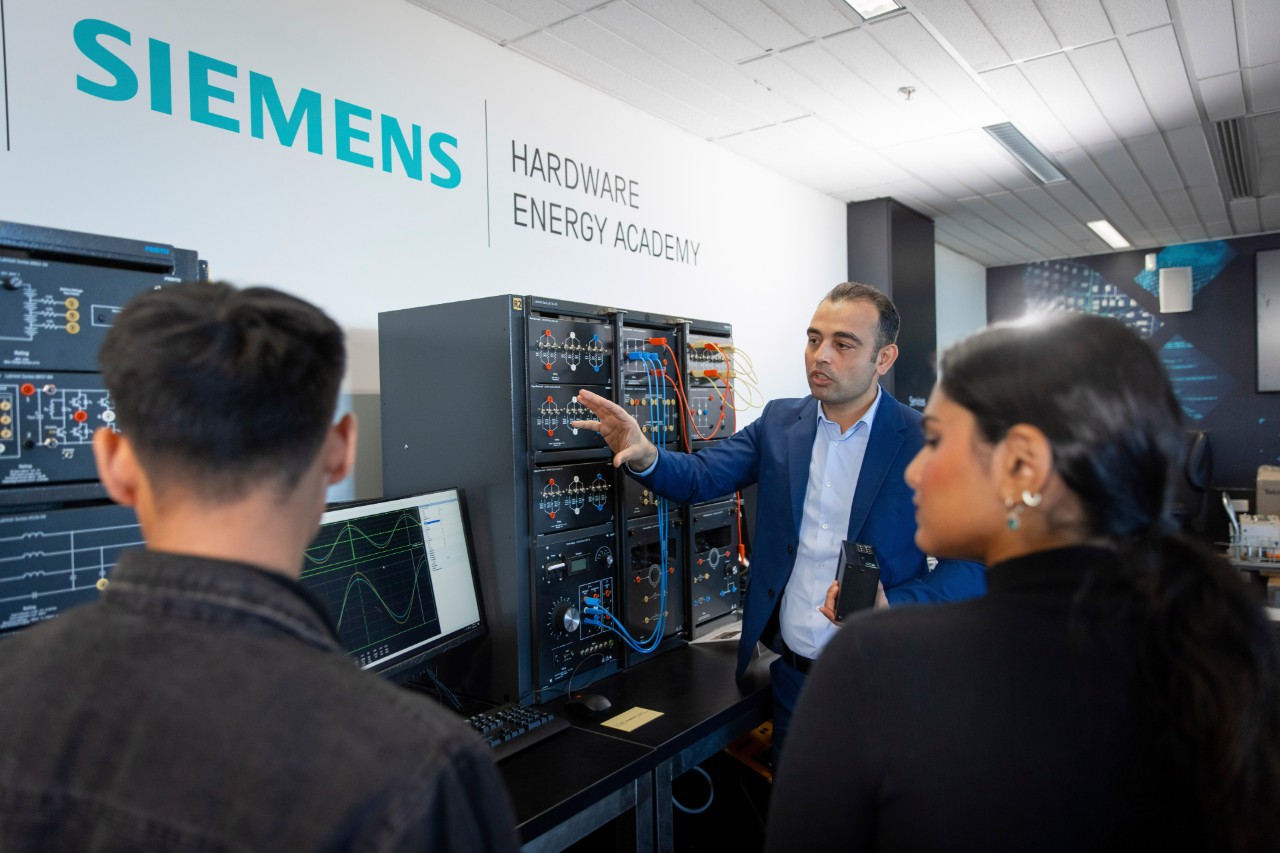 Hub Director Prof Mehdi Seyedmahmoudian teaching students about the Festo LabVolt electrical energy systems emulator


Related courses
-
Bachelor of Engineering (Honours), Major in Electrical and Electronic Engineering
-
Graduate Certificate of Engineering specialising Electrical Engineering
-
Graduate Certificate of Engineering specialising in Electronics and Telecommunications Engineering
-
Graduate Certificate of Engineering specialising in Mechanical Engineering
-
Master of Engineering Science Specialising in Electrical Engineering
-
Master of Engineering Science Specialising in Electronics and Telecommunications
-
Master of Engineering Science Specialising in Mechanical Engineering
-
Master of Engineering (Research)
-
Associate Degree of Engineering majoring in Electrical
Short courses
The Siemens Swinburne Energy Transition Hub, in conjuction with Swinburne Edge, also offers a series of short courses.
-
5 days
Industrial Training Course – PSS®E Module 1
-
5 days
Industrial Training Course – PSS®E Module 2
Partner with us
Want to make use of the lab’s state-of-the-art software, collaborate on sustainable energy projects, or work with Swinburne students? Get in touch with our team today.
Our partnerships
- AEMO
- Ambri Co.
- Bendigo
- AIRAH
- ARENA
- Brightcell Energy Pty Ltd.
- City of Melbourne
- CitiPower / PowerCor
- CSIRO
- DWELP
- EcoGen Technologies
- Edge Electrons
- Factory of the Future
- FESTO
- Gannawarra Shire Council
- Haemograph
- Iberdrola
- IGTS Pty Ltd.
- LabVolt
- Melbourne Water
- McLean Care
- Net Zero Stack
- PEARL
- PREDIQ Pty Ltd.
- Powerledger
- Sebstainable
- Siemens
- Surf Coast Shire
- Ventia
- Victoria State Government
- Victorian Hydrogen Hub
- Wyndham City
- Yarra Energy Foundation
- CADET-VR Lab, Deakin University
- Coventry University
- Delft University of Technology
- Monash University
- RMIT University
- University of Bedfordshire
- University of Malaya
- University of Melbourne
- Victoria University
Our latest news
- $5.2m green energy hub aims for real-world impact
- Are batteries the environmental Achilles heel of electric vehicles?
- Are electric vehicles really eco-friendly?
- Batteries are the environmental Achilles heel of electric vehicles – unless we repair, reuse and recycle them
- Climate sceptics on wrong side of thermodynamics law
Location and contact
ATC701, Hawthorn campus
Professor Mehdi Seyedmahmoudian:
mseyedmahmoudian@swinburne.edu.au