


Swinburne University of Technology community members are recognised for excellence in their fields, reflecting the depth and breadth of knowledge, experience and service.
Our international reputation as a leader in research and innovation continues to go from strength to strength, further elevating the cutting-edge technologies, partnerships and expertise for social impact and the benefit of our community.
We congratulate our staff and students on their success, and we are proud to provide an environment in which excellence can thrive.
September 2026
Swinburne astrophysics PhD graduate wins 2026 Bragg Gold Medal
7 September 2026

Dr Luisa Buzzo, recipient of the 2026 Bragg Gold Medal from the Australian Institute of Physics, on the summit of Mauna Kea with the Keck Observatory.
Swinburne University of Technology astrophysics PhD graduate Dr Luisa Buzzo has been awarded the 2026 Bragg Gold Medal by the Australian Institute of Physics (AIP).
The Bragg Gold Medal is awarded annually for the most outstanding PhD thesis in physics completed at an Australian university.
Dr Buzzo completed her PhD in Astrophysics at Swinburne's Centre for Astrophysics and Supercomputing in 2025. Her thesis, “The Origins of Ultra-Diffuse Galaxies”, used observations from the Keck Observatory to investigate how these unusually faint galaxies form and evolve.
“I'm truly honoured to have received these prizes for my thesis. It's work that really excites me and that I love to have done. I'm also so happy to help bring visibility to the fields of Astronomy and Astrophysics and this leaves me with the hope of little girls from across the globe that get to see this,” says Dr Buzzo.
The award represents national recognition of Dr Buzzo’s research and adds to her growing list of honours. She has also received the Astronomical Society Australia’s prize for the best PhD thesis in astronomy and the lain Wallace Prize for Swinburne’s best PhD thesis.
Her PhD supervisors, Professor Duncan Forbes and Distinguished Professor Jean Brodie, welcomed the national recognition, saying the well-deserved achievement highlights the quality and impact of astrophysics research being undertaken at Swinburne.
The 2026 AIP Awards will be presented at the AIP Congress in December.
Swinburne recognised for global education excellence at Governor of Victoria Export Awards
4 September 2026
Swinburne University of Technology has been named the winner of the International Education and Training category at the 2026 Governor of Victoria Export Awards, recognising the University's outstanding contribution to delivering Australian education to students across Asia and the Middle East.
The prestigious award celebrates Swinburne's success in expanding access to world-class Australian education through our campus in Malaysia, as well as Swinburne’s network of in-country delivery partners and online learning platforms that reach students around the globe.
Swinburne Vice-President of External Engagement Bronte Neyland said the award highlighted Swinburne’s commitment to ensuring that a world-class education is available to students across the globe.
“Wherever you are in the world, Swinburne is committed to creating tailored and innovative pathways for learners.”
“We’re proud to be recognised for making high-quality education more accessible internationally while equipping learners with the skills, experience and connections they need to succeed in a rapidly changing global economy."
By combining international reach with academic excellence, Swinburne continues to strengthen Victoria's reputation as a leading provider of education and training on the world stage.
Swinburne's transnational education model enables students to earn a recognised Australian qualification without leaving their home countries, creating opportunities for learners who may otherwise face barriers such as cost, distance or visa constraints.
The university delivers career-focused education across technology, engineering, business, the creative industries, health and science, with programs designed in partnership with industry to ensure graduates are job ready.
As a category winner, Swinburne University of Technology will go on to represent Victoria at the Australian Export Awards, showcasing the University's innovative approach to global education and its growing impact across international markets.
Swinburne students shine at Graduate of the Year awards
1 September 2026

Swinburne's SoDA students have been recognised among Victoria's top emerging designers at the Design Institute of Australia's Graduate of the Year Awards
Swinburne’s School of Design and Architecture (SoDA) students have been recognised among Victoria’s top emerging designers, taking home multiple honours at the Design Institute of Australia’s Graduate of the Year Awards. The awards support and celebrate exceptional Australian designers at the beginning of their careers across four categories; Place, Use, Interact and Convey.
Among the winners, Bachelor of Design (Interior Architecture) (Honours) student, Kate Harris claimed a state award in the Place category, which recognises excellence in the designs of spaces we occupy.
Giulia Cilotti Bueno, a Bachelor of Design (Industrial Design) (Honours) student was recognised in the Use category, which celebrates excellence in the designs of objects we use.
Bachelor of Design (Communication Design) (Honours) student Alyssa Payad took out the state award in the Convey category, which recognises designs that communicate ideas and information. Fellow Communication Design students Charles Horne and Bella Forbes also received commendations in the Convey category.
When speaking about the recognition of Swinburne’s design students, SoDA Associate Dean, Growth and Program Innovation, Dr Andrew Haig said “Our students are tackling real-world challenges through thoughtful, innovative design, and these awards celebrate their creativity and technical excellence.”
Dr Haig added that “To be acknowledged among Victoria's top emerging designers is an outstanding achievement. We look forward to seeing how they continue to shape the future of the design industry."
August 2026
Swinburne named finalist in national higher education awards
19 August 2026

Students during the 2025 federal election live broadcast with the central hub in a Swinburne lecture theatre
Swinburne has been recognised as a finalist in the Community Engagement category of the Australian Financial Review (AFR) 2026 Higher Education Awards for the 2025 federal election night live radio broadcast.
Hosted at Swinburne, the 2025 broadcast event brought together students from 14 universities across Australia to deliver live election coverage. The program aired on Vision Australia (VA) Radio, and was carried by partner stations across the country, as well as streamed online via The Junction and VA.
The initiative provided students with a rare, authentic live broadcast and newsroom experience. More than 70 student journalists contributed to the project, working across production, on-air presentation, reporting, analysis and digital publishing. Broadcasting from a central newsroom at Swinburne meant that presenters, producers, analysts and social media staff could all work collaboratively while giving audiences access to timely and accessible election coverage.
Swinburne Communications and Radio Lecturer Peter Marcato served as Co-Executive Producer.
“We had students from universities all over the country coming together to tell the story of the election night and demonstrate their considerable skills. It was a great live learning environment that provided real outcomes for students for their future careers.” Marcato says.
The award recognition highlights Swinburne’s commitment to industry-connected learning, cross-sector collaboration and community engagement, while showcasing the capability and leadership of its students and academic staff.
Professor Feng Wang honoured for leadership in sustainable aviation fuel development
13 August 2026

L-R: Gordon Chakaodza, Professor Andrew Ang, Professor Feng Wang, Professor Karen Hapgood and Professor Virginia Kilborn at the Australian Aviation Awards
Swinburne’s Professor Feng Wang has been named winner in the Engineering Professional of the Year category at the 2026 Australian Aviation Awards.
The Australian Aviation Awards celebrate the people and organisations shaping the nation’s aviation sector. The Engineering Professional of the Year category recognises outstanding technical contributions, industry participation and work that advances safety, innovation or sector development.
Professor Wang was nominated for her work on high energy density (HED) sustainable aviation fuels (SAF), an emerging area of research that focuses on reducing the environmental impact of aviation, while helping create a more resilient future for the sector.
Commenting on the award, Professor Wang said that the award was a recognition of her sustained efforts to advance theory-driven molecular design for sustainable fuels,” and that she hoped to “inspire Australia’s future energy research leadership.”
When discussing the impact of her work, Professor Wang explained that it’s more than environmental science - it is helping to build national security.”
Professor Wang's win was one of two Swinburne recognitions in this year's Australian Aviation Awards. Professor Andrew Ang was also nominated in the Engineering Professional of the Year category for his work on testing and evaluation services for aviation companies. The dual recognition highlights the important and innovative work Swinburne is doing to future-proof the aviation sector.
July 2026
Dr Anais Möller recognised with prestigious ASA prize
8 July 2026

Dr Anais Moller recognised with the Astronomical Society of Australia’s Anne Green Prize for outstanding contributions to astronomy research.
Swinburne’s Dr Anais Möller has received the Astronomical Society of Australia’s (ASA) Anne Green Prize for a Significant Advance or Accomplishment by a mid-career scientist.
Dr Möller’s award-winning research uses AI to harness the power of the latest telescopes and facilities in the world, enabling scientific discoveries.
Dr Möller is an internationally recognised expert in cosmology and time-domain astronomy. Her leadership of the Fink Broker – an astronomical alert broker that acts as an intermediary between survey telescopes and the scientific community – is helping researchers everywhere act on discoveries as they happen.
“Receiving this prize means a great deal; it's fuel to keep pushing this work forward. It also represents something bigger: the collaborative effort that Fink is and being a driving force in global cutting-edge science. Fink is a community of more than 130 researchers across 14 countries working together, so this recognises all of us, not just my own work,” said Dr Möller.
The ASA prizes are supported by the Foundation for the Advancement of Astronomy (FAA) and supports the development and promotion of astronomy in Australia.
June 2026
Swinburne celebrates first Advance HE fellows
24 June 2026

Swinburne staff receive their Advance HE fellowship.
Swinburne is celebrating its first cohort of fellows and senior fellows of the Advance HE Fellowship Scheme. Thirty-six academic and professional staff were recently celebrated at a presentation across both our Hawthorn and Sarawak campuses.
Advance HE, originating in the UK, is an international organisation that works with universities to improve education quality, leadership, and student outcomes.
The four levels of fellowship (Associate Fellow, Fellow, Senior Fellow and Principal Fellow) acknowledge excellence in teaching and provide educators with a portable qualification that can be transferred between institutions.
“This is an incredible milestone and reflects a considerable level of achievement of our talented and dedicated staff,” says Professor Llew Mann, Pro Vice-Chancellor, Educational Innovation.
Swinburne’s Education Innovation Exchange (EIX) supports academic and professional staff interested in attaining a fellowship through its EIX Advance HE Support Program, providing workshops, mentorship and application reviews.
“Swinburne is continuing to develop our partnership with Advance HE and has more than 100 academics and professional staff working towards fellowship status,” says Professor Mann.
Swinburne astronomers named in Australian Space Awards
22 June 2026

Dr Rebecca Allen and Professor Virginia Kilborn have been named in the 2026 Australian Space Awards.
Two Swinburne astronomers have won 2026 Australian Space Awards, recognising their contributions to driving Australia’s space economy.
Professor Virginia Kilborn, Swinburne’s Chief Scientist, was awarded Scientist of the Year and Dr Rebecca Allen, co-director of the Space Technology and Industry Institute, was awarded Mentor of the Year.
The awards recognise individuals and organisations who are leading, innovating and making real-world impact across all areas of Australia’s space sector.
As Swinburne’s Chief Scientist (and the first chief scientist at an Australian university), Professor Kilborn provides leadership and expert scientific knowledge both within the university and outside it, driving scientific relationships and policy with government, industry and schools.
Her Scientist of the Year award recognises her leadership in advancing science, building partnerships and championing the role of research.
Dr Allen’s Mentor of the Year award recognises her passion and ability for making science accessible to everyone and her work supporting students, early-career researchers and industry partners to thrive in the space sector.
Dr Allen leads initiatives that give students hands-on experience in space, including opportunities to design and send experiments into orbit.
May 2026
Professor Alan Duffy named as a Fellow of The Royal Society of Victoria
22 May 2026

Professor Alan Duffy has been named as a Fellow of the Royal Society of Victoria, for his contributions to astrophysics, scientific entrepreneurship and public engagement with science
Swinburne’s Pro Vice-Chancellor, Flagship Initiatives, Professor Alan Duffy has been elected as a Fellow of the Royal Society of Victoria.
Professor Duffy was recognised for distinguished contributions to astrophysics, scientific entrepreneurship and public engagement with science.
“It is an honour to be elected as a Fellow of the Royal Society of Victoria,” says Professor Duffy.
“This recognition reflects a shared commitment to discovery, collaboration across academia and industry, and making science more accessible to all. I look forward to continuing this important work in the future,”
The Royal Society of Victoria's Fellowships represent the society's highest honour. They recognise leaders across research, industry and government who have made outstanding contributions to science and technology in Victoria and internationally.
Siemens Swinburne Energy Transition Hub recognised for impact in energy research and training
15 May 2026

The Siemens Swinburne Energy Transition Hub has been awarded the Community Academic Impact Award PSS®E Community Recognition Awards. The ceremony was held at the Siemens Grid Software Summit in Amsterdam.
PSS®E is a globally recognised industry-standard platform used for modelling, analysing and planning modern power systems. Over the past 50 years, it has played a critical role in supporting the design, operation and resilience of electricity networks worldwide, underpinning the transition towards more complex, data-driven and renewable-integrated energy systems.
This award recognises worldwide contributions towards strengthening academic foundations and integrating industry-standard tools, such as PSS®E into research, education and industry training. It also reflects ongoing efforts in upskilling and reskilling students and the broader energy workforce to address real-world challenges in an evolving power system landscape.
“This recognition demonstrates how strong industry-academia collaboration can create global impact during one of the most transformative and challenging periods for the energy sector,” says Director of the Siemens Swinburne Energy Transition Hub, Professor Mehdi Seyedmahmoudian.
“It is a proud moment for our team of researchers, engineers and industry partners, and for the growing collaboration between academia and industry in shaping the future energy system.”
Celebrating the inaugural Northern Territory Programs Trade Talent Awards
8 May 2026
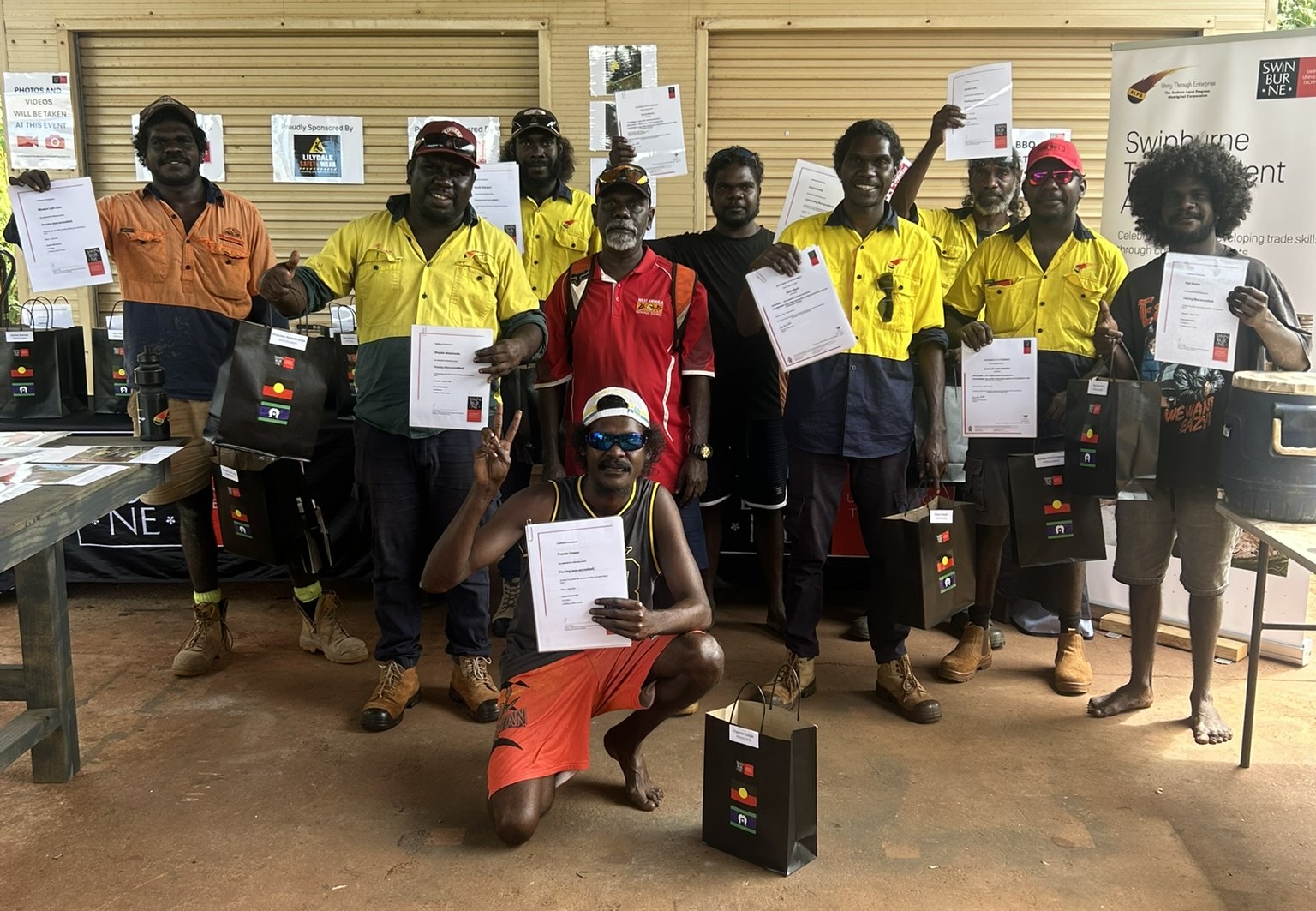
The Minjilang mens' group, who participated in accredited and non-accredited trade-based short courses.
Two participants have been recognised in Swinburne’s first Northern Territory Programs Trades Talent Awards for their contributions and progress.
Dallas Mayali from Minjilang completed an accredited concreting skill set, as well as non-accredited skill sets in landscaping and fencing.
Robert Nawirridj from Gunbalanya completed two accredited skill sets in carpentry and small motor maintenance, and a non-accredited skill set in fencing.
The awards recognise students who display teamwork in the workplace, consistent attendance and participation, initiative, innovation, workplace health and safety, skills progression, leadership and managing competency challenges effectively.
Swinburne Northern Australia Programs Teacher Jon Wallace said both Robert and Dallas were dedicated learners throughout the program.
“Both Robert and Dallas were keen to learn. You could see the satisfaction when they completed a project or solved a problem,” he said.
“The award gave the recipients a sense of achievement and gives our participants something to aim for in the future.”
Dallas and Robert were presented with prizes and timber trophies, designed by Advanced Diploma of Graphic Design students Jade Bevilacqua and River Evans. The trophies were made by Tall Sticks Furniture Coburg.
Other prize sponsors included Swinburne’s Moondani Toombadool Centre, Milwaukee tools, Lilydale Safety Wear and Access Workwear and Safety Ringwood.
Swinburne partners with the Arnhem Land Progress Association’s Remote Australia Employment Service (ALPA RAES) to deliver its Northern Australia Programs in remote communities.
Swinburne’s Northern Australia Programs Manager Rachael Woods said the awards reflect individual training accomplishments and help improve future employment opportunities.
“It’s a unique opportunity to recognise and award the hard work demonstrated by our students through our partnership with ALPA, and to reinforce the value of training and education in their communities,” she said.
The programs ran in six remote communities in 2025, delivering a range of trade-based accredited and non-accredited short courses to 175 adult Indigenous students.
The students learn and gain experience through community projects like concreting paths, landscaping, building furniture and maintaining small machinery.
ALPA RAES Community Hub Manager (Gunbalanya) Rebecca Smith said the program's courses are practical, achievable and immediately relevant in remote areas.
“Having local people complete the work also builds pride, ownership and longer‑term care of shared areas,” she said.
She explained the awards are positive examples and demonstrate possibilities to other community members.
“These programs build confidence, work readiness and real skills, while creating pathways into further training or employment without overwhelming participants."
April 2026
Swinburne interior architecture graduate wins Madeline Lester Award
14 April 2026

(L-R) Dr Phuong Quoc Dinh, Lauren Roberts and Dr Simon Lloyd at the Hall of Fame Celebration at the National Gallery of Victoria, where Lauren was presented with the Madeline Lester Award
Swinburne graduate, Lauren Roberts has been named as the recipient of the 2025 Australian Graduate of the Year, Madeline Lester Award by Design Institute Australia (DIA).
The Madeline Lester Award recognises an early career designer of exceptional promise whose work, thinking and practice signal a meaningful contribution to the future of the industry.
"I feel so fortunate to have won this award and it still feels very surreal. The recognition has been overwhelming and has given me more confidence to pursue my career goals," Lauren says.
Lauren’s award-winning project, the Eden Community Centre, was her final year capstone project focused on reducing loneliness among women by repurposing a former church into a warm, socially connected environment. The jury commended her strategic clarity and ability to address complex housing and social issues through sustainable, community-focused spatial design.
"I credit so much of this achievement to Swinburne and the guidance of my tutors. I could never have imagined how far I would come in the four years of my degree. The course truly exceeded my expectations by setting me up for a career in the design industry and making the transition into the workforce so much easier," Lauren says.
March 2026
Swinburne researchers honoured with two international sustainable metallurgy awards
19 March 2026

A group of Swinburne researchers have been honoured with two prestigious international awards at The Minerals, Metals, and Materials Society (TMS) 2026 conference in San Diego, USA.
The awards rewarded their collective efforts in sustainable metallurgy, including extracting and refining metals.
The EPD Science Award
This award was presented to Swinburne researchers Dr Deddy Nababan (now at the Argonne National Laboratory, USA), Professor Akbar Rhamdhani, Associate Professor Yvonne Durandet, and Dr Reiza Mukhlis. Professor Leon Prentice (SDI), William Rickard (Curtin University), and Mark Pownceby (CSIRO) also contributed.
The award recognises papers that contribute to scientific understanding in extracting and processing metallurgy, presented to the team for their paper Recycling of LiCoO2 Battery Cathode Material Through Aluminothermic Reduction Using Aluminium Waste Chips, published in Metallurgical and Materials Transactions B.
Led by Dr Deddy Nababan as part of his PhD research at Swinburne, they found that high temperatures and aluminium waste chips could be used to recycle battery cathodes, using a low energy and zero carbon process.
The EPD/LMD Journal of Sustainable Metallurgy Best Paper Award
This award was presented to Swinburne researchers Bima Satritama, Professor Akbar Rhamdhani, Associate Professor Andrew Ang, Professor Geoffrey Brooks, Dian Fellicia, Dr Reiza Mukhlis, and Professor Suresh Palanisamy. Other contributors include Christopher Cooper, Associate Professor John Pye, and Alireza Rahbari (Australia National University); and Mark Pownceby (CSIRO).
This award recognises their paper Hydrogen Plasma for Low-Carbon Extractive Metallurgy: Oxidises Reduction, Metals Refining, and Wastes Processing, published in the Journal of Sustainable Metallurgy.
Led by Bima Satritama, a current PhD student at Swinburne, this research used SwinH2+, a new hydrogen plasma reduction reactor, to make metals from stable minerals. This process has zero emissions and leaves water as the only byproduct.
Swinburne Professor Akbar Rhamdhani, who supervised Dr Deddy Nababan’s PhD research and is currently supervising Bima Satritama’s research, said the awards are a great honour and recognition of the teams’ innovative research.
“Our research focuses on fundamentally rethinking how metals are produced and recycled, particularly by replacing carbon-based reactions with alternative pathways,” he said.
“Receiving these awards from TMS is a great recognition of our team’s work on developing low-emission metallurgical processes.”
Swinburne plumbing students tap into talent at World Plumbing Day Apprentice Skills contest
19 March 2026

Lachlan Radford (right) at the World Plumbing Day Apprentice Skills Contest, pictured with plumbing teacher Stephen Neasey.
Swinburne plumbing student Lachlan Radford has scored second place in the Plumbing Industry Climate Action Centre (PICAC) 2026 World Plumbing Day Apprentice Skills Contest, held on March 13.
Celebrated on 11 March, World Plumbing Day is recognised internationally to raise awareness of plumbers and plumbing in water management and protecting public health.
The PICAC competition is a test of plumbing apprentice skills, rewarding quality work such as no misaligned pipes, no excess glues or sealant, and accurate measurements.
Lachlan said the competition gave him the opportunity to demonstrate the skills developed during his studies.
“I’m there for a reason: I’ve got the skills I need and I really liked showing how precise I could be,” he said.
“It was a really great feeling to win and show my best work.”
James O’Connor, senior plumbing educator at Swinburne, explained competing in competitions such as the World Plumbing Day Apprentice Skills Contest helped to sets apprentices apart.
“Being involved can help apprentices develop further relationships in the plumbing community with mentors,” he said.
“These competitions also allow them to test their skills and knowledge against their peers. The leadup to the competition makes them become more accountable and well-rounded plumbers, with proven job-ready skills.”
One of the top three apprentices at the PICAC competition is selected to compete in the United Association of Plumbing Journeymen and Apprentices of the Plumbing and Pipe Fitting Industry of the United States and Canada.
Louisa Ellum awarded for vocational education leadership excellence
19 March 2026

Louisa Ellum (right) with her award, pictured with Shae McGregor from TAFEGippsland.
Louisa Ellum, Director of VET Pathways and Engagement, has been awarded the Leadership Excellence in VET Award at the 2026 Australia VET Conference Awards, held on 12 March.
This award honours registered training organisation (RTO) managers and leaders that make exceptional contributions to training quality, compliance and organisational culture.
Louisa said she is proud of this achievement and her work in a sector that highlights skill development for social and economic impact.
“My leadership comes from being an enabler and champion of my team, my colleagues, and our industry and community partners – we all create change and opportunities from the ground up,” she said.
Swinburne Pro Vice-Chancellor and Chief Executive Vocational Education Madelyn Bolch said Louisa’s leadership is defined by clarity, integrity and purpose – fostering a culture of support and pride in vocational education.
“This achievement reflects Louisa’s expertise and dedication, as well as her positive and lasting impact on learners, staff, and the broader Swinburne community,” she said.
The Australian VET Conference Awards is an annual event that brings together RTOs, sector leaders and decision-makers to shape the future of Australia's vocational education and training system.
Professor Geoffrey Brooks honoured with 2026 AIST Distinguished Member and Fellow Award
12 March 2026

Swinburne Professor Geoffrey Brooks has been awarded the 2026 AIST Distinguished Member and Fellow Award by the Association for Iron & Steel Technology (AIST). Professor Brooks was recognised for his outstanding contributions to the advancement of steelmaking technology and his dedicated service to the global steel industry. The award is one of the highest distinctions presented by the AIST.
The AIST Distinguished Member and Fellow Award recognises exceptional technical contributions to the iron and steel industry and outstanding service to the AIST. With only 1% of members eligible, it is one of the AIST’s most prestigious honours.
“I am really humbled by this award. To be acknowledged by the peak global industry body in my field in this way is really something. I am so grateful to my many excellent students and collaborators over the last 30 years. I also need to say that the support I have received in the last twenty years at Swinburne have been central to my success. Thank you,” says Professor Brooks.
Professor Brooks is a longstanding member of Swinburne’s academic community, where he serves as a leading researcher in advanced steelmaking science. His work has significantly shaped Swinburne’s research capability in advanced manufacturing and has strengthened global partnerships across the steel industry.
February 2026
Dr Sarah Barradell successful in the Australian Awards for University Teaching (AAUT)
26 February 2026

Dr Sarah Barradell, Senior Lecturer, Physiotherapy in the School of Health Sciences
Congratulations to Swinburne’s Dr Sarah Barradell, Senior Lecturer, Physiotherapy, who has been recognised in the Australian Awards for University Teaching (AAUT).
Dr Barradell received an AAUT Citation for excellence in research-led curriculum design, teaching and evaluation. Her work has enhanced physiotherapy students’ readiness for practice through scholarly, evidence-informed educational innovation.
To understand their future roles and become self-aware practitioners, contemporary learners in physiotherapy require capabilities beyond traditionally valued clinical techniques. Dr Barradell’s unique research-led approach has allowed her to critically examine not just what students learn but how they learn.
Dr Barradell has challenged assumptions about becoming a physiotherapist, designed curriculum that enhances learning and prepared learners for professional practice.
School of Health Sciences Executive Dean Distinguished Professor James Ogloff AM said that by placing professional practice at the heart of the course, Dr Barradell’s work has grounded the physiotherapy curriculum at Swinburne in authentic, relevant and meaningful experiences that are responsive to the evolving demands of healthcare.
“The unique demands of the Master of Physiotherapy program require a targeted and thoughtful approach to curriculum design,” Distinguished Professor Ogloff said.
“Dr Barradell’s contributions benefit not only individual graduates but also the broader physiotherapy profession. I am confident that her work will continue to shape the future of physiotherapy education in Australia.”
Moondani Toombadool Centre recognised at 2026 CareerTrackers National Gala Awards
25 February 2026

Swinburne University of Technology’s Moondani Toombadool Centre (MTC) recently received the University Excellence Award at the 2026 CareerTrackers National Gala Awards Night.
The CareerTrackers National Gala Awards celebrate excellence across business, education and community. The University Excellence Award highlights institutions that demonstrate sustained impact and a deep commitment to improving professional outcomes for First Nations students.
“MTC was proud to be recognised as an organisation whose leadership, commitment and partnership with CareerTrackers is helping shape a stronger future for First Nations professionals,” said Joel Boojers, Swinburne Manager, Indigenous Student Services.
“A big shout out as well to Swinburne Indigenous students who are undergoing professional internships through the CareerTrackers program.”
At Swinburne, the Moondani Toombadool Centre leads Indigenous student engagement, support and success initiatives. Through its partnership with CareerTrackers, four Swinburne Indigenous students are undertaking professional internships aligned with their career goals, at LinkedIn, NAB, Hassell and Telstra.
The award reinforces Swinburne’s commitment to supporting First Nations students to thrive during their studies and beyond.
Swinburne PhD student selected for inaugural NDRP Disability Leadership Program
25 February 2026

Mark Hanson, a Swinburne PhD candidate and wheelchair user investigating wheelchair accessibility within air travel, has been selected out of 14 recipients in the inaugural National Disability Research Partnership (NDRP) Disability Research Leadership Program as Australia’s first national cohort of emerging disability research leaders.
The program is Australia’s first dedicated initiative supporting emerging researchers with disability, offering each participant $30,000 in flexible support over 12 months. The program aims to address the systemic barriers disabled researchers face in progressing their education and research careers.
Mark’s doctoral research examines the challenges faced by wheelchair users when navigating air travel, contributing critical evidence to improve accessibility standards and transport design.
“It is a great privilege to be accepted into the first national cohort of emerging disability research leaders. I am very excited and looking forward to participating in the program, as well as connecting with the other recipients over the next 12 months,” Mark says.
“This will allow me to have extra funding to support my research and professional development activities. Wheelchair accessibility within air travel is a prominent topic for people living with a disability, and I am hoping that the outcomes of my research will contribute and shape the evidence base that informs policy and practice.”
At Swinburne, Mark is completing his PhD within MedTechVic, where he works as a clinical advisor contributing to user-centred design and assistive technology innovation. His research has informed industry and community discussions on accessible travel, demonstrating the realworld impact of his contributions.
Swinburne researchers focused on green steelmaking awarded 2026 AIST Environmental Technology Best Paper
24 February 2026

Swinburne PhD student, Tiara Triana and Swinburne supervisors Professor Geoffrey Brooks, Professor Akbar Rhamdhani and Professor Mark Pownceby from CSIRO, have received the 2026 AIST Environmental Technology Best Paper Award.
The team was recognised at the AISTech Conference in Pittsburgh, USA, for their paper, ‘Ammonia Direct Reduction of Iron Oxides – Kinetics Aspects and Process Development’.
Tiara’s research investigates the use of ammonia as a chemical that helps convert iron ore into iron, presenting an innovative approach to low emission pathways for ironmaking. The paper was selected by the world’s largest steel conference, highlighting the growing global interest in decarbonisation technologies within the steel industry.
“I’m truly honoured to receive this award. It recognises the collective effort behind advancing green steelmaking research at Swinburne and the invaluable support of my supervisors,” says Tiara.
At Swinburne, Tiara is completing her PhD in advanced ironmaking processes with a focus on sustainable industrial decarbonisation. She has also been recognised for her contribution to an industry research collaboration project investigating green steel technologies, underscoring the real-world impact of her work.
This achievement further strengthens her research trajectory as she continues to explore innovative pathways for cleaner, more sustainable steelmaking.
Jessica wins Design Matters National Outstanding Student of the Year Prize
20 February 2026

Jessica Cetinich has won the Outstanding Student of the Year Prize by Design Matters National, presented to outstanding building design students from across Australia. (image supplied)
Swinburne graduate Jessica Cetinich has been awarded the Outstanding Student of the Year Prize by Design Matters National.
She studied an Advanced Diploma of Building Design (Architectural) in 2025 and has been commended for combining creativity with dedication in her studies and professional practice.
“Receiving this award has made me feel incredibly proud of how far I’ve come and has given me the confidence to keep pushing myself professionally,” she said.
The prize recognises exceptional graduating building design students who demonstrate strong design thinking and creativity, advanced digital skills, commitment to sustainability and human-centred design, and evident growth throughout their studies.
Design Matters National is Australia’s peak body for building designers, energy assessors, and built environment professionals in Australia. The award recognises students from across the country and bridges education and professional practice.
“My time at Swinburne has allowed me to explore and refine my creative process, while also challenging my critical thinking and time management skills under guided, industry-focused projects,” Jessica said.
Translating science into music

(from left) Professor Richard Manasseh and Elissa Goodrich and their ensemble at a production of their Bubbles and Waves work
Sound artist and Swinburne Visiting Fellow, Elissa Goodrich has been announced as the recipient of the Australian Network for Art and Technology (ANAT) Synapse 2026 Residency Program. As part of her residency, Elissa will be working with Swinburne’s Professor Richard Manasseh on communicating Swinburne’s research in fluid mechanics.
The ANAT Synapse Residency program brings artists and researchers together to create new knowledge and ideas that drive impact beyond their fields.
“This residency is a wonderful recognition of the benefits when researchers work with artists. Elissa has a track record of transforming science and engineering research into music, making complex research accessible by one of our most basic senses – hearing,” says Professor Manasseh.
Elissa is a globally recognised expert in the translation of science into music. She has produced 12 international sound-art productions from her work with Professor Manasseh and his team.
“Our project explores the paths of bubbles under ocean waves and how they make and deflect underwater sounds. When bubbles are formed, they emit sounds we hear, creating the natural ‘music’ of running water and of breaking ocean waves,” says Elissa.
“Measuring bubble sounds provides context on some hard-to-control processes. For example, breaking waves generate vast clouds of bubbles that dissolve a quarter to a third of our carbon emissions. Therefore, measuring bubble sounds may enable measurement of this control on our climate,” Professor Manasseh adds.
“Further, understanding how bubbles make music also allows us to design bubbles to block noise. For instance, engineers create curtains of bubbles to protect marine mammals from pile-driving shocks during the construction of offshore wind turbines.”
The 2026 ANAT Synapse Residency Program is supported by the Australian Network for Art and Technology (ANAT) and Swinburne University of Technology.
More achievements
Keep on exploring
-
Rankings and ratings
Our standing in prestigious world academic rankings reflects our commitment to high-quality teaching, research and graduate outcomes.
-

Achievements and success stories
We don’t just talk the talk — we walk the walk. Read about some of our key partnerships, programs and recent success stories.
-
Research achievements and recognition
Swinburne’s reputation as a leader in research and innovation is growing year-on-year.


