

New measurement brings us closer to understanding the Universe’s rate of expansion

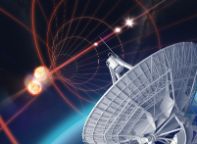
An artists conception of the GW170817 afterglow being observed by an antenna of the Very Large Array. The jet of material launched away from the merging neutron stars causes a radio glow as it interacts with the surrounding gas, which moves with time across the sky. Image Credit: Carl Knox, OzGrav, Swinburne University of Technology.
In summary
- The fiery aftermath of an immense cosmic collision has made a new measurement of the speed at which the Universe is expanding
- Swinburne University of Technology and CSIRO have combined telescope and gravitational wave data in an attempt to unlock the true value of the Universe’s expansion
- Existing measurements of the Hubble Constant have split cosmologists for more than a decade
Researchers closely observing the fiery aftermath of an immense cosmic collision have made a new measurement of the speed at which the Universe is expanding.
The international team led by researchers at the Swinburne University of Technology and CSIRO, Australia’s national science agency, combined telescope and gravitational wave data in an attempt to unlock the true value of the Universe’s expansion, called the Hubble Constant.
Knowing how fast the Universe is expanding is extremely important, as it helps scientists to determine how large or far away objects are, the role of dark matter in the evolution of the Universe, as well as the Universe’s origin and ultimate fate.
Two existing measurements of the Hubble Constant have split cosmologists for more than a decade.
Lead researcher, CSIRO’s Dr Kelly Gourdji, said the two independent measurements are described as the ‘Hubble tension’.
“One method uses data from the very early Universe -the cosmic microwave background radiation - to make the measurement, while the other uses measurements from relatively nearby supernovae, making it data from the late Universe,” Dr Gourdji said.
These precise measurements disagree with one another: either one measurement is wrong, or our understanding of the physics that govern the Universe is wrong, leaving the true nature of the Hubble Constant shrouded in mystery.
“Our independent measurement using gravitational waves is a late Universe method, but the result is more consistent with the early Universe value,” Dr Gourdji said.
The dramatic collision of two neutron stars, which was visible to telescopes and caused a gravitational wave to be detected on Earth, provided an opportunity for the team to take this new measurement.
After black holes, neutron stars are the densest objects in the Universe with a huge amount of mass in a very small area. This density creates an intense gravitational field, more than 100 billion times stronger than the gravitational field on Earth.
The collision between these neutron stars was so powerful that it sent ripples through space and time – gravitational waves – whilst also sending jets of energetic particles into space.
Professor Adam Deller of the Swinburne University of Technology, who led the radio observations used in the research, said the jets caused by the collision were essential to making the measurement.
“These jets are launched for only a couple of seconds, but as they slam into the surrounding gas, they glow for months afterwards. We analysed almost a year of observations from the Hubble Space Telescope and two different arrays of radio telescopes spread across the USA and Europe,” Professor Deller said.
By combining all the data, the team revealed a new value for the Hubble Constant which, while not as precise as the more established measurements that underpin the Hubble tension, is more accurate than previous attempts made using gravitational waves. This is the strongest indication yet that gravitational waves could settle the debate.
Professor Deller said that the finding was significant.
“Some astronomers had proposed ways in which both measurements could be correct if our understanding of cosmology was changed - but our measurement argues quite strongly against that solution,” explained Professor Deller.
Dr Gourdji said more observations would be needed to confirm the finding.
“This would suggest that there is not something wrong with our understanding of cosmology, though we’ll need to examine more neutron star mergers like this one to be sure. For now, this result adds another data-point for cosmologists to consider in the lively Hubble tension debate,” said Dr Gourdji.
-
Media Enquiries
Related articles
-
- Astronomy
- Science
- University
Swinburne JWST collaboration to receive prestigious 2027 Berkeley Prize from American Astronomical Society
Swinburne leads the international team who have been awarded the American Astronomical Society’s 2027 Lancelot M. Berkeley Prize for the UNCOVER project
Friday 18 September 2026 -
- Astronomy
Rare ultra-magnetic star the key to solving a quantum cold case
A Swinburne astronomer may have just confirmed one of the quirkiest aspects of quantum mechanics: that seemingly empty space can alter the behaviour of light.
Thursday 06 August 2026 -

- Astronomy
- Education
- Business
- Science
Planting the seeds for future space scientists
A Swinburne spinout LaunchLabz, is inspiring the next generation of space scientists with their Mission Kits
Monday 17 August 2026 -
- Astronomy
New measurement brings us closer to understanding the Universe’s rate of expansion
Researchers have used gravitational waves from a neutron star collision to make a new measurement of the Universe’s expansion rate, offering new insight into the long-standing Hubble tension.
Tuesday 30 June 2026 -
- University
Swinburne recognises Australian space innovator with Honorary Doctorate
Swinburne University of Technology has recognised Katherine Bennell-Pegg, a trailblazer in space engineering and exploration, with an Honorary Doctorate of the University.
Friday 08 May 2026


