

Swinburne welcomes calls for reform to Australia’s research ecosystem

Swinburne Deputy Vice-Chancellor Research, Professor Karen Hapgood, says the report is a once-in-a-generation opportunity to build Australia’s future.
In summary
- Swinburne welcomes the Ambitious Australia report and backs the call for urgent action to build capability and new industries
- Swinburne Deputy Vice-Chancellor Research, Professor Karen Hapgood, says the report is a once-in-a-generation opportunity to build Australia’s future
- The report advocates for sustained investment in Australia's RD&I capabilities
Swinburne has welcomed the Ambitious Australia report released today and backs the call for urgent action to build capability and new industries.
The final report, released by Strategic Examination of Research and Development, focuses on how Australia can leverage research investment and scientific strengths to address national priorities.
Swinburne Deputy Vice-Chancellor Research, Professor Karen Hapgood, says the report is a once-in-a-generation opportunity to build Australia’s future.
“We support this report, which brings a holistic and strategic approach to Australia's RD&I ecosystem whilst also recognising the importance of diversity in RD&I activities, including First Nations people and women,” Professor Hapgood says.
The report advocates for sustained investment in Australia's RD&I capabilities, and for Australia's government to utilise Australian research, ‘by partnering with universities, supporting industry PhDs and sourcing from Australian RD&I active firms’.
“The report closely aligns with Swinburne’s approach, which we first implemented in 2022, and identifies six priority research areas within our own research and innovation ecosystem,” Professor Hapgood adds.
“These areas will have maximum impact across fundamental, applied and commercial research, and we’re thrilled to see the same targeted approach reflected in this report.”
Among other industries, the report focuses on new ways to use AI, quantum and critical technologies to drive better outcomes for Australians, and how governments, business, workers, industry, universities, researchers and scientists can work together to lift productivity and boost Australia’s economic resilience.
Industry engagement – a cornerstone of Swinburne’s DNA as a multi-sector university – also forms a key theme in the findings.
Professor Hapgood said the report identifies world-class foundational research as essential.
“Translation of this research, through skills development and capacity building is also crucial,” she said.
“We’re pleased to see the national pillars align with Swinburne’s priorities, and our mission to bring people and technology together for purpose.”
-
Media Enquiries
Related articles
-

- University
Update on Windsor Community Children’s Centre – April 2026
Swinburne has provided an update on the status of the Windsor Community Children’s Centre.
Wednesday 29 April 2026 -

- Astronomy
One of the world’s most ambitious 3D immersive LED screens, the Virtual Universe, launches at Swinburne
Swinburne's Virtual Universe is opening at Swinburne University of Technology for public and undergraduate education
Thursday 30 April 2026 -
- University
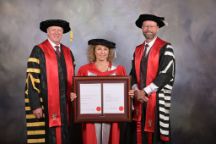
Swinburne recognises space innovator with Honorary Doctorate
Swinburne University of Technology has recognised Anousheh Ansari, a trailblazer in space engineering and exploration, with an Honorary Doctorate in Science.
Friday 17 April 2026 -
.jpg/_jcr_content/renditions/cq5dam.web.256.144.jpeg)
- Health
Swinburne and batyr welcome Prince Harry and Meghan, Duke and Duchess of Sussex for youth mental health event
Swinburne has helped bring global attention to youth mental health, with Prince Harry and Meghan attending a workshop hosted by batyr at Swinburne’s Hawthorn campus.
Thursday 16 April 2026 -

- Design
- University
Future of design industry recognised at first ever Swinburne Top Designs Awards
Swinburne University of Technology has celebrated four of Victoria’s most promising young designers as part of the annual Top Designs exhibition at Melbourne Museum.
Tuesday 14 April 2026


