

Swinburne secures grant to advance next-generation metamaterials research

Swinburne physicist Dr Weibai Li has received a Discovery Early Career Researcher Award from the Australian Research Council
In summary
- Swinburne physicist Dr Weibai Li has received a Discovery Early Career Researcher Award from the Australian Research Council
- Their project will develop new topology-optimisation tools to design tunable wave metamaterials with broad applications in sensing, energy harvesting and communications
- The DECRA scheme supports promising early career researchers to develop in supportive environments
Swinburne has secured $526,081 in funding, awarded to physicist Dr Weibai Li under the Australian Research Council’s Discovery Early Career Researcher Award (DECRA) scheme.
Metamaterials are artificially engineered materials with unique properties that are created by their precisely designed structure, rather than from their chemical composition. Dr Li’s pioneering project will use a topology-optimisation framework to automatically discover and design wave metamaterials for energy concentration. The research will produce a computational tool and new optimisation algorithms able to engineer materials with a wide range of frequency responses. These tunable metamaterials promise to overcome current limitations faced by conventional waveguides, sensors and energy harvesters.
“It is fantastic to see the ARC recognise and support early-career researchers in delivering high-quality research in a truly cutting edge field that will create transformative impact for our society. We take immense pride in our early career researchers and are thrilled by the ARC’s recognition of Dr Weibai Li,” says Swinburne's Deputy Vice-Chancellor Research, Professor Karen Hapgood.
The project aims not only to model, but also to fabricate and characterise next-generation metamaterials capable of complex, high-performance wave manipulation. If successful, this work could lead to breakthroughs in how energy is captured, concentrated or directed. Potential applications include sensing, energy harvesting, communications and more.
“This DECRA enables me to explore new and more automatic ways of discovering high-performance metamaterials. I hope the outcomes will provide researchers and engineers with new tools for solving complex wave-control challenges,” says Dr Weibai Li.
The DECRA scheme, part of the broader ARC Discovery Program, is specifically designed to support outstanding early-career researchers in Australia. DECRA funding enables researchers to pursue innovative and high-impact research over three years.
-
Media Enquiries
Related articles
-
- Science
World-first psilocin binge eating disorder trial reveals improvement in all patients
Swinburne University of Technology and Entropy Neurodynamics’ world-first IV-infused psilocin binge eating disorder trial has led to improvement in all participants.
Tuesday 15 September 2026 -

- Science
We must seed discoveries for a strong nation
This National Science Week, Swinburne’s Chief Scientist is calling on the federal government to rethink our investment in science as a matter of global importance.
Wednesday 19 August 2026 -

- Technology
- Health
- Science
- University
- Engineering
Swinburne joins global biomaterials research training program
Swinburne has joined the prestigious German Research Foundation-funded International Research Training Group (IRTG) on Multidimensional Biomaterials (MB)2 program
Monday 17 August 2026 -
- Science
- University
- Technology
Swinburne celebrates the seeds of discovery for National Science Week
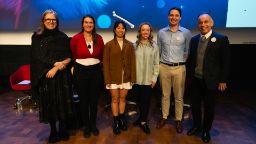
Swinburne celebrated National Science Week 2026, culminating with the Seeds of Science Festival, held on 21 August. The festival showcased the people, research and ideas shaping the future of science and innovation.
Friday 21 August 2026 -

- Astronomy
- Education
- Business
- Science
Planting the seeds for future space scientists
A Swinburne spinout LaunchLabz, is inspiring the next generation of space scientists with their Mission Kits
Monday 17 August 2026


