

New JWST observations reveal black holes rapidly shut off star formation in massive galaxies

This research published in Nature is the first direct confirmation that supermassive black holes are capable of shutting down galaxies...
In summary
- New observations from the James Webb Space Telescope that suggest black holes rapidly shut off star-formation in massive galaxies by explosively removing large amounts of gas
- Swinburne was part of the international team found that more than 90 per cent of the galactic wind is made of neutral gas
- This work is the first direct confirmation that supermassive black holes are capable of shutting down galaxies
New research published in Nature showcases new observations from the James Webb Space Telescope (JWST) that suggest black holes rapidly shut off star-formation in massive galaxies by explosively removing large amounts of gas.
The international team found that more than 90 per cent of the galactic wind is made of neutral gas, and therefore was virtually invisible in previous studies. This work is the first direct confirmation that supermassive black holes are capable of shutting down galaxies.
The difference between this new study and previous works is found in the type of gas observed: until now it was only possible to detect ionised gas, which is warm; while the JWST was able to also detect neutral gas, which is cold.
Dr Rebecca Davies from Swinburne University of Technology’s Centre for Astrophysics and Supercomputing led the Australian team behind this discovery and helped to find the powerful black-hole driven outflow in a distant massive galaxy with a very low level of star-formation.
“The outflow is removing gas fasting than gas is being converted into stars, indicating that the outflow is likely to have a very significant impact on the evolution of the galaxy. Our findings provide new evidence to indicate that black-hole driven outflows are able to rapidly shut-off or ‘quench’ star-formation in massive galaxies.”
When star formation is quenched, it means that a galaxy has stopped forming stars. It represents the transformation between a galaxy that is actively forming stars, allowing it to grow and change, and a galaxy that is 'dead' and static. Quenching is therefore a fundamental process in the life cycle of galaxies. However, astronomers still don't understand in detail what leads galaxies to stop forming stars.
Alongside internationally recognised researchers, particularly lead author Sirio Belli from the University of Bologna, Dr Davies studied a galaxy that is located at an enormous distance from Earth whose light took more than ten billion years to reach us.
Active galactic nuclei (AGN) - supermassive black holes consuming large amounts of gas - can drive outflows from galaxies. The most powerful AGN drive very massive outflows that could possibly remove all of the gas from their host galaxies in a relatively 'short' amount of time and cause star-formation to cease.
“The JWST made it possible for us to observe the cooler, neutral gas phase of normal AGN-driven outflows in distant galaxies. In the galaxy studied, we found that the outflow rate in the neutral phase was ~100 times larger than the outflow rate in the ionized phase, therefore revealing a lot of outflowing mass that was previously invisible.”
Dr Davies says the JWST can be used to detect a much larger fraction of the outflows, whereas previous ionized gas observations were only able to detect about one per cent.
“Before the JWST, we were only scraping the tip of the iceberg when it comes to the outflowing mass.”
The team are excited for what they might discover as they analyse more galaxies in the future.
-
Media Enquiries
Related articles
-
- Astronomy
- Science
- University
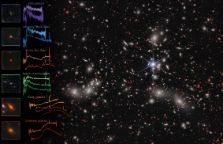
Swinburne JWST collaboration to receive prestigious 2027 Berkeley Prize from American Astronomical Society
Swinburne leads the international team who have been awarded the American Astronomical Society’s 2027 Lancelot M. Berkeley Prize for the UNCOVER project
Friday 18 September 2026 -
- Astronomy
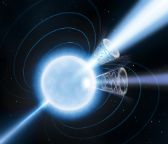
Rare ultra-magnetic star the key to solving a quantum cold case
A Swinburne astronomer may have just confirmed one of the quirkiest aspects of quantum mechanics: that seemingly empty space can alter the behaviour of light.
Thursday 06 August 2026 -

- Astronomy
- Education
- Business
- Science
Planting the seeds for future space scientists
A Swinburne spinout LaunchLabz, is inspiring the next generation of space scientists with their Mission Kits
Monday 17 August 2026 -
- Astronomy
New measurement brings us closer to understanding the Universe’s rate of expansion
Researchers have used gravitational waves from a neutron star collision to make a new measurement of the Universe’s expansion rate, offering new insight into the long-standing Hubble tension.
Tuesday 30 June 2026 -
- University
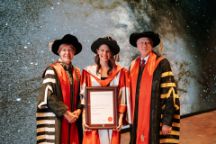
Swinburne recognises Australian space innovator with Honorary Doctorate
Swinburne University of Technology has recognised Katherine Bennell-Pegg, a trailblazer in space engineering and exploration, with an Honorary Doctorate of the University.
Friday 08 May 2026


