

The PrimeSCI! Team is excited to announce the launch of our new Pop-up Planetarium - an immersive experience taking your students on a guided tour of the universe, distinct astronomical objects, the night sky and more!
Effective from Term 2 2026, PrimeSCI! Pop-Up Planetarium fees for hands-on science incursions (one hour):
- $900 + GST for two sessions (minimum)
- $350 + GST for each additional session (up to four per day)
Please note, for schools/venues further than 75kms from Swinburne Wantirna, additional travel/accommodation costs will apply.
What happens in our Pop-up Planetarium?
Inside the inflatable planetarium, students are seated on the floor and accompanied by teachers and/or support staff. Looking up, they explore the night sky, through a presenter-led experience, discovering planets, moons and stars visible from Melbourne during the month of your school booking. This is followed by a short, age-appropriate full-dome film selected to suit your students. Approximately half of the session will be spent inside the dome.
What happens outside the Pop-up Planetarium?
After being welcomed by our presenters and completing the planetarium experience, students will move between hands-on activities designed to support learning about the Earth, Sun, Moon and planets of our Solar System. These activities have been chosen for maximum student engagement, so that students have a valuable experience both inside and outside the dome.
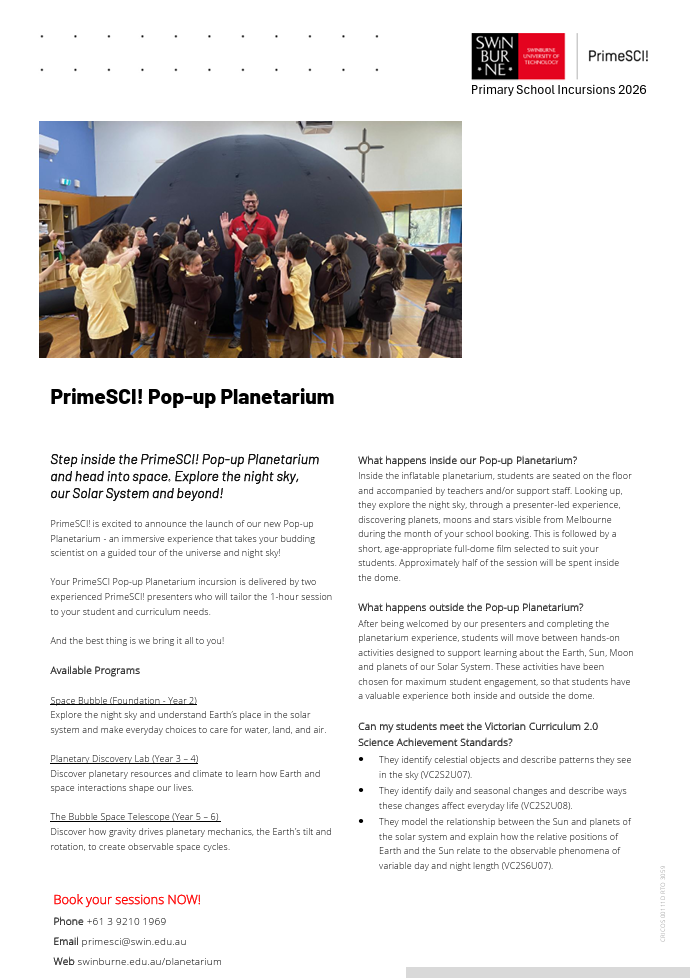
PrimeSCI! Pop-up Planetarium 2026 flyer

Guided tours of the universe and night sky!
How can I use the PrimeSCI Pop-up Planetarium to help my students meet the Achievement Standards of the Victorian Curriculum 2.0 for Science?
Foundation to year 2
- Identify celestial objects and describe patterns seen in the sky (VC2S2U07).
- Identify daily and seasonal changes and describe ways these changes affect everyday life (VC2S2U08).
Years 3 & 4
Identify forces acting on objects and describe the effects of these (VC2S4U10).
Years 5 & 6
Model the relationship between the Sun and planets of the solar system and explain how the relative positions of Earth and the Sun relate to the observable phenomena of variable day and night length (VC2S6U07).
Topics
The session is made up of two parts, a pop-up planetarium experience followed by hands-on learning activities outside the planetarium.
Inside the pop-up planetarium students with watch one of two short films. "Cycle" looking a time-lapse footage of daily and seasonal patterns or "Children of Water" looking at the importance of water and making better everyday choices that will help you to care for water, land, and air.
After the short film, students will be guided through a live view of the night sky highlighting star-based navigation, visible planets, constellations and the movement of objects in space.
Outside the planetarium, activities will involve Earth, Moon and Sun orbital movements with torch and mirror ball, gravitational movement testing, Solar System orbit and rotation times and UV bead bracelet making.
Discover planetary resources and climate to learn how Earth and space interactions shape our lives.
The session is made up of two parts, a pop-up planetarium experience followed by hands-on learning activities outside the planetarium.
Inside the pop-up planetarium students with watch one of two short films. "Cycle" looking a time-lapse footage of daily and seasonal patterns or "Losing the Dark" which highlights the harmful effects of light pollution and encourages simple actions to help preserve our view of the night sky and protect natural ecosystems.
After the short film, students will be guided through a live view of the night sky highlighting star-based navigation, visible planets, constellations and the complexity around the movement of objects in space. Any special point of interest can also be covered here.
Outside the planetarium, activities will involve Earth, Moon and Sun orbital movements with torch and mirror ball, gravitational movement testing, Solar System orbit and rotation times and their relationship to each other and UV bead bracelet making.
Learn how gravity drives planetary movement, including the Earth’s tilt and rotation, to create observable space cycles.
The session is made up of two parts, a pop-up planetarium experience followed by hands-on learning activities outside the planetarium.
Inside the pop-up planetarium students with watch one of two short films. "Journey to the Centre of the Milky way" which takes viewers on a faster-than-light voyage from Chile’s Atacama Desert to the heart of our galaxy, exploring the fundamental force of gravity that gives rise to a supermassive black hole and 84 million stars, each with the potential to host planets, water, or even life or "Incredible Sun" breathtaking time-lapse imagery and real data from NASA’s Solar Dynamics Observatory to reveal the Sun’s dynamic nature. The film showcases solar flares, sunspots, and coronal mass ejections, explaining how these phenomena affect Earth by creating auroras and disrupting satellites and power grids.
After the short film, students will be guided through a live view of the night sky highlighting star-based navigation, visible planets, constellations and the complexity around the movement of objects in space. Any special point of interest can also be covered here.
Outside the planetarium, activities will involve Earth, Moon and Sun orbital movements with torch and mirror ball, gravitational well dynamic testing, Solar System orbit and rotation times and their relationship to each other and UV bead bracelet making.
Book an Inflatable Pop-Up Planetarium science incursion now
Frequently asked questions
The maximum capacity for each 60-minute lesson is 30 students. Taught by two experienced PrimeSCI! presenters, the cohort may be split into two groups (max. 15 students each), depending on the class size and the age of students.
One group will commence with an in-planetarium experience, while the other will participate in hands-on activities and demonstrations outside the planetarium. Students will swap after 30-minutes.
Presenters will work with classroom teachers to set clear expectations before students enter the inflatable dome, supporting smooth entry and exit and ensure a safe, engaging learning environment throughout.
- $900 + GST for two sessions (minimum)
- $350 + GST for each additional session (up to four per day)
Please contact PrimeSCI at primesci@swin.edu.au to check if your Year 5/6 classes are eligible for equity-based subsidised excursion fees.
- Indoor space to accommodate the Inflatable Pop-up Planetarium (minimum 7m diameter x 3.4m height), e.g. school hall.
- Easily accessible power points near where the dome will be set up.
- Supervising class teacher(s) in attendance
There are no additional travel costs for schools/venues 75km from Swinburne Wantirna.
For schools/venues further than 75km from Swinburne Wantirna, additional travel/accommodation costs will apply.
Have questions?
Learn more about the PrimeSCI! Pop-up Planetarium by emailing primesci@swinburne.edu.au.