

Swinburne’s new space institute blasts off

A satellite orbiting the Earth (iStock).
In summary
- Swinburne’s Space Technology and Industry Institute will bring together world-class capabilities in astrophysics, aerospace, aviation, advanced manufacturing, artificial intelligence and education
- The new institute will inspire education, research and innovation in a sector that is projected to be worth US$1.1 trillion globally by 2040
- The institute will be led by pre-eminent astronomer and science communicator Professor Alan Duffy
An interplanetary refuelling station on the Moon and vastly improved satellite imaging technology are just two of the projects being worked on by the new Space Technology and Industry Institute, launched today by Swinburne University of Technology.
Swinburne’s Space Technology and Industry Institute will bring together world-class capabilities in astrophysics, aerospace, aviation, advanced manufacturing, artificial intelligence and education to tackle challenges at the edge of human understanding and imagination.
The new institute will be an engine room for innovation and economic growth, as well as inspiring education from vocational training to the PhD level, in a sector that is projected to be worth US$1.1 trillion globally by 2040.
The institute will be led by pre-eminent astronomer and science communicator Professor Alan Duffy. Professor Duffy, who was recently named Academic of the Year at the Australian Space Awards, said the institute is an important step forward in the ongoing growth and development of the Australian space industry, for both research and educating the next wave of space professionals.
“Space research, technology and education is, like the universe itself, incredibly complex and interdependent. It requires close collaboration, targeted investment and new ways of working to succeed. Australia has the potential to be a global leader in space research and technology, as well as teaching the brightest minds. But to do it, we need all our rockets at full throttle,” Professor Duffy said.
“I’m delighted to be uniting the efforts of my colleagues at Swinburne to help achieve this and make that next big breakthrough,” he said.

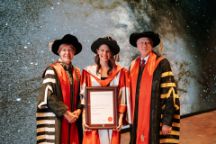
From left to right: Professor Pascale Quester, Professor Alan Duffy and Professor Bronwyn Fox launching the new Space Technology and Industry Institute.
Swinburne’s Vice Chancellor Professor Pascale Quester said research and education into space technologies and their terrestrial applications had extraordinary potential for both economic and social impact.
“Swinburne is in a unique position to offer both research and education capabilities and opportunities to pursue the greatest space endeavours,” Professor Quester said.
“Our end-to-end coverage of R&D, as well as developing the people and skills needed to build new space industries of the future, means that Swinburne is perfectly positioned to enter a new frontier in space discovery and innovation. We have all the experience, equipment and thirst for knowledge under one roof to help our industry partners move into this market and capitalise on the vast potential of space,” she said.
Working with industry
Swinburne’s Deputy Vice-Chancellor of Research and Enterprise Professor Bronwyn Fox said the Space Technology and Industry Institute would provide industry partners with a platform for building lighter, stronger and cheaper materials with faster production enabled by cutting edge additive manufacturing processes.
“We’re opening up a world of possibilities to expand our stellar capabilities and the new institute will make the most of our globally recognised expertise in digitalisation and materials engineering,” Professor Fox said.
“We are in the midst of a space revolution, and Australia has a unique opportunity to emerge as a major player in the global space market,” she said.
Connecting across the sector
Projects currently being undertaken by the Space Technology and Industry Institute include:
- developing new materials that are lighter, stronger, and offer self-healing properties or radiation protection to support the next generation of satellites
- work on a cutting-edge technique called ‘super-resolution’ that uses artificial intelligence to improve satellite images that can help farms and mines see their holdings better
- supporting a nationwide collaboration to access the resources of the Moon using new engineering processes for use as a base for resupplying and refuelling the exploration of our solar system.
The institute will build on Swinburne’s place at the heart of Australia’s space industry, connecting research and teaching, and driving industry engagement in:
- astronomy: galaxy formation, gravitational waves, dark matter
- aerospace: aerostructures, aircraft technologies, drones, aircraft systems
- aviation: flight simulation and control, pilot training, AI and mobility, future aviation
- space applications of technology: satellite instrumentation and sensors, Earth observation and AI, in-situ resource processing and utilisation, data visualisation and supercomputing.
The Space Technology and Industry Institute will also harness the innovative work being done at Swinburne’s internationally renowned Centre for Astrophysics and Supercomputing and the three Australian Research Council (ARC) Centres of Excellence that Swinburne is part of: Dark Matter Particle Physics (CDM), Gravitational Wave Discovery (OzGrav) and All Sky Astrophysics in 3 Dimensions (ASTRO 3D).
-
Media Enquiries
Related articles
-

- Astronomy
- Science
- University
Swinburne JWST collaboration to receive prestigious 2027 Berkeley Prize from American Astronomical Society
Swinburne leads the international team who have been awarded the American Astronomical Society’s 2027 Lancelot M. Berkeley Prize for the UNCOVER project
Friday 18 September 2026 -

- Astronomy
Rare ultra-magnetic star the key to solving a quantum cold case
A Swinburne astronomer may have just confirmed one of the quirkiest aspects of quantum mechanics: that seemingly empty space can alter the behaviour of light.
Thursday 06 August 2026 -

- Astronomy
- Education
- Business
- Science
Planting the seeds for future space scientists
A Swinburne spinout LaunchLabz, is inspiring the next generation of space scientists with their Mission Kits
Monday 17 August 2026 -

- Astronomy
New measurement brings us closer to understanding the Universe’s rate of expansion
Researchers have used gravitational waves from a neutron star collision to make a new measurement of the Universe’s expansion rate, offering new insight into the long-standing Hubble tension.
Tuesday 30 June 2026 -
- University
Swinburne recognises Australian space innovator with Honorary Doctorate
Swinburne University of Technology has recognised Katherine Bennell-Pegg, a trailblazer in space engineering and exploration, with an Honorary Doctorate of the University.
Friday 08 May 2026


