

Space awards recognise the stars among us

Swinburne’s stars of space science and leadership are among the nominees for the 2022 Aviation/Aerospace Australia Airspace Awards
In summary
- Swinburne’s Pro Vice-Chancellor, Research Partnerships and Digital Innovation, Professor Alan Lau, was nominated for the Distinguished Leadership Award
- The Swinburne Haileybury International Space Station Experiment (SHINE) was nominated for Outstanding Outreach with a Steam Project or Program
- Kim Ellis Hayes was nominated for – and won – the Women in Aviation/Aerospace Outstanding Achievement in the Aviation and Aerospace Sectors Award
Swinburne University of Technology is a leader in Australia's new era of space research and education, exploring and investigating new frontiers. So it was no surprise to see Swinburne’s superstar space scientists and leaders among the nominees for the 2022 Aviation/Aerospace Australia Airspace Awards.
As the national peak body for Australia's aviation and aerospace industries, Aviation/Aerospace Australia's A22 Airspace Awards recognise leadership and excellence amongst Australia’s best and brightest individuals, teams and organisations in the aviation and aerospace sector.
Discover the Swinburne nominees.

Swinburne’s Pro Vice-Chancellor, Research Partnerships and Digital Innovation, Professor Alan Lau, is nominated for the Distinguished Leadership Award
Distinguished Leadership Award
Pro Vice-Chancellor, Research Partnerships and Digital Innovation Professor Alan Lau is responsible for Swinburne’s key research initiatives, research performance and links to industry.
He says, ”Our future needs research and education of both the next generation and training of existing workforces to enable them to adapt to a fast-moving, high tech environment. Our success depends entirely on how universities, industries, governments and training organisations work together to develop a long-term strategic plan.”
Professor Alan Lau is also an expert in aviation, advanced materials and manufacturing, and product design and development.

Members of the SHINE 2019 team watched NASA's livestream of the launch of their experiment into space
Outstanding Outreach with a Steam Project or Program
Blasting student work into space was an amazing achievement in itself, so to see the Swinburne Haileybury International Space Station Experiment (SHINE) among the nominees was worthy recognition. Each year, Swinburne mentors work with high school students from Haileybury College to design, build and program their own experiment to learn more about microgravity conditions aboard the International Space Station (ISS).
In 2021, the students designed an experiment to create yoghurt in space – a giant leap for the gut health of astronauts – and the program was extended to involve the winning team from the Swinburne Youth Space Challenge.
The Swinburne team delivering the ambitious program is packed with star power, including astronomers Dr Rebecca Allen, Dr Sara Webb and Professor Virginia Kilborn, biologist Dr Huseyin Sumer and space lawyer Kim Ellis-Hayes.

Kim Ellis Hayes is nominated for the Women in Aviation/Aerospace Outstanding Achievement in the Aviation and Aerospace Sectors Award
Women in Aviation/Aerospace Outstanding Achievement in the Aviation and Aerospace Sectors
Kim Ellis Hayes is undoubtedly a role model for anyone looking to build a career in the space sector. She is Australia’s first female astronaut, trained for research and testing in microgravity in suborbital space missions. As Senior Lecturer in Space Research and Law, Kim brings her expertise as an international lawyer and in space law to Swinburne students, alongside her leadership in curriculum development for undergraduate, postgraduate and professional courses.
Kim’s thought leadership has seen her recruited by a World Economic Forum consortium, the European Space Agency and MIT to contribute to creating the model to provide a new, innovative way of addressing the orbital challenge: encouraging responsible behaviour in space through increasing the transparency of organisations’ debris mitigation efforts.
She received the award for Women in Aviation/Aerospace Outstanding Achievement in the Aviation and Aerospace Sectors at the 2022 awards night. Congratulations, Kim!
Leading Australia’s new space and aerospace economy
Swinburne is a leader in space research and education.
The Space Technology and Industry Institute, led by Professor Alan Duffy, is the engine room for innovation and economic growth in astrophysics, aerospace, aviation, AI and more. But aerospace research isn’t confined to one area. The Aerostructures Innovation Research (AIR) Hub is another research and industry collaboration developing the next generation of aerostructures, including for use in space.
We will see enormous growth in Australia’s space industry in the coming years and our students will graduate with the skills to take up these exciting careers. In addition to a strong cohort of postgraduate and PhD candidates working across space research, Swinburne’s Space Technology co-major is open to all undergraduate students. The co-major spans space science, microgravity science, space environment, data and visualisations, space entrepreneurship, space policy, space law and space technologies. The space industry will also need talented ‘space tradies’ to build the launch facilities and technology needed. A Swinburne trades education can cover precision welding, circuits and electronics, metal fabricators and other critical skills for the next generation of tradies to be involved from the ground up, where the sky is far from the limit.
-
Media Enquiries
Related articles
-
- Science
World-first psilocin binge eating disorder trial reveals improvement in all patients
Swinburne University of Technology and Entropy Neurodynamics’ world-first IV-infused psilocin binge eating disorder trial has led to improvement in all participants.
Tuesday 15 September 2026 -
- Technology
- Education
- Science
- University
Swinburne’s research quality rises in global rankings
Swinburne has placed 294th globally in the 2027 Times Higher Education World University Rankings
Wednesday 30 September 2026 -
- Astronomy
- Science
- University
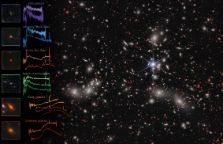
Swinburne JWST collaboration to receive prestigious 2027 Berkeley Prize from American Astronomical Society
Swinburne leads the international team who have been awarded the American Astronomical Society’s 2027 Lancelot M. Berkeley Prize for the UNCOVER project
Friday 18 September 2026 -

- Technology
- Health
- Education
- Science
- University
- Engineering
Swinburne continues to rise in global subject rankings
Swinburne has achieved strong results across 26 subjects in the ShanghaiRanking’s Global Ranking of Academic Subjects 2026.
Thursday 17 September 2026 -

- Science
We must seed discoveries for a strong nation
This National Science Week, Swinburne’s Chief Scientist is calling on the federal government to rethink our investment in science as a matter of global importance.
Wednesday 19 August 2026


