
About Us
Modern problems in theoretical physics are wide-ranging. Within our group we focus on topics ranging from ultra-cold atoms to genetics, computational science, quantum information, condensed matter and the foundations of quantum mechanics. Many are linked to SUT experimental work.
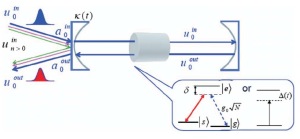 Quantum memory proposal: Phys. Rev. A 79, 022310 (2009). |
Quantum InformationQuantum information is the study of how to apply quantum mechanics in the development of new technologies. We are interested in quantum memories, as an enabling technology for many areas of quantum information. A quantum memory is able to store a quantum state indefinitely, to be read out on demand. Possible quantum memory devices range from cold atoms to superconducting circuits and nano-oscillators. |
Foundations of Quantum MechanicsThe well-known 1935 paper of Einstein et al. (EPR) led to the famous Bell theorem, which rules out local realism--a result that has been called "the most profound discovery of Science". The Schrödinger cat paradox raises an even more important issue -- how to reconcile quantum realities with classical realities at the macroscopic level. Specific research topics include:
|
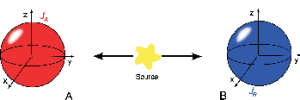 Spin-EPR proposal |
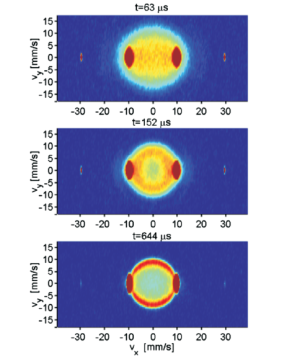 Colliding BEC quantum dynamics: Phys. Rev. Lett. 98, 120402 (2007). (Editor's Suggestion) |
Bose-Einstein Condensates and Atom LasersAtom lasers, or Bose-Einstein condensates (BEC) exist at temperatures below one nano-Kelvin -- a billion times colder than interstellar space. The bosonic atoms occupy an identical quantum state, so BECs are quantum systems on a macroscopic scale, with atoms behaving as waves but having particle-like qualities when detected. High-precision interferometry applications are being studied experimentally at Swinburne University. Theory projects on the quantum noise properties of BECs are:
|
Quantum SimulationsWe are developing new algorithms based on phase-space representations for simulating quantum many-body systems. These include the world's best-tested and the largest known quantum simulations, with experimental verification down to well below the vacuum noise level. Methods include Wigner representations, positive-P representations, general Gaussian phase-space methods and spin representations. Recent work has included quantum simulations of: dynamical Bell violations, large multipartite entangled spin systems, early universe quantum fluctuations, interferometers using Bose-Einstein condensates and quantum opto-mechanics. Simulations use the Swinburne gStar GPU based supercomputer, as well as desktop GPU systems, programmed with Australian developed codes. |
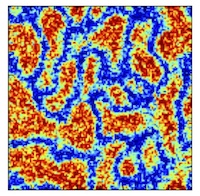 Domains in a 3D model of the early Universe: Ann. Phys. 525, 866–876 (2013). |
|
Ultracold Fermi gasesThis research programme is motivated by the rapid experimental developments in degenerate Fermi gases. These systems are controlled at an unprecedented level and are well-described by quantum many-body models. The programme involves themes designed to develop fundamental knowledge of the underlying physics, and to provide theoretical guidance to experiments at Swinburne University. Specific topics include:
|
SUT Theory News
- June 2023
Professor Margaret Reid honoured as University Distiguished Professor (link) - May 2023
Professor Tien Kieu derived Quantum Central Limit Theorem (link) - May 2023
Dr Nathan Clisby co-organised the annual ANZAMP conference (link) - Apr 2023
Prof Bryan Dalton appointed as an Associate Editor of Frontiers in Quantum Science and Technology (link) - Mar 2023
Outstanding Referee Award and Physical Review Letters Divisional Editor (link) - Mar 2023
Prof Margaret Reid Retires from Physical Review A (link) - Feb 2023
Highly cited author in Physical Review A (link) - Feb 2023
Dr. Ria Joseph obtains a faculty position at Deakin University (link) - Jan 2023
Dr Nathan Clisby was awarded an ARC Discovery Project (link) - Jan 2023
Prof Xia-Ji Liu honoured with Fellowship of Australian Institute of Physics (link) - Jan 2023
A/Prof Hui Hu appointed to the ARC College of Experts (link) - Jan 2023
Inaugural Physical Review Research Board Member (link) - Aug 2022
CQTT art work featured by the exhibition "UNDUPLICATED" in Hong Kong (link) - Apr 2022
Exact Many-Body Solution for Fermi Polarons (link) - Feb 2022
Second Sound Attentuation Near Quantum Criticality (link) - Jan 2022
Prof Xia-Ji Liu appointed to the ARC College of Experts (link) - Dec 2020
CQTT researchers are successful in academic promotions (link) - Nov 2019
Prof Margaret Reid to receive the 2019 Moyal Medal (link) - Oct 2019
Prof Peter Drummond awarded the Weston Visiting Professorship (link) - Jun 2018
CQOS Researchers win two of the 2018 FSET Research Awards (link) - Jun 2018
CQOS Prof Bryan Dalton honoured with Fellowship of the Institute of Physics (link) - Feb 2018
Quantum Scientists win major APS awards (link) - Feb 2018
CQOS paper chosen as a Journal of Physics A Highlight of 2017 (link) - Jan 2018
Realizing Fulde-Ferrell Superfluids via a Dark-State Control of Feshbach Resonances (link) - Jan 2018
Prof Margaret Reid has been appointed to the Editorial board of PRA (link)